










VRL Logistics Limited operates 5,941 vehicles across 1,337 branches
Key highlights
- VRL operated 5,941 vehicles as of June-26, up 159 from 5,782 in Q2FY26.
- VRL reported 81,985 tonnes of carrying capacity, excluding cranes and tankers, as of June-26.
- VRL had 1,337 branches and 50 hubs across 24 states and four Union Territories as of Sep 26.
- LTL freight generated 90.4% of VRL revenue in H1FY27.
powered by IRIS
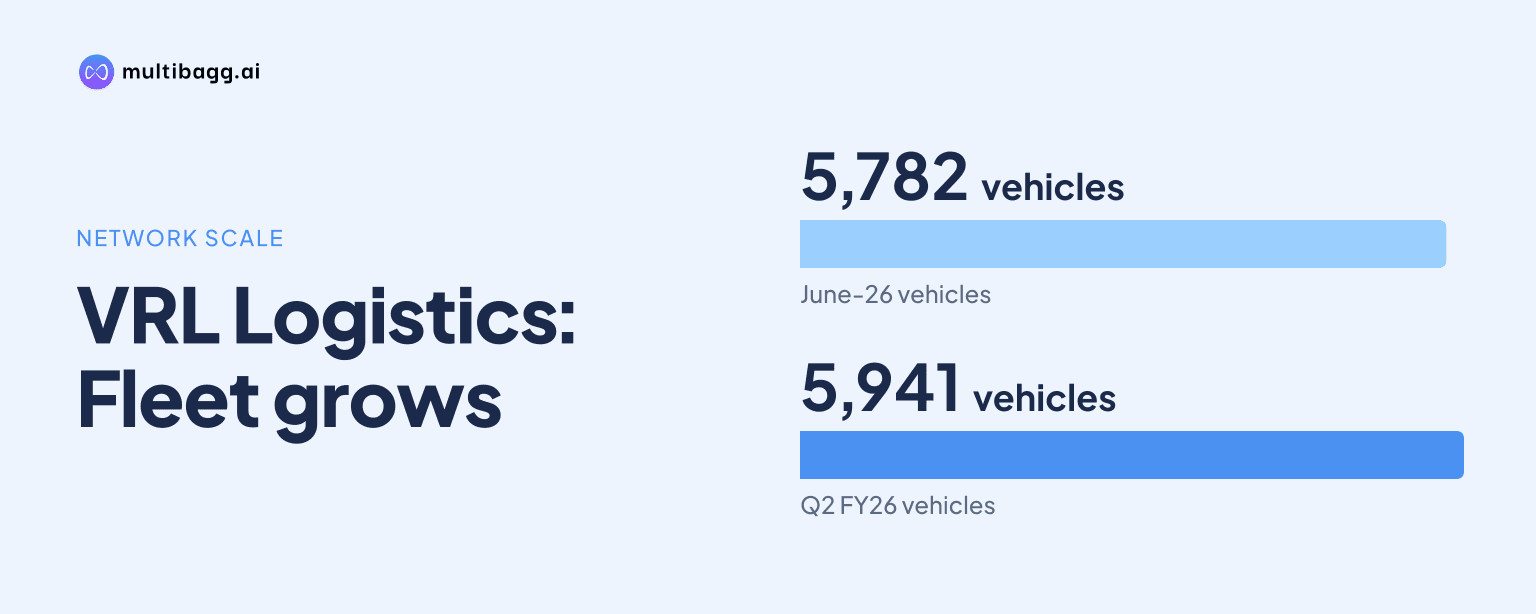
VRL Logistics Limited operated 5,941 vehicles as of June-26 and 1,337 branches as of Sep 26, supported by 81,985 tonnes of carrying capacity and 50 hubs. VRL’s network spans 24 states and four Union Territories, serving a business-to-business less-than-truckload model that generated 90.4% of H1FY27 revenue.
Know VRL Logistics inside out
Results, valuation, peers and who's buying, in one view.
How large are VRL’s fleet and carrying capacity?
VRL had 5,941 total vehicles, including cranes and tankers, as of June-26, while carrying capacity excluding cranes and tankers was 81,985 tonnes. The vehicle count was 159 higher than 5,782 in Q2FY26 but 40 below 5,981 in Q1FY27. Carrying capacity increased by 4,701 tonnes from 77,284 tonnes in Q2FY26, while falling by 393 tonnes from 82,378 tonnes in Q1FY27.
The year-on-year fleet movement reflected 490 vehicle additions and 331 vehicles scrapped, producing the net increase of 159 vehicles. On a quarter-on-quarter basis, VRL added 131 vehicles and scrapped 171, accounting for the net reduction of 40 vehicles. The company reported that 76% of its total vehicles were debt free and 11% were fully depreciated while operating in what it described as optimal condition.
Which vehicle categories provide VRL’s capacity?
VRL’s 15-to-20-tonne category was its largest disclosed goods-transport, or GT, vehicle group, with 2,252 vehicles and 41,650 tonnes of capacity as of June-26. This category had more than three times the capacity of the 25-to-30-tonne group, which had 469 vehicles and 12,893 tonnes, and exceeded the 11,656 tonnes in the 10-to-15-tonne category.
The six disclosed GT categories ranged from 489 vehicles below five tonnes to 1,374 vehicles in the five-to-10-tonne segment. Together, their listed capacity was 81,984 tonnes, compared with the separately reported total carrying capacity of 81,985 tonnes excluding cranes and tankers. VRL says its fleet includes trucks, trailers and specialised equipment, while all owned vehicles are covered and equipped with global positioning system, or GPS, tracking.
Where does VRL operate its branch and hub network?
VRL operated 1,337 branches and 50 hubs across 24 states and four Union Territories as of Sep 26. Karnataka had the largest disclosed branch network with 238 branches, followed by Maharashtra with 172, Tamil Nadu with 142 and Gujarat with 113. Andhra Pradesh had 88 branches, Uttar Pradesh had 85 and West Bengal had 68.
VRL reported owned properties in 40 locations, with 1.87 million square feet of owned hub space and 4.56 million square feet of leased hub space. Leased hub space was therefore 2.69 million square feet greater than owned hub space. Its listed owned-hub locations include Bhiwandi, Mumbai; Bengaluru; Hubbali, Varur; Vijayapura; Surat; Davanagere; Mangaluru; Ballari; Mysuru; Vishakhapatnam; and Nagpur.
Got a follow-up? Ask IRIS
How does VRL’s hub-and-spoke model support LTL freight?
VRL’s hub-and-spoke model collects freight through origin routes and spokes, consolidates loads at hubs, and fragments them for destination delivery routes. The process supports less-than-truckload, or LTL, transport, in which consignments from multiple customers are carried in one vehicle. LTL produced 90.4% of H1FY27 revenue, compared with 8.2% from full-truckload, or FTL, services and 1.4% from other revenue.
VRL lists continuous load movement, reduced length of haul, vehicle utilisation, driver recruitment and retention, productivity and a lower carbon footprint as model strengths. Its 1,337 branches and 50 hubs form the collection, consolidation and distribution points for this structure. The presentation identifies geographical expansion as a focus and says the network supports nationwide demand fulfilment across its 24-state and four-Union-Territory presence.
How does VRL collect revenue and monitor network operations?
VRL reported that 68% of H1FY27 revenue came from to-pay freight, collected at the delivery station from the consignee, while 15% came from paid freight collected at booking. Account customers operating under standard credit periods accounted for 16% of revenue, with percentages rounded in the presentation. VRL reported trade receivable days of 10 days in H1FY27 and said most sales were collected without credit.
VRL uses an in-house enterprise resource planning system for real-time operations and consignment movement, alongside systems monitoring vehicle movement, fuel consumption per kilometre, distance travelled and driver payments. GPS devices are used in hired and owned vehicles, and loading is tracked before trip-sheet preparation to monitor capacity utilisation. The fleet also included 77 electric vehicles and 109 compressed natural gas vehicles, while centralised closed-circuit television monitoring was under branch-wise rollout.
Conclusion
VRL’s disclosed infrastructure combines 5,941 vehicles, 81,985 tonnes of carrying capacity, 1,337 branches and 50 hubs around an LTL-led freight model. The fleet and capacity were higher than in Q2FY26 by 159 vehicles and 4,701 tonnes respectively, but both measures were modestly lower than in Q1FY27 after quarterly scrapping exceeded additions.
The next disclosed operating factors to watch are VRL’s geographical-expansion focus, branch and hub additions across its 24-state and four-Union-Territory network, and the balance of vehicle purchases and scrapping. Management’s reported 10-day H1FY27 trade-receivable period and 68% to-pay revenue mix are also relevant as the 50-hub network handles further LTL volumes.