










Wakefit Targets Two-Year Payback on Rs 50 Crore Bengaluru Store
Key highlights
- Wakefit expects its first Bengaluru jumbo store to cost more than Rs 50 crore, including construction and display inventory.
- Wakefit expects the Bengaluru jumbo store to open in Q2 of FY28 with more than 1.2 lakh square feet of retail space.
- Wakefit targets payback close to two years for the jumbo format, compared with under one year for normal stores.
- Wakefit had 205 stores as of 30 September, including around 110 mega stores and 95 mini stores.
powered by IRIS
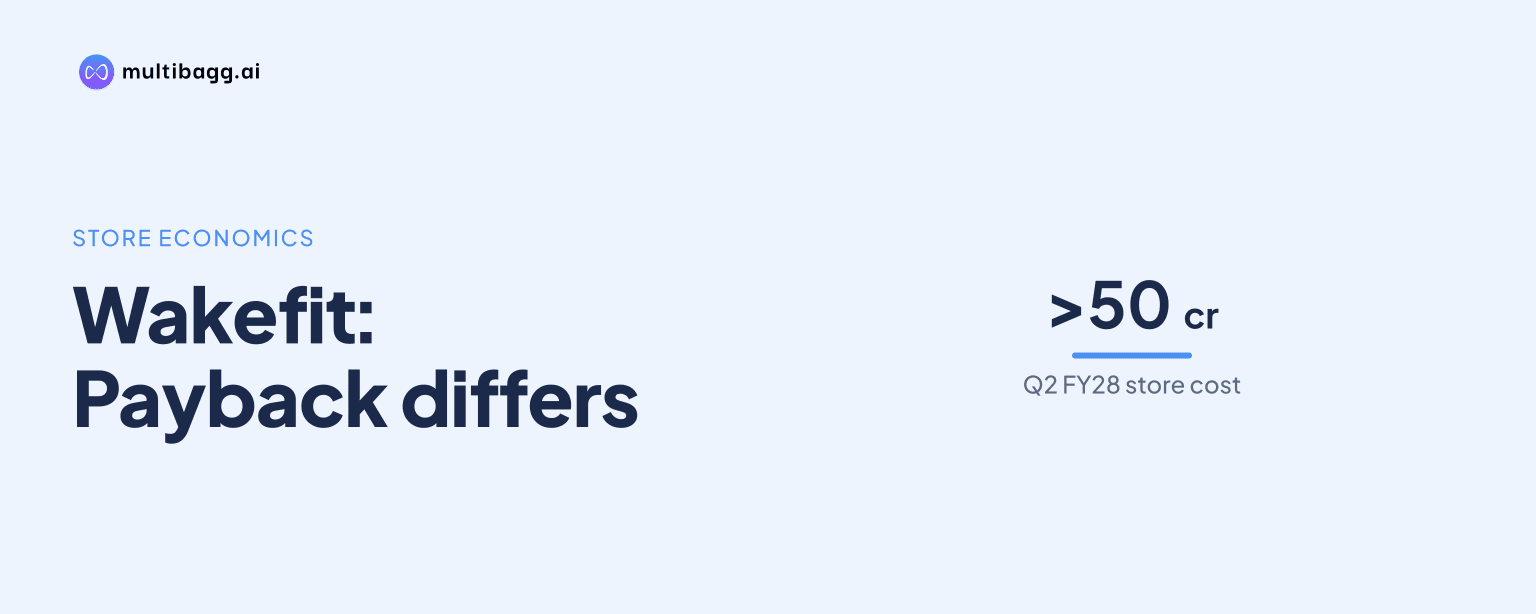
Wakefit Innovations Limited expects its first Bengaluru jumbo store to cost more than Rs 50 crore and is targeting payback in about two years after its planned Q2 FY28 opening. Management’s case rests on more than 1.2 lakh square feet of retail space, low land rent and lower supply-chain costs for furniture delivered near the store.
Know Wakefit Innovations inside out
Results, valuation, peers and who's buying, in one view.
What will Wakefit spend on its Bengaluru jumbo store?
Wakefit expects the all-in cost of its first jumbo store to exceed Rs 50 crore. Management said the amount covers capital expenditure, construction and display inventory, rather than merely retail fit-out costs. The Bengaluru location is expected to go live in Q2 of FY28, and management said it is focused on making this one store successful before pursuing a wider rollout.
The site will have more than 1.2 lakh square feet of retail space, a scale that differentiates it from Wakefit’s current mega and mini formats. Its cost structure will be weighted toward upfront investment because Wakefit will rent only the land and construct the facility for its requirements. Management expects rent to be only a few lakh rupees a month, but did not disclose a monthly amount or a split of the more than Rs 50 crore investment.
Wakefit also linked the format to deployment of its cash balance. Management said it had around Rs 400 crore of cash before its initial public offering, raised about Rs 377 crore during the offering and subsequently added cash through operations. A permanent factory base, inorganic acquisitions and faster jumbo-store expansion were identified as possible uses, although management said each had progressed more slowly than anticipated and expected deployment over the next two years.
Why does Wakefit target a two-year payback period?
Wakefit is targeting payback close to two years for the jumbo format, compared with under one year for its normal stores. Management said the longer runway reflects a first-time format rather than a change to the stated economics of the existing network. The target remains an internal objective because the Bengaluru store has not yet opened.
Management’s principal cost argument is that furniture sold in a few pin codes surrounding the jumbo store should be cheaper to fulfil than furniture sent across India. It said the supply-chain cost could improve by a double-digit percentage of selling price when a large share of sales is local. Wakefit did not disclose its current furniture logistics cost, the expected percentage saving or the local-sales mix required to produce the two-year payback.
The revenue argument is a wider physical catalogue. Management said a standard mega store can display only two or three variants in categories including sofas, bedframes, tables and chairs, while the jumbo format is designed to show tens and dozens of stock-keeping units and variants. Management also plans to position the location as a design destination with food and a family day-out element, but gave no revenue, margin or break-even target.
How will Wakefit measure jumbo-store sales?
Wakefit will measure both point-of-sale sales in the jumbo store and influenced sales in a surrounding 3-kilometre to 5-kilometre catchment. Management said it will track both measures closely because customers may inspect furniture in a store but complete the transaction through Wakefit’s website or another channel. This means store-counter sales alone will not be its basis for judging the format.
Wakefit instead assesses its own online and offline channels together when making capital-allocation decisions. Management said it uses systems and artificial-intelligence-enabled trackers to observe conversion, but channel sales can move with store openings, discounts and sale events. It cited a marketplace-funded bank offer that ran for about 10 days as an example of a promotion that shifted transactions temporarily to a marketplace.
Management also said purchases above Rs 10,000 often involve store visits because customers want to touch and feel products before buying. In smaller towns where Wakefit opened stores without prior offline presence, management said combined online-plus-offline catchment growth was more than three times the previous level after six months. That result relates to existing smaller-town stores and does not establish an outcome for the Bengaluru jumbo format.
Got a follow-up? Ask IRIS
How does the jumbo store compare with Wakefit’s current network?
Wakefit had 205 stores as of 30 September, including around 110 mega stores and 95 mini stores. In March of the previous year, it had 139 stores, with mini stores numbering around 30. The jumbo store’s more than 1.2 lakh square feet of space and more than Rs 50 crore of upfront cost place it outside the disclosed scale of these existing formats.
Management said normal stores pay back in under one year, but did not disclose typical floor area, capital expenditure, revenue or payback for mega and mini stores separately. It also distinguishes exclusive brand outlets from company-owned and company-operated stores. Wakefit said all its company-owned and company-operated stores are exclusive brand outlets staffed by Wakefit employees, unlike the franchise-operated exclusive outlets used by many traditional mattress brands.
Wakefit’s current stores sell furniture, recliners, coffee tables, pots and pans, furnishings and decor alongside mattresses. Management said that broader range can increase both cart value and the number of products in a cart compared with a traditional mattress outlet. The jumbo format is intended to extend that multi-category approach by providing enough space to display substantially more furniture variants.
What demand case does Wakefit see in Bengaluru?
Wakefit’s Bengaluru demand case is based on management’s market work rather than a disclosed store-sales forecast. Management said it visited and interviewed more than 150 to 200 Bengaluru furniture stores, identified the price points at which Wakefit operates and estimated that this portion of the city’s annual furniture market totals a few thousand crore rupees.
That total addressable market estimate is management’s assessment, and the call did not provide its calculation, Wakefit’s expected market share or a sales target for the store. Management said the revenue needed for payback would be small under the facility’s planned cost structure. Actual performance will depend on local furniture demand, conversion, product mix and the realised supply-chain savings after the Q2 FY28 opening.
Conclusion
Wakefit is testing a retail format with a materially higher upfront commitment than its normal stores: more than Rs 50 crore for a Bengaluru site targeting about a two-year payback, versus under one year for normal stores. Management expects the larger furniture display, delivery savings near the location and low land rent to support that target.
The next disclosed milestone is the expected Q2 FY28 opening. Investors will need to watch Wakefit’s reporting on store point-of-sale sales, the 3-kilometre to 5-kilometre catchment and local furniture fulfilment costs, since management has not provided a revenue target, margin target or detailed capital-cost breakdown.