










Wakefit to slow H2 store additions after opening 68 in H1
Key highlights
- Wakefit added 68 COCO stores in H1 FY27, including 41 stores in Q2 FY27.
- Wakefit had 205 COCO stores across 137 cities as of September 30, 2026.
- Management expects FY27 net store additions to exceed its original target of 80.
- Wakefit's website and COCO stores generated 70% of Q2 FY27 revenue, versus 60.2% a year earlier.
powered by IRIS
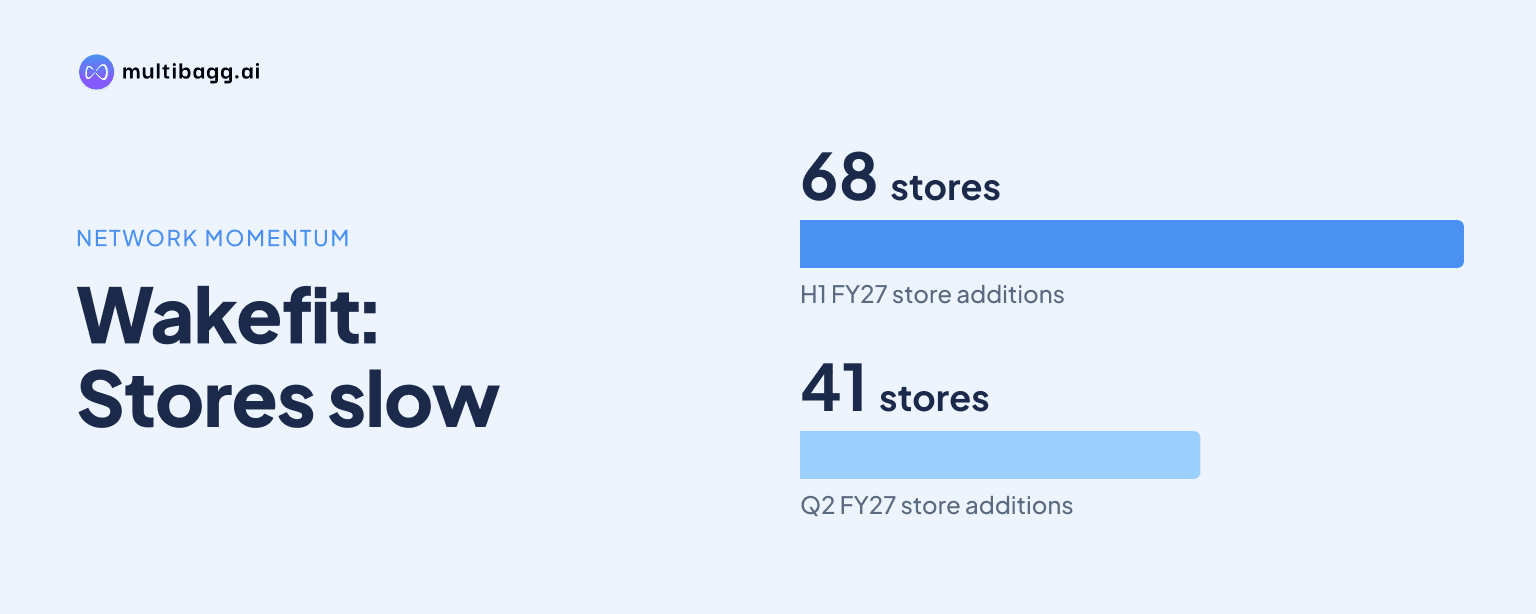
Wakefit will slow H2 FY27 store additions after opening 68 company-owned, company-operated stores in H1 FY27, while management expects more than 80 net additions for the full year. Wakefit Innovations Limited had 205 company-operated stores across 137 cities on September 30, 2026, and plans to focus on productivity at recently opened locations.
Know Wakefit Innovations inside out
Results, valuation, peers and who's buying, in one view.
Why is Wakefit slowing store additions in H2 FY27?
Wakefit is moderating H2 FY27 openings to ramp up newer stores, improve their productivity and calibrate operating metrics before increasing expansion again. Management said it deliberately front-loaded store additions in H1 FY27 so that a greater portion of second-half revenue can come from locations that have had more time to mature.
Wakefit added 41 company-owned, company-operated, or COCO, stores in Q2 FY27 and 68 stores in H1 FY27. Its reported COCO network stood at 205 stores across 137 cities on September 30, 2026, compared with 165 stores in 100 cities at the end of June 2026. The company is continuing to open stores in Q3 FY27, but at a moderated pace in the second half.
The productivity focus follows mid-teens like-for-like growth at stores that had been in operation, according to management. Management also said the first 30 to 33 days of the festive period were decent rather than exceptional, after sale events began around October 8 in 2026 compared with September 22 in the prior year.
Will Wakefit exceed its FY27 store-addition target?
Wakefit expects to exceed its original FY27 target of 80 net store additions, although management did not provide a revised target. On the November 13, 2026 earnings call, management said that 68 H1 FY27 additions and continuing Q3 openings should take the final number above 80 despite the planned H2 moderation.
The 68 H1 additions left Wakefit 12 stores below its initial 80-store target before the second half. Management said it had intentionally not set a revised figure because the company wants to prioritise revenue from stores opened earlier in FY27 and said it may have more clarity on the final total at the next earnings call.
Wakefit is also using multi-brand outlets, or MBOs, to enter markets with limited upfront capital investment. The MBO network rose to 2,589 outlets in 787 cities as of September 30, 2026, from approximately 2,250 outlets in 701 cities at the end of June, expanding distribution beyond the directly operated 205-store network.
How is the store network changing Wakefit's sales mix?
Wakefit's website and COCO stores generated 70% of Q2 FY27 revenue, up from 60.2% in Q2 FY26, with revenue from these own channels rising nearly 39.4% year on year. The 9.8-percentage-point increase in own-channel mix coincided with the expansion of the company-operated store network and faster direct-channel growth than total revenue.
Total revenue from operations reached Rs 452 crore in Q2 FY27, up 19.9% year on year and the highest quarterly revenue reported on the call. Because own-channel revenue grew nearly 39.4%, faster than the company's 19.9% total revenue growth, direct channels increased their contribution to sales. Management said website and COCO channels provide greater control over customer experience and derived margins.
Wakefit reported that repeat customers contributed more than 32% of revenue in Q2 FY27, while the average cart carried close to two products. These measures matter to the store-productivity plan because customers buying mattresses may add pillows and bedsheets, while furniture customers may buy complementary products within the same purchase.
Category performance also supports the focus on physical retail productivity. Mattresses accounted for 61.8% of Q2 FY27 revenue and grew 21.4% year on year, while furniture represented 30.1% and grew 24.9%. Furnishings contributed 8.1% of revenue and remained softer, although management saw improvement toward the end of the quarter.
Got a follow-up? Ask IRIS
What role will jumbo stores play in Wakefit's expansion?
Wakefit is targeting a Q2 FY28 launch for its first jumbo store in Bengaluru, where construction was progressing as of the November 13 call. Management said the larger format and a broader product catalogue are intended to support the next phase of furniture growth by offering customers a wider range of products.
Wakefit expects FY27 capital expenditure of around Rs 100 crore to Rs 120 crore, with nearly 80% directed toward retail-footprint expansion, particularly jumbo stores. The remaining 20% is planned for manufacturing, automation and other regular business upgrades, according to the chief financial officer.
The jumbo-store plan comes as furniture grew faster than mattresses in Q2 FY27, at 24.9% versus 21.4%. Management said it expects furniture growth to accelerate as jumbo stores become operational and the product catalogue deepens, but the first Bengaluru location is not targeted to open until Q2 FY28.
What financial measures will show whether the slower rollout is working?
Wakefit's store-productivity strategy will be reflected in same-store growth, direct-channel sales mix and margins as newer locations mature. Q2 FY27 reported earnings before interest, tax, depreciation and amortisation, or EBITDA, excluding other income, rose 21.5% year on year to Rs 50.2 crore, producing an 11.1% margin.
Operating EBITDA rose 26% year on year to Rs 30.5 crore in Q2 FY27, and its margin expanded to 6.7%. However, gross margin declined to 53.9% from 57.7% in Q2 FY26, while employee benefit expense increased 30% year on year to Rs 54.5 crore as Wakefit added leadership and other resources for business growth and network expansion.
Management cited elevated crude-linked raw-material costs, particularly polyol and toluene diisocyanate, or TDI, alongside logistics disruption linked to West Asia. Wakefit said it had taken calibrated price increases but did not expect further increases unless crude prices rise unexpectedly, after making a couple of price hikes since the conflict began in February.
Conclusion
Wakefit's shift is from opening stores rapidly to extracting more revenue from the 68 COCO stores added in H1 FY27. The company still expects FY27 net additions to exceed 80, but its operational emphasis is now on mature-store sales, a direct-channel mix that reached 70% of Q2 FY27 revenue, and furniture growth that outpaced mattresses during the quarter.
The next disclosures to watch are management's updated expectation for the final FY27 store count, progress in ramping recently opened stores and the Q2 FY28 target for the Bengaluru jumbo-store launch. Gross margin, which fell to 53.9% in Q2 FY27 from 57.7% a year earlier, will also show the effect of raw-material costs and prior price increases.