










Wakefit targets a 70%-72% share of sales from own channels
Key highlights
- Wakefit's own channels accounted for around 70% of sales in the quarter and grew around 40% year on year.
- Wakefit is targeting approximately 70%-72% of sales from own channels and 25%-28% from external channels.
- Wakefit said new stores generally require 2 to 4 months to stabilise.
- Wakefit retained full-year advertising and marketing spending guidance of 7%-8%.
powered by IRIS
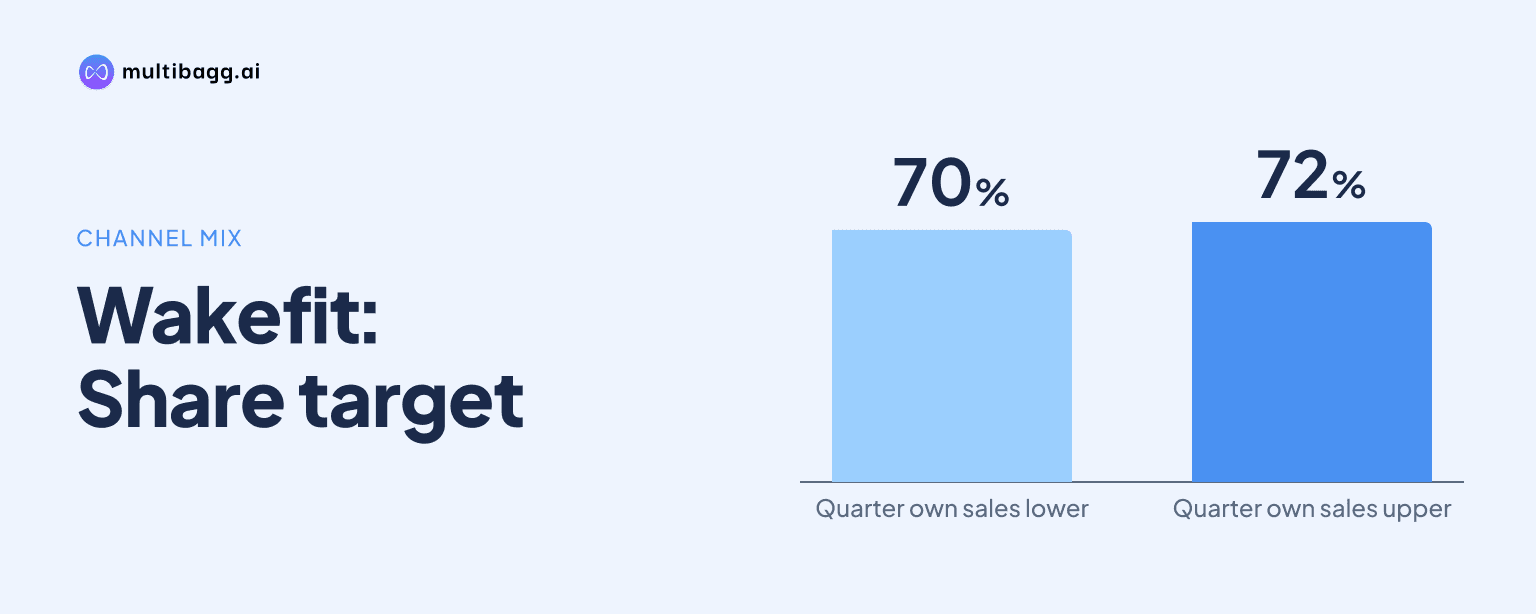
Wakefit is targeting a 70%-72% share of sales through its own channels after those channels accounted for about 70% in the quarter and grew around 40% year on year. Management said the deliberate shift toward its website and retail stores is margin accretive and gives Wakefit customer data and customer relationships.
Know Wakefit Innovations inside out
Results, valuation, peers and who's buying, in one view.
What channel mix is Wakefit targeting?
Wakefit wants approximately 70%-72% of sales to come from own channels and 25%-28% from external channels at the company level. Management said the mix may move between quarters as festive periods and sale events change the contribution of each route, but it expects to keep that broad allocation rather than continually reduce marketplace participation.
In the quarter discussed on the call, own channels represented around 70% of sales and grew about 40% year on year. Wakefit tracks retail stores and its website together because a customer may research online before buying after a store visit, or visit a store before completing a purchase on the website. Management said reporting the two routes separately would not fairly reflect their contribution.
Why is Wakefit moving sales to own channels?
Wakefit is moving more sales to own channels because management said they are margin accretive and allow the company to own customer data and the customer relationship. On external platforms, management said Wakefit does not receive customer data and cannot communicate with buyers individually, making the roughly 70%-72% own-channel mix a deliberate company-level decision.
The approach links Wakefit's website and physical retail network rather than treating them as competing formats. In the first half (H1) of fiscal year 2027 (FY27), management said it had front-loaded much of its store-opening target so stores could mature in H2. It also said customers can move between the website and stores during a purchase process, which is why Wakefit evaluates its own online and offline routes as one aggregated channel.
How do marketplaces fit Wakefit's channel plan?
Marketplaces remain an important discovery and customer-acquisition route for Wakefit, particularly during festive and quarterly sale events. Management said external partners help new-to-category and new-to-company customers find Wakefit and its products, even as the company aims to hold external-channel sales near 25%-28% of the overall mix.
Marketplace contribution can rise around specific events. Management cited the July Prime Day sale and the August Independence Day sale as periods that produced healthy marketplace growth, alongside growth from retail stores and the website. The targeted mix is therefore not a fixed quarterly rule: management expects sales share to shift between own and external channels when sale calendars, including the October-November-December period, affect demand.
Wakefit gave a similar explanation for furnishing products, which management said sell especially well through three routes: cash-and-carry displays in stores, frequently-bought-together widgets on the website, and marketplaces and quick commerce. After a leadership gap of about 6 to 9 months in the furnishing category, management said growth returned to normal from July through September and expected better growth in the October-November-December quarter. Availability, catalogue quality and delivery speed, rather than marketing spending, were identified as conversion drivers for this smaller-ticket segment.
Got a follow-up? Ask IRIS
How will stores and advertising affect Wakefit's mix?
New stores are intended to support Wakefit's own-channel mix, although management said they generally take 2 to 4 months to stabilise. The company front-loaded openings in H1 so that the stores could contribute more steady-state revenue in H2. Mattress growth came from all three routes: expansion into Tier 2 towns, retail stores and the website, while marketplace sales also benefited from the July and August events.
Wakefit said retail-channel sales grew 24%, broadly similar to overall mattress growth, despite faster year-on-year store-network expansion. Management attributed the outcome partly to newly opened stores still maturing. It distinguished larger furniture-and-mattress mega stores, of which it had about 105 to 110 until last year, from newer mini stores of roughly 1,000 square feet focused mainly on mattresses, bedding and accessories. Management said both formats have payback periods of under one year but did not disclose city- or format-level unit economics.
Advertising and marketing spending will also be assessed alongside store costs, rather than solely through the accounting expense line, according to management. Wakefit said a store in a good location, supported by hyperlocal activation, acts as a marketing point. It nevertheless retained full-year accounting-level advertising and marketing spending guidance of 7%-8%, after spending about 5% in the quarter and around 6% in H1, because the October-November-December sale period usually requires a higher proportion of spending.
Conclusion
Wakefit's approximately 70%-72% own-channel target combines margin accretion, customer-data ownership and store-supported website sales, rather than signalling an exit from marketplace distribution. The quarter's roughly 70% own-channel share and around 40% year-on-year own-channel growth show that Wakefit was already close to its stated company-level allocation, while retail, website and marketplace routes each contributed to mattress growth.
The next items to watch are the maturity of stores opened in H1, the October-November-December sale period and whether the mix shifts temporarily toward external platforms during events. Management retained its 7%-8% full-year advertising and marketing spending plan and said Wakefit is tracking toward its Board-approved annual operating plan, while declining to provide a specific revenue or margin-growth percentage for H2.