










Western Carriers domestic containers rise 21% as mix shifts
Key highlights
- Western Carriers’ domestic container volumes rose by more than 21% sequentially to 28,933 in Q2 FY27.
- Western Carriers handled 59,343 TEUs in Q2 FY27, up 1,082 TEUs from 58,261 TEUs in Q1 FY27.
- Western Carriers reported H1 FY27 total volume of 1,17,604 TEUs, compared with 1,06,621 TEUs in H1 FY2526.
- Western Carriers reported Q2 FY27 EBITDA of Rs 21.9 crore and profit after tax of Rs 9 crore.
powered by IRIS
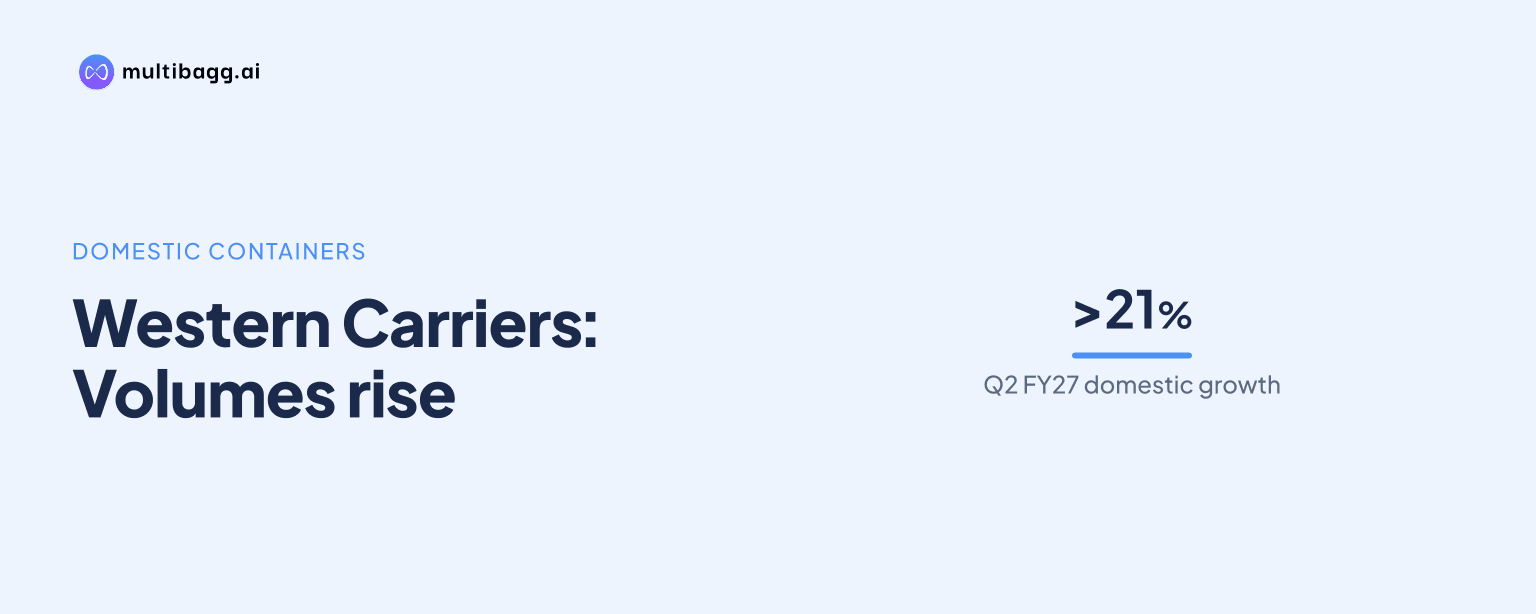
Western Carriers (India) Limited increased domestic container volumes by more than 21% sequentially to 28,933 in Q2 FY27 from 23,909 in Q1 FY27, helping total volume rise to 59,343 TEUs despite lower EXIM traffic. Management said Morbi tiles traffic and the September 2026 Kolkata terminal launch are supporting a move towards a near 50-50 metals and non-metals cargo mix.
Know Western Carriers (India) inside out
Results, valuation, peers and who's buying, in one view.
What drove Western Carriers’ domestic container growth in Q2 FY27?
Western Carriers’ domestic container volumes rose by 5,024 to 28,933 in Q2 FY27, compared with 23,909 in Q1 FY27. Management attributed the sequential increase to wider customer traction across sectors and geographies, supported by integrated logistics services that combine containerisation, storage, handling and first- and last-mile movements.
The domestic increase more than offset a decline in export-import, or EXIM, volumes during Q2 FY27. Total volume reached 59,343 twenty-foot equivalent units, or TEUs, up by 1,082 TEUs from 58,261 TEUs in Q1 FY27. For H1 FY27, total volumes were 1,17,604 TEUs, compared with 1,06,621 TEUs in H1 FY2526, an increase of more than 10% year-on-year.
Management said in the call that domestic volume growth was almost 34% in H1 FY27 and that domestic cargo’s share of overall volumes had increased to 45% from 37%. Western Carriers did not disclose a separate domestic TEU total for H1 FY27, so the transcript does not permit an independent calculation of the period’s domestic growth rate.
Why did Western Carriers’ EXIM volume decline in Q2 FY27?
Western Carriers’ EXIM volume fell to 30,410 TEUs in Q2 FY27 from 34,352 TEUs in Q1 FY27 because some customer exports moved as break-bulk rather than containers and July floods disrupted train services in Gujarat and Maharashtra. Management said total volume would have been higher without the rail disruption.
The company also cited erratic vessel schedules, congestion at transshipment ports and reduced availability of empty containers as constraints on Indian EXIM trade. Management linked these issues to the continuing Middle East conflict, saying delayed and bunched vessel arrivals can leave logistics assets underused for part of a month while raising congestion, retention and demurrage at other points.
Western Carriers nevertheless identified South Asian Association for Regional Cooperation trade as an area of improvement in Q2 FY27. Management said Nepal movements increased after customs formalities became available at Biratnagar and Jogbani in addition to Birgunj through Raxaul, while Bangladesh trade had begun to grow after several quarters of low or nil growth.
How are Morbi and Kolkata expanding Western Carriers’ non-metals network?
Western Carriers is using its more than 42-acre Devaliya multimodal container terminal, rail code WCGD, in Gujarat’s Saurashtra region to serve domestic tiles, ceramics, industrial chemicals and food cargoes. The terminal expanded its services during the quarter to CMLK in the north, Bengaluru Whitefield in the south, Kolkata in the east and Guwahati in the northeast.
Tiles traffic at Morbi improved in the month preceding the November 16, 2026 call after two relatively quiet quarters, according to management. It said gas availability, which had been affected by the war, had improved but was not fully normalised. Management estimated that Morbi volumes remained at about one-third of the terminal’s optimal level and expected Phase 2 to become fully operational over the next couple of quarters.
Morbi is currently a domestic operation rather than an EXIM facility because Western Carriers does not yet have an inland container depot there. Management said its initial west-to-east domestic route was Kolkata, followed by services to Guwahati, CMLK, Delhi National Capital Region and Bengaluru, creating pan-India domestic coverage from the Saurashtra cluster.
Western Carriers also began operations in early September 2026 at the General Goods Terminal, called the GCD Yard, at Syama Prasad Mookerjee Port in Kolkata. Phase 1 was fully operational from launch, with reach stackers, cranes, forklifts, commercial vehicles and manpower in place. Management expects the terminal, located opposite the port gate, to generate incremental volumes from Q3 FY27 across domestic and EXIM cargo.
Got a follow-up? Ask IRIS
How far has Western Carriers moved away from metals cargo?
Western Carriers said its business mix has shifted from roughly 60% metals and mining-related cargo and 40% other cargo to nearly 50% metals and 50% non-metals. Management attributed the change over about eight quarters to customer additions at Morbi and the Kolkata GCD Yard, even as the company’s overall cargo base expanded.
The non-metals categories named by management include tiles, ceramics, industrial chemicals, food products, pharmaceuticals, fast-moving consumer goods, fertilizers and salt. Management said it had added a substantial number of micro, small and medium enterprise customers in western India and also added customers in eastern and northeastern markets, with repeat orders contributing to domestic volumes.
Management expects the mix to reach 45% metals and 55% non-metals in the next four to six quarters. That is a management expectation rather than a reported result. It depends on the rollout of Morbi’s Phase 2, further domestic network utilisation and the contribution from the Kolkata terminal, which started only in September 2026.
What do the changing volumes mean for Western Carriers’ earnings and investment plans?
Western Carriers reported Q2 FY27 revenue from operations of Rs 449 crore, compared with Rs 440 crore in the corresponding quarter a year earlier. Earnings before interest, taxes, depreciation and amortisation, or EBITDA, were Rs 21.9 crore, up from Rs 18.7 crore in Q1 FY27 and up 17% year-on-year, according to management.
Profit after tax was Rs 9 crore in Q2 FY27, compared with Rs 8.7 crore in Q1 FY27. The profit-after-tax margin increased by 15 basis points to 2.02% from 1.87% sequentially. Management said it does not disclose revenue per TEU across domestic and EXIM operations or split financial results between rail, road and ocean because it provides multimodal supply-chain solutions.
Management said 75% to 80% of Western Carriers’ work is linked to multimodal logistics and expects a greater rail-based mix to improve margins over time. Road diesel-price changes are covered by diesel price variation clauses with large corporate customers, while rail haulage changes can be passed through, management said, although route execution inefficiencies are not pass-through costs.
For FY27, Western Carriers envisages capital expenditure of about Rs 100 crore, with the timing and scale dependent on customer commitments, volume visibility and market conditions. It had completed Rs 30 crore of capital expenditure in H1 FY27, mainly on specialised containers, commercial vehicles and equipment for specific client requirements.
Conclusion
Western Carriers’ Q2 FY27 results show domestic cargo becoming a larger offset to EXIM disruption. Domestic containers increased by 5,024 sequentially while EXIM volumes fell by 3,942 TEUs, leaving total volumes 1,082 TEUs higher. Morbi’s tiles, ceramics, chemicals and food traffic, alongside the Kolkata terminal’s domestic and EXIM capability, is central to management’s effort to reduce the relative share of metals.
The next developments to watch are Morbi Phase 2, which management expects to be fully operational in the next couple of quarters, and incremental Q3 FY27 volumes from the Kolkata GCD Yard. Management also targets receivable days below 120 and then 110 over the following four to six quarters, while the remaining FY27 capital expenditure will depend on customer commitments and volume visibility.