










Windlas Biotech Plant-6 takes oral capacity to 10.5 billion
Key highlights
- Windlas says Plant-6 was commercialized in September 2026 with 200 million tablet and capsule units of stated capacity.
- Windlas lists total tablet and capsule capacity of 10.522 billion units across five Dehradun plants.
- Windlas reported FY26 capacity utilisation of 66%, compared with 59% in FY25.
- Windlas spent Rs. 8.3 crore on R&D in FY26 and recorded 4,393 complex-generics variations.
powered by IRIS
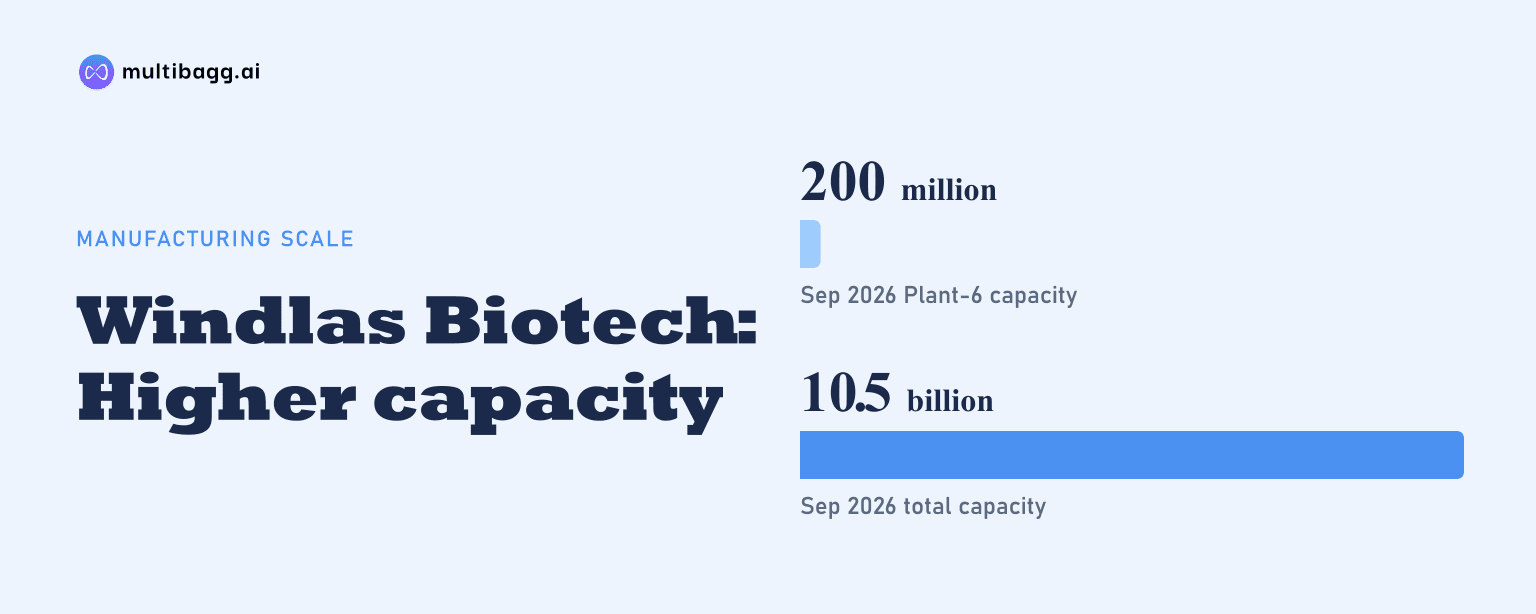
Windlas Biotech said Plant-6 was commercialized in September 2026, taking its stated tablet and capsule capacity to 10.522 billion units across five Dehradun oral-solid plants. The new plant is listed with 200 million units of capacity, while Windlas reported FY26 utilisation of 66%, compared with 59% in FY25.
Know Windlas Biotech inside out
Results, valuation, peers and who's buying, in one view.
How much oral-solids capacity does Windlas have after Plant-6?
Windlas lists total tablets and capsules capacity of 10,522 million units after Plant-6, with Plant-2 accounting for 5,477 million units, or more than half of the total. Plants 1, 2, 3, 4 and 6 are all in Dehradun, manufacture oral solid drugs and are described as compliant with World Health Organization Good Manufacturing Practice standards.
Windlas also reports capacity for 61 million liquid bottles and 54 million pouches and sachets, separate from its tablet and capsule network. Plant-1 has capacity for 23 million liquid bottles and 22 million pouches and sachets, Plant-2 has 38 million liquid bottles and 20 million pouches and sachets, and Plant-4 adds 12 million pouches and sachets.
When was Plant-6 commercialized and when does it commence?
Windlas says Plant-6 was commercialized as of September 2026, while its manufacturing-facilities table lists 2027 as the plant's commencement year. The presentation does not explain the difference between the September 2026 commercialization statement in its corporate timeline and the 2027 date in the capacity table.
Windlas initiated Plant-6 capital expenditure for oral-solid dosage capacity expansion in 2025, after completing the Plant-2 extension in the same year. Its tablet and capsule capacity had risen from more than 5 billion units as of March 31, 2020, to more than 7 billion units as of March 31, 2022; the current stated total of 10.522 billion units is a further increase, although no immediate pre-Plant-6 total is disclosed.
What does Windlas report on utilisation and dosage expansion?
Windlas reported capacity utilisation of 66% in FY26, up 7 percentage points from 59% in FY25. The increase was reported alongside FY26 capital expenditure of Rs. 73 crore, gross block of fixed assets of Rs. 426 crore as of March 2026, and Rs. 184 crore invested in building property, plant and equipment and other assets.
Windlas is also adding injectable dosage forms through Plant-5, which has a 2024 commencement year and manufactures ampoules, liquid vials and lyophilized vials. The corporate timeline says the injectable facility received Good Manufacturing Practice certification in 2025, and management says it plans to scale the platform across generic formulation contract development and manufacturing organisation, trade generics and institutional sales, and exports.
How is Windlas using R&D for differentiated formulations?
Windlas spent Rs. 8.3 crore on research and development in FY26, up from Rs. 6.3 crore in FY25 but below Rs. 8.9 crore in FY23. Complex-generics variations reached 4,393 in FY26, compared with 4,340 in FY25 and 1,325 in FY22, while the company lists a Department of Scientific and Industrial Research-approved laboratory, pilot-scale equipment and 250 quality-control personnel.
Windlas categorises 34% of its disclosed complex-generics mix as fixed-dosage modified-release products and 28% as fixed-dosage combinations. Customized generics account for 10%, chewable or dispersible products for 2%, and plain oral solids for 26%; management also identifies medicated multivitamin chewing gum, chocolate-flavoured chewable tablets, dispersible tablets and sustained-release products as development areas.
Got a follow-up? Ask IRIS
Which business channels could use the added capacity?
Windlas identifies three core verticals for its manufacturing and development platform: generic formulation contract development and manufacturing organisation, trade generics and institutional sales, and exports. The company says almost 100% of its contract development and manufacturing supplies are products where it owns the intellectual property from initiation through regulatory permission.
Trade generics and institutional sales generated Rs. 195 crore in FY26, compared with Rs. 172 crore in FY25 and Rs. 61 crore in FY22, while the number of brands rose to 546 from 400 in FY25. This vertical contributed 13% of revenue as of H1FY27 and was distributed through 1,582 stockists and distributors in FY26, compared with 1,095 in FY25.
Exports generated Rs. 46 crore in FY26, up from Rs. 33 crore in FY25 and Rs. 20 crore in FY23, although the number of exported products fell to 67 from 80 in FY25. Exports contributed 5% of revenue as of Q2FY27, and Windlas says it develops and registers product dossiers to secure marketing authorizations in emerging and semi-regulated international markets.
What is management's stated plan for the expanded network?
Management says it plans to focus on first-to-launch complex generics, novel dosage formats and high-bioavailability products, with launches aligned to upcoming patent expirations. The stated strategy also includes expanding wallet share with value-added contract development and manufacturing clients, acquiring new customers and mitigating customer-concentration risk.
For Plant-5, management's stated plan is to broaden the injectable portfolio towards critical-care and specialised therapeutic segments. For Plant-6, the presentation describes commercialization of the oral-solids facility as part of future-ready infrastructure that also includes digital quality management systems and real-time analytics intended to support compliance, traceability and efficiency.
Conclusion
Windlas has disclosed a 10.522 billion-unit tablet and capsule network after Plant-6, with Plant-2 contributing 5,477 million units and Plant-6 adding 200 million units. The expanded oral-solids base follows a rise in reported utilisation to 66% in FY26 from 59% in FY25, alongside Rs. 73 crore of FY26 capital expenditure and continuing formulation-development investment.
The next matters to watch are whether Windlas clarifies the difference between Plant-6's September 2026 commercialization and its listed 2027 commencement year, and how it executes its stated plan to scale injectables across all three business verticals. Management has also identified first-to-launch complex generics, novel dosage forms and products linked to upcoming patent expirations as pathways intended to use the expanded infrastructure.