










Windlas broadens CDMO base to 926, lowering top-10 reliance
Key highlights
- Windlas had 926 Generic Formulations CDMO customers in FY26, up from 285 in FY22.
- Top-10 customer contribution fell to 32% in FY26 from 52% in FY22.
- Generic Formulations CDMO revenue rose to Rs 664 crore in FY26 from Rs 384 crore in FY22.
- Windlas catered to 5,644 CDMO products in FY26, and 53% of its portfolio was chronic and sub-chronic.
powered by IRIS
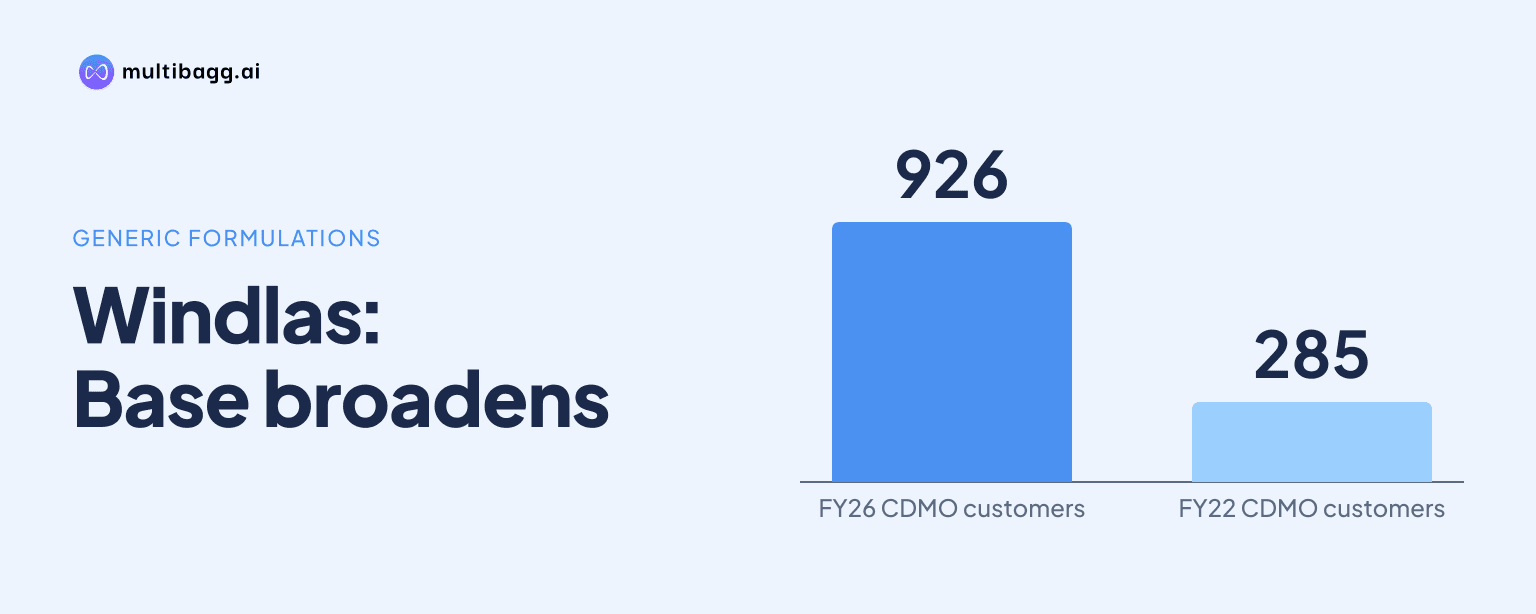
Windlas expanded its Generic Formulations contract development and manufacturing organisation (CDMO) customer base to 926 in FY26, while the contribution from its top 10 customers fell to 32% from 52% in FY22. The shift came alongside CDMO revenue of Rs 664 crore and a portfolio of 5,644 products.
Know Windlas Biotech inside out
Results, valuation, peers and who's buying, in one view.
How did Windlas expand its CDMO customer base?
Windlas increased its Generic Formulations CDMO customer count by 641, from 285 in FY22 to 926 in FY26, which the presentation reports as a 34% compound annual growth rate (CAGR). The annual additions continued through the period: the customer base reached 441 in FY23, 583 in FY24 and 757 in FY25 before reaching 926 in FY26.
The company links customer-base expansion to its end-to-end offering, from product development through clinical approvals and licensing to commercial good manufacturing practice (GMP) manufacturing. Windlas identifies audits by multinational corporations and domestic customers, dosage innovation, complex generics, responsiveness, quality standards and turnaround times as factors supporting customer acquisition and retention.
The customer count rose in every year while the top-10 share reduced in every year. The top customer’s contribution declined from 13% in FY22 to 6% in FY25, before increasing by one percentage point to 7% in FY26; the broader top-10 concentration measure nevertheless continued to decline.
Has customer concentration reduced at Windlas?
Yes. Windlas reported that its top 10 customers contributed 32% in FY26, down 20 percentage points from 52% in FY22. The annual progression was 42% in FY23, 36% in FY24 and 34% in FY25, showing a smaller share for the largest customer group as the overall base expanded.
This change is relevant to the Generic Formulations CDMO vertical because it accounted for 82% of Windlas revenue as of H1FY27. The customer-expansion presentation describes the objective as building a sustained customer base while mitigating client-concentration risk, rather than setting a customer-concentration target for a future year.
Windlas says long-term customer relationships enable planned capital expenditure and support sustainable growth and profitability. Its stated investment areas include specialised products, services, equipment and infrastructure, while commercial arrangements cover product specifications, raw-material and packaging procurement, pricing and supply terms; no capital-expenditure amount or timetable is disclosed.
How have Windlas CDMO revenue and product numbers changed?
Windlas increased annual Generic Formulations CDMO products catered from 1,834 in FY22 to 5,644 in FY26, a reported 32% CAGR. The largest increase was between FY23 and FY24, when product count rose from 2,771 to 4,273, followed by 5,582 in FY25 and a further 62 products in FY26.
CDMO revenue rose from Rs 384 crore in FY22 to Rs 664 crore in FY26, equating to the 15% CAGR stated in the presentation. Revenue increased by Rs 19 crore in FY23, Rs 78 crore in FY24, Rs 74 crore in FY25 and Rs 109 crore in FY26, making FY26 the largest year-on-year absolute increase in the five-year series.
Product count grew faster than revenue between FY22 and FY26, based on the respective reported CAGRs of 32% and 15%. The presentation does not provide product-level pricing, volumes or profitability, so it does not establish why product and revenue growth rates differed.
Got a follow-up? Ask IRIS
Which formulations underpin Windlas's expanded CDMO offering?
Windlas says 53% of its Generic Formulations CDMO portfolio is in chronic and sub-chronic therapies, compared with 47% in acute therapies. Chronic and sub-chronic categories include anti-diabetic, cardiovascular, neuropsychiatry, respiratory-health and nutraceutical products, while acute categories include gastroenterology, vitamins, minerals and supplements, analgesics, dermatology, and cough and cold treatments.
The portfolio is also weighted 74% to conventional products and 26% to complex generics. Windlas lists fixed-dosage formulations such as tablets, capsules and oral solids, alongside modified-release products, chewable and dispersible tablets, customised generics, multi-drug combinations and injectable liquid vials, lyophilised vials and ampoules.
Windlas reports that it owns the intellectual-property rights for 99% of products sold in this vertical. The presentation describes the company as among the leading domestic Generic Formulations CDMO players in India and identifies branded generic products sold to pharmaceutical companies, which market the products under their own brands, as the core CDMO model.
How does Windlas's CDMO business compare with its other verticals?
Windlas's Generic Formulations CDMO vertical was larger than its Trade Generics and Institutional and export businesses in the disclosed revenue mix. CDMO accounted for 82% of revenue as of H1FY27, compared with 13% for Trade Generics and Institutional, while exports accounted for 5% as of Q2FY27.
Trade Generics and Institutional revenue grew from Rs 61 crore in FY22 to Rs 195 crore in FY26, with brands increasing from 218 to 546 and stockists and distributors increasing from 579 to 1,582. The business sells directly to stockists and distributors and also supplies institutional customers through tender procurement, giving it a different route to market from CDMO.
Exports generated Rs 46 crore in FY26, up from Rs 21 crore in FY22, while the business exported 67 products in FY26 after 80 in FY25. The export vertical focuses on emerging and semi-regulated international markets, uses both own brands and end-customer brands, and develops product dossiers to secure marketing authorisations.
Conclusion
Windlas's FY26 data show a CDMO business becoming broader in both customers and products, with 926 customers and 5,644 products versus 285 and 1,834 respectively in FY22. Over the same period, the top-10 customer share reduced from 52% to 32%, while CDMO revenue increased from Rs 384 crore to Rs 664 crore and the vertical contributed 82% of revenue in H1FY27.
The next point to watch is whether Windlas's planned investment in specialised products, services, equipment and infrastructure supports further customer additions while maintaining the lower concentration trend. Management has not disclosed a future customer-count or concentration target, so later disclosures of customer contribution, product additions and CDMO revenue will indicate progress against that plan.