










Windlas says EU GMP alone will not produce export revenue
Key highlights
- Windlas received EU GMP certification for Plant 4 and the Plant 5 injectable facility in Q2 FY27.
- Windlas had European product filings but zero European product approvals as of the H1 FY27 call.
- Windlas reported H1 FY27 revenue of Rs 512 crore, up 18% year on year.
- Plant 6 was commercialized on September 28, 2026, with further costs expected in Q3 FY27.
powered by IRIS
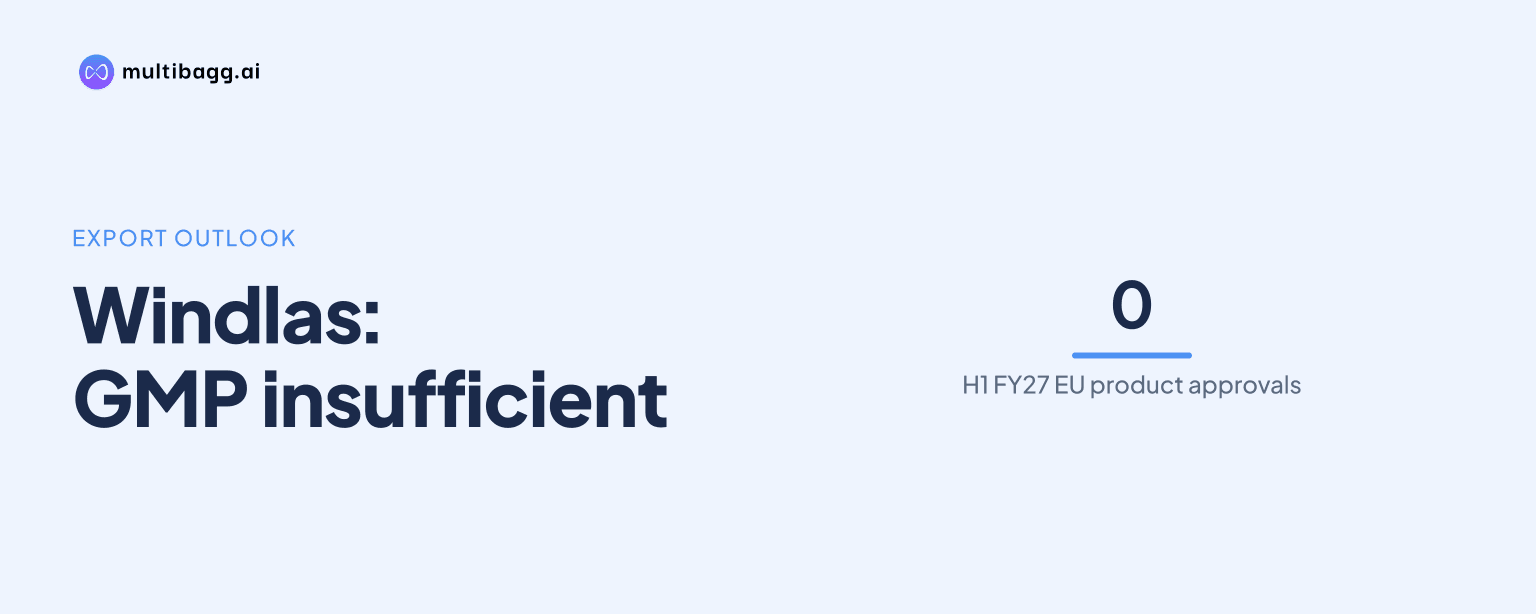
Windlas Biotech said in its H1 FY27 earnings call that EU Good Manufacturing Practice, or EU GMP, certification for Plant 4 and Plant 5 does not yet generate European export revenue, because it has filings but no European product approvals. Management said country-specific registrations and later commercialization must precede profit-and-loss contribution.
Know Windlas Biotech inside out
Results, valuation, peers and who's buying, in one view.
What does EU GMP certification mean for Windlas?
EU GMP certification confirms the manufacturing quality systems at Windlas’s Plant 4 and Plant 5 injectable facility, but it does not authorize the sale of medicines in Europe. Management called the Q2 FY27 certification a significant milestone and said the injectable facility cleared the EU GMP process on its first attempt.
Windlas said Plant 5 has so far served the domestic market, while the new certification creates a building block for regulated-market exports. Management also cited the Philippines facility approval received in the previous quarter as another step in its export preparation, rather than evidence of completed overseas commercialization.
The certification can also matter for domestic customers because an EU GMP inspection provides external validation of a plant’s quality systems. However, Windlas tied the commercial relevance of the certification to its future ability to select export products and customers, not to an immediate revenue contribution in H1 FY27.
Does Windlas have European product approvals yet?
No, Windlas had European filings but no product approvals at the time of the H1 FY27 call. Hitesh Windlass made that point after an analyst asked whether the company had already received a registration or approval for injectable or oral products in Europe.
Windlas said a site must first be certified and then each product requires an individual application in an individual country. Management said it would continue filings and work on responses to earlier dossiers, but did not disclose the number of filings, the countries involved, products under review or expected decision dates.
The company said some approvals are expected, but gave no timetable or estimate of associated sales. Management’s stated sequence is facility approval, product registration, customer development and commercialization, with the resulting business appearing in the profit and loss statement only as it builds.
How could injectable exports change Windlas’s business mix?
Management said injectable exports have a higher margin than domestic injectables, while domestic injectables are more lucrative than the contract development and manufacturing organisation, or CDMO, business. Windlas did not disclose earnings before interest, tax, depreciation and amortisation, or EBITDA, margins for individual verticals or quantify the possible export mix change.
Windlas described the opportunity as a longer-term route to a stronger revenue and margin mix, based on product selection and client selection in regulated markets. That is an aspiration rather than guidance: management did not provide an export revenue target, forecast a European launch or endorse an analyst’s suggestion that exports could reach 10% to 15% of total revenue over three to five years.
Exports are Windlas’s smallest revenue vertical, according to management. The company said it is expanding its product portfolio, pursuing facility approvals and filing dossiers, but cautioned that export outcomes depend on several factors and can be binary, particularly when a regulatory approval or commercial arrangement is pending.
Got a follow-up? Ask IRIS
What financial base is Windlas building from?
Windlas reported Q2 FY27 revenue of Rs 264 crore, up 19% year on year, and H1 FY27 revenue of Rs 512 crore, up 18%. The half-year result crossed Rs 500 crore in revenue for the first time, providing the current domestic and CDMO base from which management is funding capacity and export work.
Excluding non-cash employee stock option plan, or ESOP, expense, EBITDA was Rs 36 crore in Q2 FY27 and Rs 70 crore in H1 FY27, equal to a 13.7% margin in both periods. Management compared that margin with its earlier range of about 11% to 12%, while stressing that mix, plant operating costs and execution affect reported profitability.
On a reported basis, EBITDA was Rs 29 crore in Q2 FY27 and Rs 56 crore in H1 FY27, while profit after tax was Rs 18 crore and Rs 36 crore, respectively. The difference from the adjusted figures reflects the ESOP expense identified by management, rather than a disclosed change in European export sales.
What must Windlas execute before export revenue can scale?
Windlas must obtain product approvals and establish commercial supply after its plant certifications, because EU GMP alone covers the site rather than every medicine or country. Management also said it had nothing to announce on possible European CDMO opportunities until an arrangement is finalized and commercialized.
The company declined to disclose injectable capacity utilization or the pace of the facility’s ramp-up. It said it would consider expanding injectables once the existing facility reaches peak utilization, leaving the timing of additional injectable capacity dependent on demand and current-plant execution.
Separately, Windlas commercialized Plant 6 on September 28, 2026, and said operating costs and depreciation would flow further into Q3 FY27. Management’s near-term priority is to make Plant 6 regularly and fully utilized before beginning further oral-solid expansion, while regular maintenance capital expenditure remains the current plan.
Windlas also disclosed an operational-efficiency project that may require Rs 25 crore to Rs 30 crore of capital expenditure. Management said the project could reduce operating expenditure in coming quarters, but did not provide a savings amount, implementation date or link it to the European registration process.
Conclusion
Windlas has added EU GMP certification at Plant 4 and Plant 5 to its export preparation, but it has not reached the stage at which European sales can be recognized. The company has filings in Europe and no product approvals, so the relevant commercial test is progress from country-specific registrations to customer supply. Injectable exports could alter mix because management says they carry higher margins than domestic injectables, but no contribution has been quantified.
The next developments to watch are decisions on Windlas’s European filings, any disclosed product approval or commercialization, and the Q3 FY27 cost effect from Plant 6 after its September 28, 2026 start. Management plans to continue dossier work, build business after approvals and evaluate injectable expansion only when the existing facility approaches peak utilization.