










Windlas Biotech Limited retains capital flexibility for growth
Key highlights
- Windlas Biotech has completed two promoter-free buybacks in the past five years.
- Management said the next larger capacity decision depends on injectable-facility utilisation and the current injectable increase.
- Plant 6 was commercialised on September 28, and related costs were expected to flow into the third quarter.
- Windlas Biotech has European product filings but no product approvals so far.
powered by IRIS
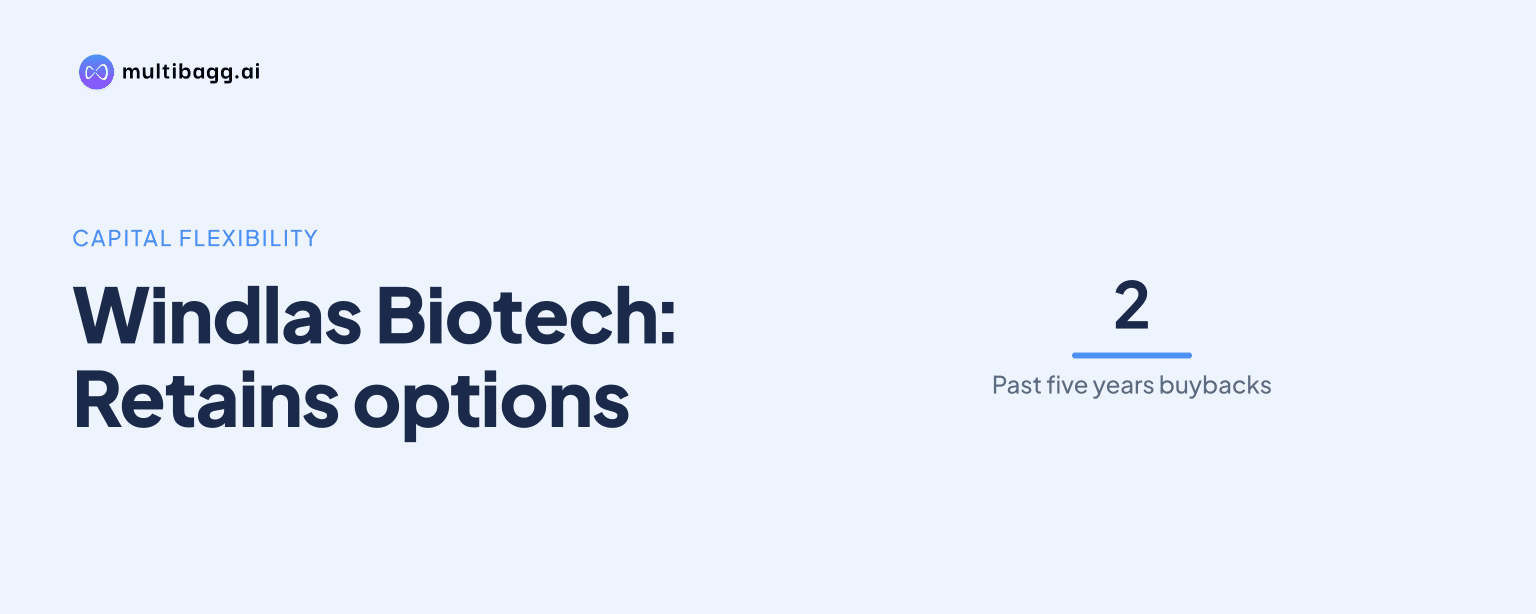
Windlas Biotech Limited will retain liquidity for acquisitions, core capacity additions, buybacks, dividends and employee initiatives rather than commit to a larger new expansion now, management said. The company has completed two promoter-free buybacks in the past five years, while management said the next material capacity decision will depend on utilisation at its injectable operations.
Know Windlas Biotech inside out
Results, valuation, peers and who's buying, in one view.
Why is Windlas Biotech retaining liquidity instead of announcing new capacity?
Windlas Biotech is retaining liquidity so it can act when an acquisition, capacity project or shareholder-return decision meets its criteria, rather than deploying cash simply because it is available. Komal Gupta said the company wants adequate cash and debt-raising capability to pursue an acquisition it likes, fund capacity in core dosage forms, start an internal project and undertake buybacks or dividends when appropriate.
Management’s framework does not include a newly announced investment amount, project date or acquisition target. Gupta said Windlas Biotech does not view cash as money that must be put somewhere immediately, but as liquidity that prevents the company from being constrained when it chooses to pursue a particular plan.
The approach also reflects management’s caution on inorganic transactions. Hitesh Windlass said the company has avoided rushing into a transaction because an asset appears inexpensive, only to inherit operational issues that require fixing. He described the company’s acquisition approach as careful and prudent, with the balance sheet providing the option to decide when an opportunity is clearest.
When will Windlas Biotech make its next capacity investment?
Windlas Biotech said its next larger capacity decision would follow higher utilisation at the existing injectable facility and the initiation of the current injectable increase, while oral-solid operations continue. Gupta gave this sequence when asked how management would choose between buying a business and spending on organic expansion.
Management did not provide a utilisation percentage, a commissioning date or a capital-expenditure budget for another facility. However, when an analyst asked whether demand could exceed available capacity at a revenue level of Rs 1,100 crore to Rs 1,200 crore, management said it would ensure that a capacity shortfall did not occur. That range came from the analyst, not from management guidance.
Windlas Biotech also distinguished routine efficiency spending from a major expansion. Management confirmed that a capital investment should ideally reduce operating expenditure after an analyst referred to an operating-cost saving plan of Rs 25 crore to Rs 30 crore. The company did not disclose the investment amount, the expected completion date or a timetable for recognising the saving.
The capacity sequence is relevant because Plant 6 was commercialised on September 28, according to management, meaning related operating costs and depreciation would flow into the third quarter. That comment concerned the recognition of Plant 6 costs, rather than a commitment to build another plant or dosage-form facility.
What does Windlas Biotech’s payout record indicate about future returns?
Windlas Biotech can consider another buyback, but management announced neither a date nor an amount. Hitesh Windlass said the company has completed two buybacks in the past five years, while Gupta said it has completed two buybacks after listing. Management said promoters did not participate in those transactions, which it described as intended to benefit shareholders.
The company also follows a dividend policy under which a certain percentage of profit is distributed, management said. Gupta added that the company wants to retain the ability to exceed that guiding percentage if it decides to do more for long-term shareholders. No additional dividend, dividend-policy revision or fresh buyback proposal was announced during the call.
Management framed payouts as one use of capital alongside acquisitions and manufacturing investment, not as a substitute for growth spending. Windlas Biotech said it also wants flexibility to support long-serving employees, in addition to preserving the capacity to fund dosage-form projects internally. The company did not quantify any employee-related allocation.
The stated order of decisions is therefore conditional rather than calendar-based. A buyback could happen again, Hitesh Windlass said, but management has only just completed the latest one and will seek to balance company growth, shareholder rewards and disciplined capital deployment.
Got a follow-up? Ask IRIS
How does acquisition optionality fit Windlas Biotech’s strategy?
Windlas Biotech remains focused on its three existing verticals and is not currently building innovator-side or early-stage capabilities. Hitesh Windlass said management sees sufficient opportunity in those verticals for the next four to five years and is executing against that existing business plan.
Management contrasted its broad-based and distributed customer model with businesses where one or two accounts generate most revenue. Windlas Biotech said a move into innovator work could occur through an acquisition if an opportunity arose, but it is not currently attempting to build that capability independently. The company did not identify a therapeutic area, target company or transaction budget.
This acquisition discipline also applies to new dosage forms. Gupta said Windlas Biotech wants the ability either to acquire a suitable opportunity or to begin capital expenditure internally for such a plan. The company’s position is not that it will choose one route now, but that it wants to preserve both routes until the operating need and available opportunity are clearer.
Management’s comments on Europe illustrate why it is not setting a fixed expansion timetable. Windlas Biotech has filed products in Europe but has received no product approvals so far, management said. Each product filing is reviewed separately after plant approval, and management declined to provide a date for European injectable revenue because the review process depends on the relevant authority.
What should investors infer from Windlas Biotech’s capital framework?
Windlas Biotech’s framework is to keep funding capacity available, then direct it toward the option that best fits operating requirements and management’s standards. The possible uses include injectable and oral-solid capacity, a new dosage-form project, an acquisition, a buyback, dividends and employee initiatives, with no announced commitment to any one of them.
The company’s current operating focus remains its three verticals rather than an immediate move into a new platform. Management said the company would not allow demand to create a capacity shortfall, but it also did not provide revenue guidance, a utilisation target or a deadline for another facility. That leaves the timing of fresh expansion dependent on operational progress.
Conclusion
Windlas Biotech is not withdrawing from growth investment; it is keeping several capital-allocation options open while utilisation and acquisition opportunities develop. Its two promoter-free buybacks in five years show that shareholder returns are part of the framework, but management placed them alongside core manufacturing capacity, potential acquisitions and dividend payments rather than ahead of those needs.
The next developments to watch are utilisation at the injectable facility, progress on the injectable increase and any formally approved acquisition or payout proposal. Management also disclosed European product filings with no approvals yet and said Plant 6 costs would begin flowing through the third quarter after its September 28 commercialisation, both of which may influence future capacity decisions.