










Adani Power has 14.64 GW PPAs for 23.72 GW expansion
Key highlights
- APL's 23.72 GW organic portfolio would increase capacity from 18.33 GW to 42.05 GW.
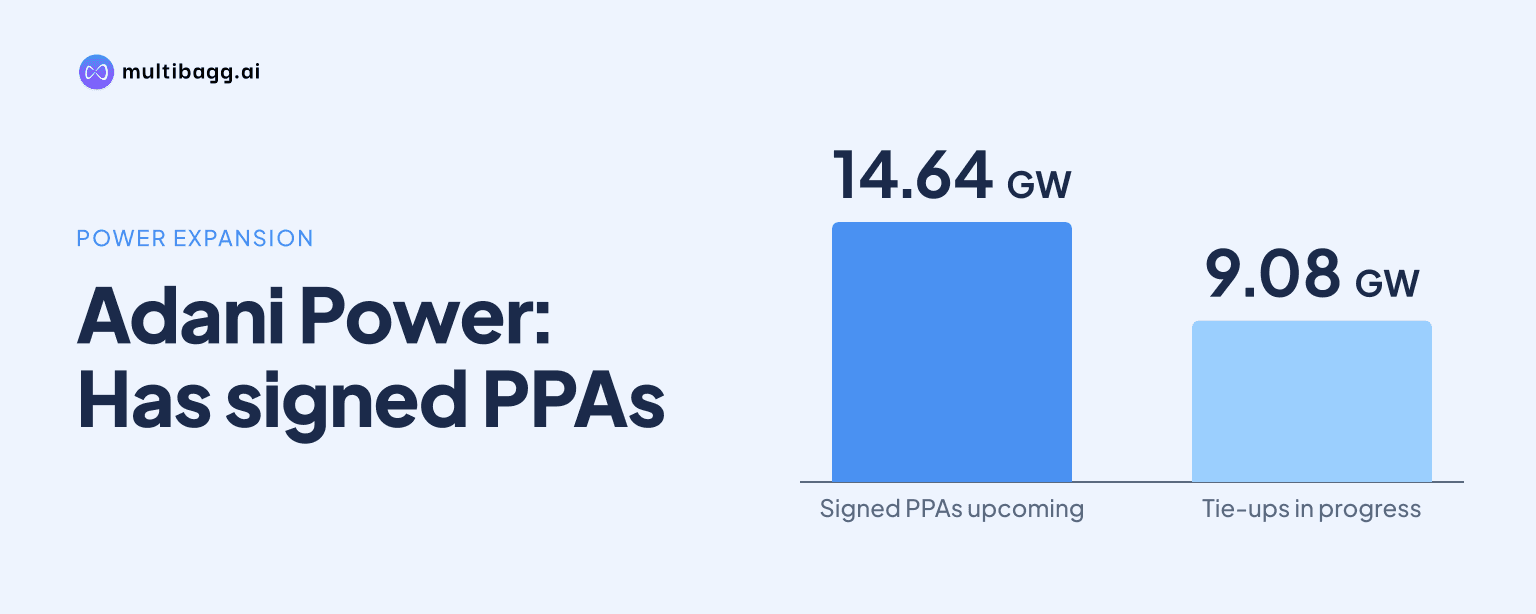
- APL reports 14.64 GW of signed PPAs for upcoming projects and 9.08 GW of tie-ups in progress.
- Land and equipment ordering cover 100% of APL's 23.72 GW portfolio, while reported environmental clearance is 87%.
- APL schedules its largest annual capacity addition, 6.40 GW, for FY 2030-31.
powered by IRIS
Adani Power (APL) has 23.72 gigawatts (GW) of organic projects in advanced development, with 14.64 GW covered by signed power purchase agreements (PPAs), and targets 42.05 GW by FY 2031-32 from 18.33 GW currently. The presentation reports land and equipment ordering across 100% of the portfolio and environmental clearance across 87%.
Know Adani Power inside out
Results, valuation, peers and who's buying, in one view.
What expansion capacity has APL identified?
APL has identified 23.72 GW of organic capacity across 12 listed projects, which is the capacity addition required to move from 18.33 GW of current installed capacity to its 42.05 GW target. The project list ranges from Korba Phase II at 1.32 GW to Raipur Phase II and III combined and Chapar, each at 3.20 GW.
The capacity timetable spreads the 23.72 GW addition over FY 2026-27 to FY 2031-32. APL lists 1.32 GW for FY 2026-27, 1.60 GW for FY 2027-28, 4.00 GW for FY 2028-29, 4.80 GW for FY 2029-30, 6.40 GW for FY 2030-31 and 5.60 GW for FY 2031-32. The stated target excludes 3 GW of projects at proposal stage.
The largest annual planned addition is 6.40 GW in FY 2030-31, compared with 1.32 GW in FY 2026-27. The schedule therefore places 16.80 GW, or more than two-thirds of the planned additions, in the three financial years from FY 2029-30 through FY 2031-32.
How much of APL's expansion has signed PPAs?
APL reports signed PPAs for 14.64 GW of upcoming projects, while its capacity tie-up chart lists 9.08 GW of tie-ups in progress. The 14.64 GW figure is also the signed-PPA total in the project portfolio table, where several remaining projects are marked as bids ongoing.
The signed capacity includes 1.32 GW at Korba Phase II, 3.20 GW at Raipur Phase II and III, 1.60 GW at Mirzapur, 2.40 GW at Pirpainti and 3.20 GW at Chapar. Mahan Phase II has 1.32 GW of PPAs against 1.60 GW of project capacity, while Anuppur has 1.60 GW of PPAs against 2.40 GW of project capacity.
APL's tie-up timeline records awards or arrangements from May 2020 to October 2026. It lists 3.20 GW in Assam in November 2025, 2.40 GW in Bihar in September 2025, 1.60 GW in Maharashtra in March 2026 and 1.32 GW in Uttarakhand in October 2026; the latter includes a Letter of Award from Uttar Pradesh Power Corporation Ltd. received in October 2026.
What makes APL's project portfolio ready for execution?
APL states that 100% of its 23.72 GW organic portfolio has land available and equipment ordering in place. Its brownfield model uses developed sites, and the presentation says this avoids land-acquisition delays while enabling faster permissions and access to shared infrastructure.
The company has advance-ordered 22.4 GW of boiler, turbine and generator (BTG) sets, which it presents as supply-chain assurance for critical equipment. This BTG figure is separate from the 23.72 GW project total, and the project table shows equipment ordering against every listed project.
APL reports environmental clearance across 87% of the organic portfolio. The table marks environmental clearance as in progress for the 3.20 GW Raipur Phase II and III project and the 1.60 GW Raigarh Phase III project; a footnote says Raipur Phase II has received clearance while Phase III remains under progress.
Got a follow-up? Ask IRIS
Which projects still have offtake or approval steps remaining?
APL lists bids ongoing for Raigarh Phase II, Mahan Phase III, Kawai Phase II and Korba Phase III, each with 1.60 GW of capacity. Raigarh Phase III, also 1.60 GW, is marked as having both bids ongoing and environmental clearance in progress.
The outstanding tie-up process is reflected in the 9.08 GW shown as tie-ups in progress in APL's capacity chart. That chart separately identifies 14.64 GW of new PPAs for upcoming projects and a 42.05 GW total target capacity, distinguishing contracted capacity from capacity still subject to further tie-ups.
APL also identifies 16.66 GW of upcoming long-term PPA bid opportunities that are separate from its signed-PPA portfolio. Invitations have been issued for 4.00 GW each in Uttar Pradesh and Gujarat, 3.86 GW in West Bengal and 3.20 GW in Rajasthan, while a 1.60 GW Andhra Pradesh invitation is marked awaited.
How does APL connect expansion with fuel and tariff mechanisms?
APL says 95% of its existing capacity is tied up under long-term and medium-term PPAs, with the remaining 5% supplying short-term demand. The presentation describes a two-part, availability-based tariff structure in which fixed capacity-charge revenue is assured on achieving normative availability of 85% to 90%.
First-year capacity charges cited for newer PPAs rose from Rs 2.89 per kilowatt-hour (kWh) for Madhya Pradesh in FY 2020-21 to Rs 3.60-Rs 3.73 per kWh in FY 2024-25. For FY 2025-26 onwards, APL cites Rs 4.11-Rs 4.30 per kWh for arrangements involving Bihar, Assam, Madhya Pradesh and West Bengal.
Fuel assurance is part of the execution plan. APL says it is developing four coal mines with 14 million tonnes per annum of production capacity, while distribution companies (DISCOMs) earmark coal linkages for each PPA bid. The presentation also cites fuel-cost pass-through, change-in-law protection and additional fuel supply agreements as mechanisms addressing fuel availability and price risk.
Conclusion
APL's presentation describes a 23.72 GW expansion programme with defined project sites, equipment orders and a 14.64 GW signed-PPA base. The proposed additions would lift installed capacity from 18.33 GW to 42.05 GW, while the planned commissioning schedule peaks at 6.40 GW in FY 2030-31.
The next disclosed milestones are progress on 9.08 GW of capacity tie-ups, environmental clearance for projects still marked in progress, and commissioning against the FY 2026-27 to FY 2031-32 schedule. APL's 16.66 GW pipeline of issued or awaited PPA bid invitations is additional opportunity, rather than part of the 14.64 GW already reported under signed PPAs.