










Ajax exports rise 47% in H1 as Africa gains overseas traction
Key highlights
- Ajax export revenue rose 47% year on year in H1 FY27, although management said exports remained a small share of revenue.
- Ajax reported H1 FY27 total revenue of Rs 961.5 crore, up 5.5% year on year.
- Ajax's SLCM revenue was Rs 783.5 crore, up 3.3%, while non-SLCM revenue rose 31.5% to Rs 103.5 crore in H1 FY27.
- Ajax reported cash and cash equivalents of Rs 1,151 crore and a 22-day working-capital cycle in H1 FY27.
powered by IRIS
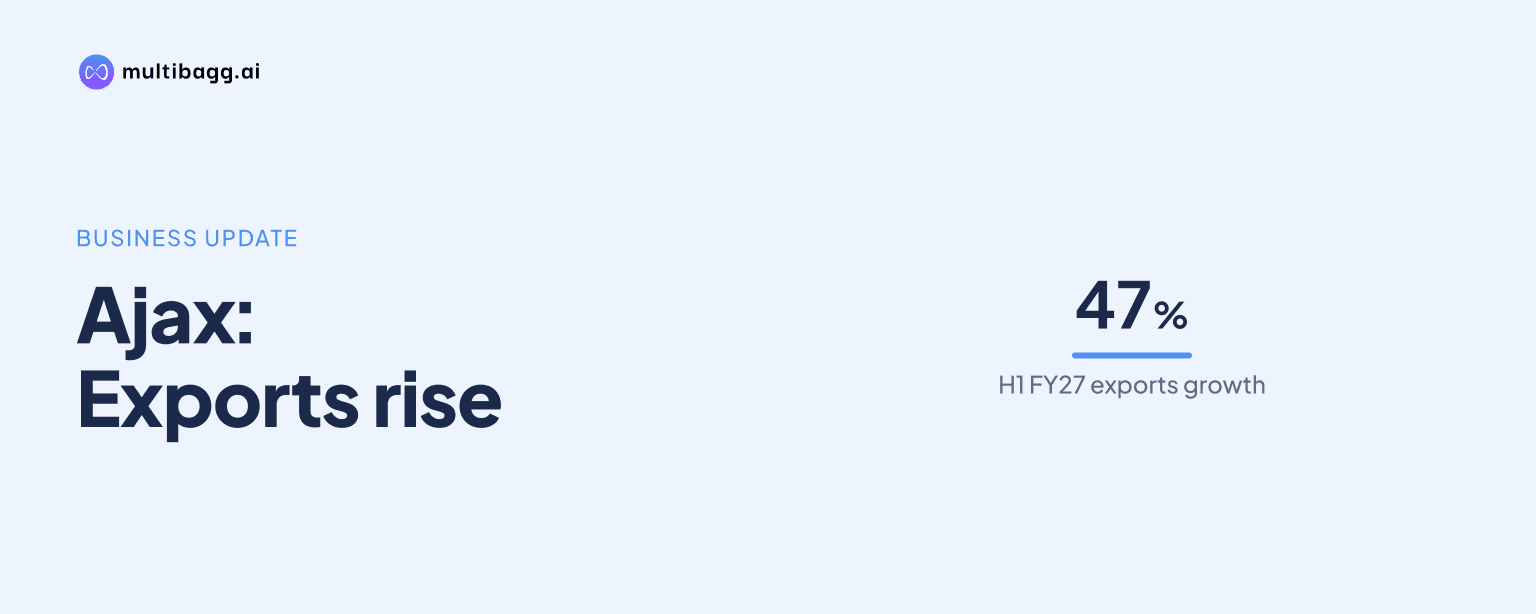
Ajax Engineering Limited said export revenue increased 47% year on year in H1 FY27, faster than its 5.5% rise in total revenue to Rs 961.5 crore, as management cited encouraging customer interest in Africa and Southeast Asia. Exports remained a small share of revenue, with no rupee value or country-level sales disclosed.
Know Ajax Engineering inside out
Results, valuation, peers and who's buying, in one view.
How fast did Ajax exports grow in H1 FY27?
Ajax's export revenue grew 47% year on year in H1 FY27, making it the fastest disclosed percentage growth figure among the company's reported revenue areas. Management identified Africa and Southeast Asia as regions where customer interest and traction were increasing during the six months ended September 30.
The company did not disclose the absolute export-revenue figure, its share of the Rs 961.5 crore H1 FY27 revenue base, shipment volumes or export order book. That means the 47% increase shows a faster growth rate from a small base, rather than establishing exports as a material contributor to revenue in the period.
What does export growth mean for Ajax's revenue mix?
Exports give Ajax an additional growth avenue, but management said they still represented a small proportion of overall revenue in H1 FY27. Total revenue increased 5.5% to Rs 961.5 crore, while export revenue increased 47%, showing that overseas business grew more rapidly than the company-wide sales base.
The contrast is relevant because domestic demand was uneven across Indian states in H1 FY27. Management reported volume growth in Gujarat, Chhattisgarh, Karnataka, Telangana, Andhra Pradesh and Uttar Pradesh, but said this was offset by industry softness in Maharashtra, Rajasthan, Madhya Pradesh and Bihar.
How did Ajax's product businesses perform alongside exports?
Ajax's self-loading concrete mixer, or SLCM, revenue rose 3.3% year on year to Rs 783.5 crore in H1 FY27, supported by 2.5% volume growth and the price increase implemented in Q4 FY26. The segment remained the largest disclosed revenue stream, representing most of the Rs 961.5 crore total revenue reported for the half year.
Non-SLCM revenue rose 31.5% to Rs 103.5 crore in H1 FY27, led largely by pumps, compared with the 3.3% growth in SLCM revenue. Spares and services generated Rs 74.6 crore and were largely stable year on year, leaving exports as the fastest-growing disclosed line in percentage terms but without a reported revenue amount.
Ajax also reported a 64.7% increase in non-SLCM revenue to Rs 55.8 crore in Q2 FY27, led by concrete pumps, batching plants and boom pumps. In the same quarter, SLCM revenue increased 5.9% to Rs 395.8 crore, while spares and services revenue fell 4.7% to Rs 35.4 crore.
Got a follow-up? Ask IRIS
What domestic conditions are affecting Ajax's growth plans?
Ajax said domestic project execution slowed in some infrastructure segments because government spending in certain states was below budgeted allocations and contractors faced delayed payments. These conditions reduced contractor cash flows and appetite for fresh equipment purchases, even as the company recorded H1 FY27 volume growth in several major states.
The company is responding by increasing its focus on private-sector projects, particularly building and urban infrastructure applications. Roads accounted for 70% of Ajax's application mix in FY25 and 67% in FY26, but fell to about 40% on a year-to-date basis in FY27; building and urban infrastructure increased from 13% in FY25 to about 39% in FY27 year to date.
Ajax's SLCM retail market share increased to 75.5% in H1 FY27 from 70.7% in H1 FY26, a gain of approximately 480 basis points. Management also said market share was 200 basis points above the FY26 average of 73.5%, despite Ajax machines carrying a price premium to competing products.
What could influence Ajax's exports and broader H2 FY27 performance?
Ajax's export progress will depend on converting management's reported interest in Africa and Southeast Asia into revenue, as the company has not disclosed country-level sales, distributors, investment plans or export targets. Its H1 FY27 disclosure therefore establishes current regional interest but not a timetable or financial commitment for overseas expansion.
Management expects customer sentiment and demand momentum to improve in the second half of FY27, which typically produces 60% to 65% of annual revenue. It also said the top 10 states account for close to 78% of total SLCM volumes, making improvement in major markets, including Maharashtra and Madhya Pradesh, relevant to the broader sales outcome.
Costs remain a variable for H2 FY27. Raw-material costs increased by close to the mid-single digits in H1 FY27 because of higher steel and other crude-linked commodity prices, while management cited steel, aluminium, foreign exchange and geopolitical developments as factors affecting the margin outlook.
Ajax took a price increase of around 2% in Q4 FY26 and a further increase of around 1% in September, with the September action expected to begin contributing from Q3 FY27. The company is also diversifying suppliers and engaging alternate vendors, while reporting cash and cash equivalents of Rs 1,151 crore and a 22-day working-capital cycle in H1 FY27.
Conclusion
Ajax's 47% export-revenue growth in H1 FY27 materially exceeded the 5.5% increase in total revenue and the 3.3% rise in its Rs 783.5 crore SLCM business. However, exports remained a small and undisclosed share of sales, so the result indicates an emerging diversification channel rather than a replacement for the much larger domestic equipment business.
The next disclosure to watch is Q3 FY27, when management expects the September price increase to start affecting results and when H2 demand should begin to determine the full-year outcome. Progress in Africa and Southeast Asia, recovery in states affected by contractor-payment delays, and the movement of steel, aluminium and foreign-exchange costs remain unresolved factors disclosed by management.