










Ajax lifts retail SLCM share 480 basis points in H1 FY27
Key highlights
- Ajax’s retail SLCM market share rose to 75.5% in H1 FY27 from 70.7% in H1 FY26.
- Ajax’s SLCM revenue increased 3.3% year on year to Rs 783.5 crore in H1 FY27.
- Non-SLCM revenue grew 31.5% to Rs 103.5 crore in H1 FY27, led largely by pumps.
- Ajax raised prices by around 1% in September after a roughly 2% increase in Q4 FY26.
powered by IRIS
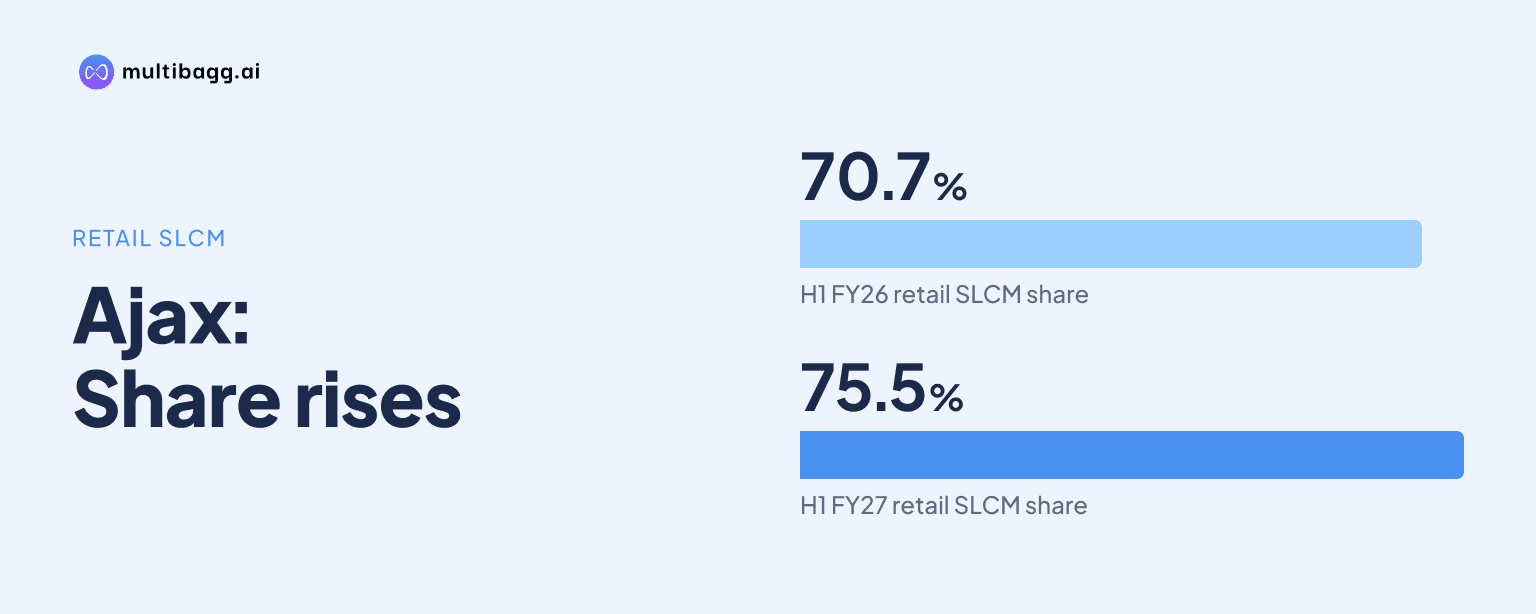
Ajax Engineering Limited increased its retail self-loading concrete mixer (SLCM) market share to 75.5% in the first half (H1) of financial year (FY) 2027, up 480 basis points from 70.7% in H1 FY26, while management said its machines commanded a price premium. Demand was softer in Maharashtra, Rajasthan, Madhya Pradesh and Bihar.
Know Ajax Engineering inside out
Results, valuation, peers and who's buying, in one view.
How did Ajax increase SLCM market share despite a price premium?
Ajax increased retail SLCM share to 75.5% in H1 FY27 from 70.7% a year earlier, a 480-basis-point increase, despite management saying its machines sell at a price premium to competing products. The H1 FY27 figure was also 200 basis points above Ajax’s average FY26 retail share of 73.5%. Management attributed the result to its brand and machine value proposition, rather than to industry growth alone.
The share improvement occurred in an uneven regional market. Ajax reported good volume growth in Gujarat, Chhattisgarh, Karnataka, Telangana, Andhra Pradesh and Uttar Pradesh, but said industry softness in Maharashtra, Rajasthan, Madhya Pradesh and Bihar offset that strength. The contrast is significant because Ajax gained share while several large state markets faced slower project execution and delayed contractor payments from state authorities.
SLCM revenue grew more slowly than market share. In H1 FY27, SLCM revenue was Rs 783.5 crore, up 3.3% year on year, supported by 2.5% volume growth and the benefit of a price increase implemented in Q4 FY26. In the second quarter (Q2) of FY27, SLCM revenue rose 5.9% to Rs 395.8 crore, driven largely by volumes, according to management.
What did Ajax’s H1 FY27 financial performance show?
Ajax reported Rs 961.5 crore of total revenue in H1 FY27, a 5.5% year-on-year increase, as volume growth and pricing outweighed softer infrastructure activity in some states. SLCMs remained the largest revenue stream at Rs 783.5 crore, while non-SLCM revenue reached Rs 103.5 crore and spares and services contributed Rs 74.6 crore.
The product mix changed materially during the half year. Non-SLCM revenue rose 31.5% from H1 FY26, led largely by pumps, compared with 3.3% growth in SLCM revenue. In Q2 FY27, non-SLCM revenue grew 64.7% to Rs 55.8 crore, with concrete pumps, batching plants and boom pumps identified as contributors. Spares and services revenue of Rs 35.4 crore in Q2 was down 4.7% year on year, while H1 revenue of Rs 74.6 crore was broadly stable.
Profit growth exceeded revenue growth, although the margin percentage declined modestly. Earnings before interest, tax, depreciation and amortisation (EBITDA) increased 3.7% to Rs 110.6 crore in H1 FY27, but EBITDA margin was 11.5%, compared with 11.7% in H1 FY26. Profit after tax rose about 16% to Rs 106.5 crore. For Q2, EBITDA rose 13.7% to Rs 51.5 crore and profit after tax increased 30.4% to Rs 50.9 crore.
Got a follow-up? Ask IRIS
Which demand changes shaped Ajax’s share gains?
Ajax shifted more of its application mix towards private-sector buildings and urban infrastructure as road activity slowed. Roads accounted for about 40% of Ajax’s FY27 year-to-date application mix, down from 67% in FY26 and 70% in FY25. Factories, buildings and urban infrastructure together rose to about 39% in FY27 year to date, from 15% in FY26 and 13% in FY25.
Management linked the change to slower state capital expenditure, payment delays to contractors and fewer new road projects. It said nine of the top 10 states increased Ajax’s market share, and six of those states had factories, buildings and urban infrastructure at or above the national 39% application share. Gujarat had about 50% of its activity in those uses, while Maharashtra was at about 50% to 55% and Madhya Pradesh was about 54%.
The geographic concentration makes demand conditions in a small number of large states important. Management said the top 10 states contribute close to 78% of total SLCM volume, with Madhya Pradesh and Maharashtra identified as two large markets that need to improve. Management expects customer sentiment and demand momentum to improve in H2, when Ajax typically generates 60% to 65% of annual revenue.
What is Ajax doing on products, pricing and distribution?
Ajax is expanding product coverage and distribution to support SLCM adoption and grow non-SLCM sales. The company said it had launched ARGO 4000 to fill a gap in its SLCM portfolio, while its UDAAN series was available in 20 states in H1 FY27 after six states were added during the half year. UDAAN volume increased to about 216 units from about 49 units in H1 of the prior year.
Pricing is one mechanism Ajax is using against rising input costs. Management said raw-material costs rose by close to mid-single digits in H1 FY27, owing to higher steel and crude-linked commodity costs. Ajax had raised prices by around 2% in Q4 FY26 and took a further increase of around 1% in September; management said the September increase would begin to affect results from Q3 FY27.
The company is also seeking cost offsets through supplier diversification, alternate vendors and a consolidated manufacturing structure under one leader. These actions helped limit the near-term effect of higher raw-material costs: gross margin improved marginally in Q2 FY27 by about 20 basis points year on year, while the H1 impact was largely offset by price increases. Management nevertheless said steel, aluminium, foreign exchange and geopolitical developments could affect margin progression.
For non-SLCM products, Ajax is using dealers to widen customer access. Management said 62 of its 68 dealers had sold at least one concrete pump, and about 12 to 15 dealers had begun selling across concrete pumps, boom pumps and batching plants. This dealer-led approach contributed to H1 non-SLCM revenue of Rs 103.5 crore, with pumps identified as the principal growth contributor.
Conclusion
Taken together, the H1 FY27 result paired a larger SLCM presence with 3.3% SLCM revenue growth and 31.5% growth in non-SLCM revenue. The move from roads, which fell to 40% of the application mix, towards buildings and urban infrastructure, which reached 39%, helped Ajax pursue demand beyond state road projects during a period of uneven regional activity.
The next indicators are the effect of the September price increase from Q3 FY27, the trajectory of steel and other input costs, and any recovery in Maharashtra and Madhya Pradesh. Management expects demand to strengthen in H2, which normally accounts for 60% to 65% of annual revenue, while UDAAN expansion across 20 states and dealer sales of pumps and batching plants remain parts of its disclosed growth plan.