










Ajax non-SLCM revenue rises 31.5% through dealer expansion
Key highlights
- Ajax’s non-SLCM revenue rose 31.5% year on year to Rs 103.5 crore in H1 FY27.
- Q2 FY27 non-SLCM revenue increased 64.7% to Rs 55.8 crore, led by pumps, batching plants and boom pumps.
- 62 of Ajax’s 68 dealers had sold at least one concrete pump.
- Ajax’s SLCM retail market share reached 75.5% in H1 FY27, up from 70.7% a year earlier.
powered by IRIS
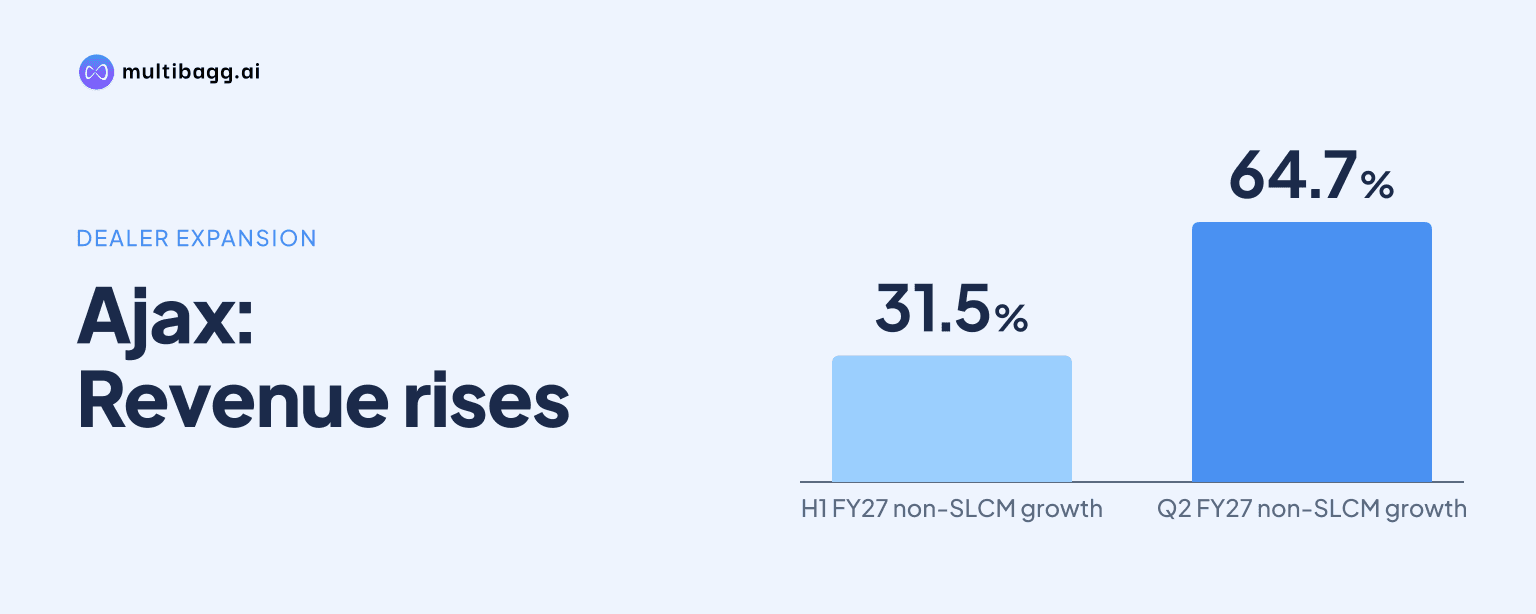
Ajax Engineering Limited’s non-SLCM revenue rose 31.5% year on year to Rs 103.5 crore in H1 FY27, outpacing 3.3% SLCM growth as its dealer network began selling concrete pumps, boom pumps and batching plants. In Q2 FY27, Ajax’s non-SLCM business grew 64.7% to Rs 55.8 crore.
Know Ajax Engineering inside out
Results, valuation, peers and who's buying, in one view.
How did Ajax’s non-SLCM revenue perform in H1 FY27?
Ajax’s non-SLCM revenue reached Rs 103.5 crore in H1 FY27, increasing 31.5% from H1 FY26 and growing materially faster than its core self-loading concrete mixer, or SLCM, revenue. Management said pumps were the principal contributor to first-half non-SLCM growth, while Q2 growth was led by concrete pumps, batching plants and boom pumps.
The contrast was visible in the quarterly numbers. Non-SLCM revenue rose 64.7% year on year to Rs 55.8 crore in Q2 FY27, whereas SLCM revenue increased 5.9% to Rs 395.8 crore. Total revenue for the quarter rose 9.5% to Rs 487 crore, making the newer equipment categories a material contributor to reported growth.
Spares and services revenue was Rs 74.6 crore in H1 FY27 and was largely stable from the prior-year period, unlike the increase in non-SLCM equipment. Management said machine running hours had fallen about 25% from the previous year, affecting demand for spare parts. The non-SLCM performance therefore came from new equipment sales rather than an acceleration in aftermarket activity.
What is driving Ajax’s non-SLCM growth?
Ajax said its dealer-led initiative, begun last year, is driving sales of products beyond SLCMs, starting with concrete pumps. Management described concrete pumps as easier for dealers to sell because the product is standardised, has fewer stock-keeping units, or SKUs, and involves lower complexity than some other equipment categories.
The rollout has reached most of Ajax’s network: 62 of 68 dealers had sold at least one concrete pump by the call date. Management also said about 12 to 15 dealers had started selling across concrete pumps, boom pumps and batching plants. This extends non-SLCM distribution beyond a limited group of outlets.
Concrete pumps and boom pumps have similar applications, though management said boom pumps are more complex. For batching plants, dealers are seeing initial traction in 20-cubic-metre and 30-cubic-metre models, which management considers easier to sell. Ajax is working to standardise configurations, commercial scope, service arrangements and parts support so batching plants can become a more established dealer portfolio product.
Which end-markets are supporting Ajax’s dealer expansion?
Ajax said private-sector construction is creating an outlet for dealer-led non-SLCM sales while SLCM demand in some markets has been affected by state capital-expenditure delays. The company is increasingly targeting factories, buildings and urban infrastructure, where its equipment can serve projects outside road-building activity.
The shift is clear in Ajax’s application mix. Roads accounted for 70% of Ajax’s business in FY25 and 67% in FY26, but stood at about 40% on a year-to-date basis in FY27. Factories, buildings and urban infrastructure together moved from 13% in FY25 to 15% in FY26 and about 39% in FY27 year to date, according to management.
Management gave several state-level examples of this changing application base. Factories, buildings and urban infrastructure accounted for about 50% of the mix in Gujarat, 50% to 55% in Maharashtra, 54% in Madhya Pradesh and 44% in Andhra Pradesh. In Karnataka, factories and buildings represented 9% while urban infrastructure represented 47%, showing the role of urban projects in the product opportunity.
Got a follow-up? Ask IRIS
How does Ajax’s non-SLCM expansion compare with SLCMs?
Ajax’s non-SLCM business remains smaller than SLCMs in absolute revenue, but it is expanding alongside a larger core franchise. SLCM revenue was Rs 783.5 crore in H1 FY27, versus Rs 103.5 crore for non-SLCM products. SLCM volume grew 2.5%, while revenue growth of 3.3% also reflected the price increase taken in Q4 FY26.
The core business retained a 75.5% retail SLCM market share in H1 FY27, up from 70.7% in H1 FY26 and from the FY26 average of 73.5%. Management said the 480-basis-point year-on-year increase was achieved despite a price premium to competing products. One basis point equals one-hundredth of a percentage point.
Price and cost conditions are relevant to both businesses. Ajax took an approximately 1% price increase in September after an approximately 2% increase in Q4 FY26, and management later disclosed another 1% increase in November with a further 2% decision planned for Q4. It said steel had moved from Rs 58 per kilogram to about Rs 68 per kilogram, with market expectations at the time pointing to Rs 75 to Rs 76 per kilogram.
What is Ajax planning next in non-SLCM equipment?
Ajax expects dealer-led growth in pumps and batching plants to continue, but management did not provide a numerical non-SLCM revenue target. Its stated work is to make batching-plant selling and support more repeatable through standardised configurations, service and parts processes, while dealers build confidence and capability beyond concrete pumps.
Management also said it was working on a potential paver development but could not comment on timing. That leaves the paver contribution unresolved. The disclosed product plans sit alongside the ARGO 4000 SLCM launch and broader efforts to increase SLCM adoption through the UDAAN series, whose H1 volume rose to about 216 units from about 49 units a year earlier across 20 selling states.
Conclusion
Ajax’s H1 FY27 figures show that non-SLCM equipment is becoming a faster-growing revenue stream: Rs 103.5 crore of revenue grew 31.5%, compared with 3.3% growth in Rs 783.5 crore of SLCM revenue. Concrete pumps supplied much of that increase, while sales of boom pumps and 20-cubic-metre and 30-cubic-metre batching plants are extending the dealer network’s role.
The next point to watch is whether more than the 12 to 15 multi-product dealers can convert initial sales into repeatable sales and service capability. Management’s planned standardisation of batching-plant configuration and support, its unspecified work on a paver, and commodity-price movements after steel reached about Rs 68 per kilogram will shape the pace of the expansion.