










Ajax roads mix falls to 40% as private applications rise
Key highlights
- Ajax’s roads application mix fell to 40% in FY27 year to date from 70% in FY25.
- Factories, buildings and urban infrastructure rose to 39% of Ajax’s FY27 year-to-date mix from 13% in FY25.
- Ajax’s non-SLCM revenue increased 31.5% year on year to Rs 103.5 crore in H1 FY27.
- Ajax’s H1 FY27 SLCM retail market share reached 75.5%, up from 70.7% a year earlier.
powered by IRIS
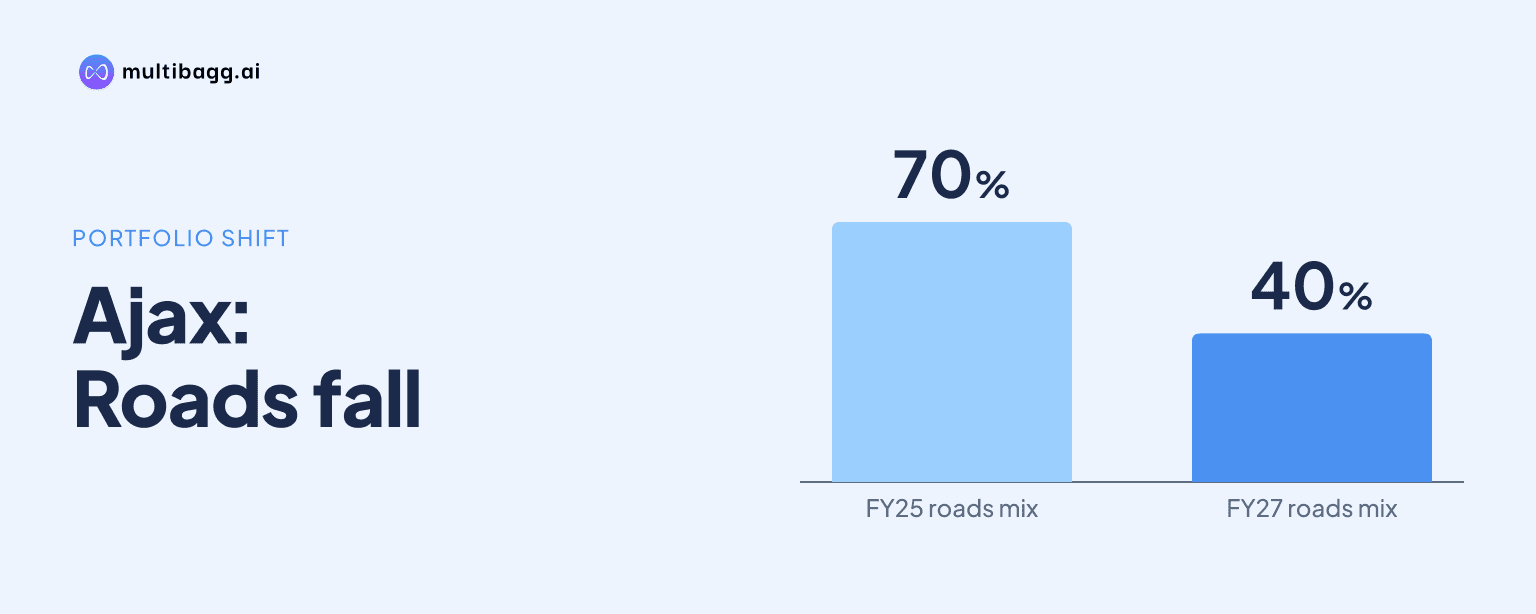
Ajax shifted its application mix in financial year 2027 (FY27) year to date, with roads falling to about 40% from 70% in FY25 and factories, buildings and urban infrastructure rising to about 39% from 13%. Management attributed the change to slower road activity and increased private-sector construction demand.
Know Ajax Engineering inside out
Results, valuation, peers and who's buying, in one view.
Why has Ajax’s application mix changed in FY27?
Ajax’s mix changed as road-project activity slowed while factories, buildings and urban infrastructure gained weight in its applications. Management said weaker state capital expenditure, delayed payments to contractors, fewer new projects and contractors’ reluctance to take fresh orders had reduced road activity. Roads had represented 70% of Ajax’s application mix in FY25 and 67% in FY26.
The three-year comparison shows a 30-percentage-point fall in roads’ share between FY25 and FY27 year to date, while factories, buildings and urban infrastructure rose by 26 percentage points. These are application-mix figures rather than a stated revenue split, but they show that private construction and urban infrastructure have approached the road segment’s contribution.
Management described the movement as a response to demand conditions, not a withdrawal from road projects. Ajax expects 60% to 65% of annual revenue to arise in the second half of FY27, meaning the full-year mix will also depend on whether road activity improves in major states.
Which states have the highest private and urban mix for Ajax?
Ajax said six of its top 10 states had factories, buildings and urban-infrastructure application shares equal to or above the 39% national FY27 year-to-date level. Management also said Ajax increased market share in nine of the top 10 states and gained share in the six states where these applications exceeded the national mix.
Gujarat had about 50% of Ajax applications in factories, buildings and urban infrastructure. Maharashtra was in a 50% to 55% range, partly supported by Pune, Nashik and Ahmednagar, while Madhya Pradesh had 19% in factories and buildings and 35% in urban infrastructure, taking its combined share to about 54%.
Karnataka had 9% in factories and buildings and 47% in urban infrastructure, with management linking the latter to layouting activity. Telangana recorded 47% in factories and buildings and 18% in urban infrastructure, while Andhra Pradesh had 17% and 27%, respectively, for a combined 44%.
The state mix remained uneven. Uttar Pradesh was at 23% for the combined applications, Rajasthan about 29%, Chhattisgarh 24% and Odisha about 2%. Management nevertheless identified Gujarat, Karnataka, Uttar Pradesh, Andhra Pradesh, Telangana and Rajasthan as markets holding up better than Maharashtra and Madhya Pradesh, where contractor-payment delays persisted.
How is Ajax expanding beyond road-project demand?
Ajax is using its dealer network to expand sales of non-self-loading concrete mixer equipment, or non-SLCM products, into private construction applications. Management said it began a dealer-led non-SLCM initiative in the prior year, initially centred on concrete pumps because these have fewer stock-keeping units and are simpler for dealers to sell.
By the first half of FY27 (H1 FY27), 62 of Ajax’s 68 dealers had sold at least one concrete pump. Management said about 12 to 15 dealers had started selling across concrete pumps, boom pumps and batching plants, and dealers were gaining traction in 20-cubic-metre and 30-cubic-metre batching plants.
Non-SLCM revenue rose faster than sales of self-loading concrete mixers, or SLCMs. Non-SLCM revenue increased 64.7% year on year to Rs 55.8 crore in the second quarter of FY27 (Q2 FY27), led by concrete pumps, batching plants and boom pumps. In H1 FY27, it rose 31.5% to Rs 103.5 crore, against 3.3% growth in SLCM revenue to Rs 783.5 crore.
Management said it was simplifying configuration, standardisation, commercial scope, service and parts support to make batching plants a larger dealer-led portfolio. It was also working on a paver initiative, although it did not disclose a launch date. The dealer model gives Ajax a route to sell products serving high-rise and other private construction projects.
Got a follow-up? Ask IRIS
What do Ajax’s FY27 results show about demand changes?
Ajax reported total H1 FY27 revenue of Rs 961.5 crore, up 5.5% year on year, with both volumes and pricing contributing. SLCM revenue remained its largest product line at Rs 783.5 crore, but non-SLCM’s 31.5% growth exceeded the 3.3% increase in SLCM revenue, reflecting stronger momentum in pumps and related equipment.
In Q2 FY27, total revenue was Rs 487 crore, up 9.5% year on year. SLCM revenue rose 5.9% to Rs 395.8 crore, while spares and services revenue fell 4.7% to Rs 35.4 crore. Management linked the spares and services decline partly to machine running hours falling about 25% from the previous year.
Ajax’s H1 FY27 SLCM retail market share reached 75.5%, compared with 70.7% in H1 FY26 and the FY26 average of 73.5%. Management said the 480-basis-point year-on-year increase occurred despite Ajax products carrying a price premium over competing offerings.
Profit growth was lower than the increase in non-SLCM revenue. Earnings before interest, tax, depreciation and amortisation (EBITDA) rose 3.7% to Rs 110.6 crore in H1 FY27, while the EBITDA margin declined to 11.5% from 11.7% in H1 FY26. Profit after tax increased about 16% to Rs 106.5 crore and the working-capital cycle was 22 days.
What could determine whether Ajax’s mix shift continues?
Ajax’s full-year mix will partly depend on road contracts and contractor payments in Maharashtra and Madhya Pradesh. Management said the top 10 states account for about 78% of total SLCM volume, and identified those two large markets as requiring improvement while several other states continued to hold up.
Management cited a possible road opportunity in Uttar Pradesh, where it understood the state government was preparing small contracts totalling up to Rs 2,000 crore for cement-concrete roads. It also said a proposed circular could place SLCMs and batching plants together in road construction instead of manual mixers. These were management expectations rather than confirmed Ajax orders.
Input costs are another variable. Management said steel had increased from Rs 58 per kilogram to about Rs 70 per kilogram, with Rs 68 per kilogram the latest level cited, and that market expectations indicated Rs 75 to Rs 76 per kilogram. Ajax took 1% price increases in September and November and management said it planned another 2% increase in the fourth quarter of FY27, subject to commodity movements.
Conclusion
Ajax’s FY27 year-to-date mix shows a material change in demand exposure: roads fell from 70% in FY25 to 40%, while factories, buildings and urban infrastructure increased from 13% to 39%. Faster non-SLCM revenue growth of 31.5% in H1 FY27, against 3.3% for SLCM revenue, is consistent with management’s account of wider private-construction and urban-infrastructure demand.
The next indicators are H2 FY27 demand in Maharashtra and Madhya Pradesh, progress on possible Uttar Pradesh road contracts worth up to Rs 2,000 crore, and the effect of price actions against steel-cost movements. Management expects 60% to 65% of annual revenue in H2 and said it would like Ajax to end FY27 with growth close to double digits, while cautioning that commodity prices and foreign exchange remain uncertain.