










Akanksha Power & Infrastructure PBDIT margin reaches 17%
Key highlights
- APIL reported PBDIT of Rs 7.72 crore, up 36.6%, and a 17% margin versus 13% a year earlier.
- APIL's sales increased 4.9% to Rs 45.93 crore in the current reported period.
- Depreciation rose 207.4% to Rs 1.66 crore and interest increased 32.8% to Rs 2.59 crore.
- APIL reported Rs 39.42 crore of unexecuted capacitor order booking as of 14 November 2026.
powered by IRIS
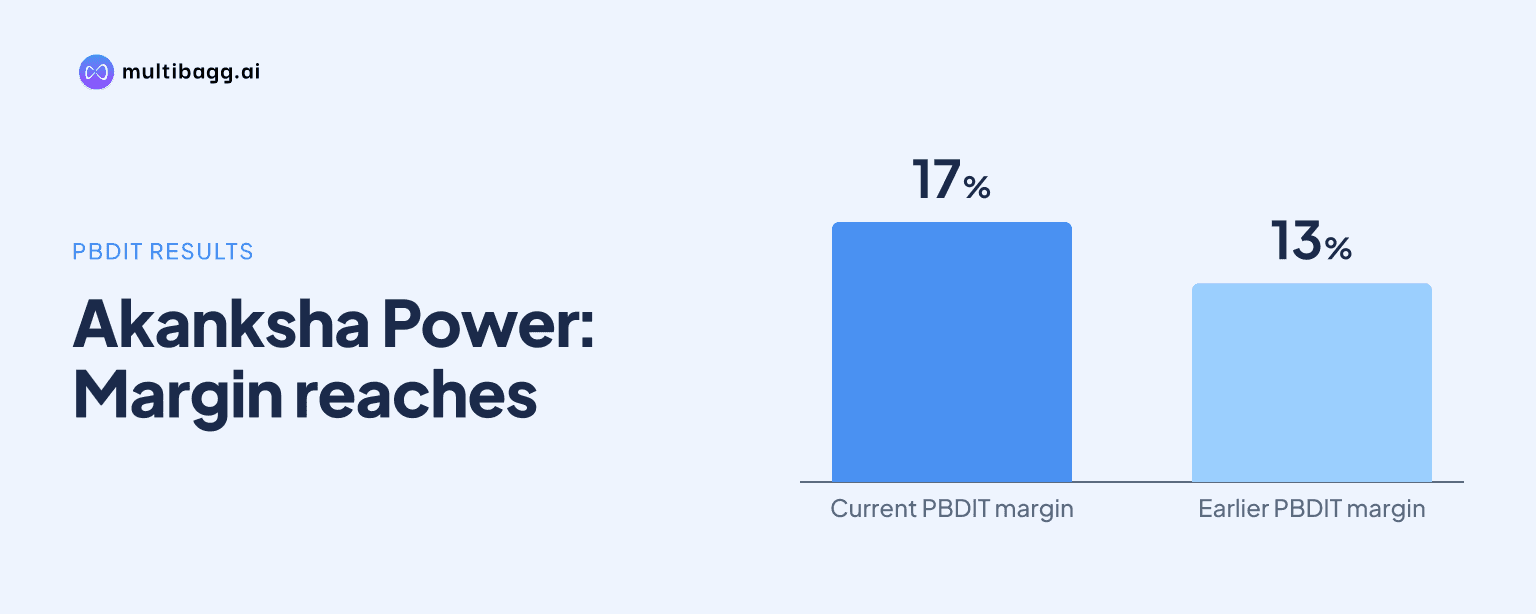
Akanksha Power & Infrastructure Limited reported a 17% profit before depreciation, interest and tax (PBDIT) margin in the current reported period, up from 13% a year earlier, as PBDIT rose 36.6% to Rs 7.72 crore despite sales growth of 4.9%; Rs 4.25 crore of depreciation and interest then limited profit after tax growth to 12.5%.
Know Akanksha Power & Infrastructure inside out
Results, valuation, peers and who's buying, in one view.
How did APIL reach a 17% operating margin?
APIL reached a 17% PBDIT margin by increasing PBDIT to Rs 7.72 crore from Rs 5.65 crore, a 36.6% year-on-year rise, while sales increased 4.9% to Rs 45.93 crore from Rs 43.79 crore. The margin therefore expanded by 390 basis points, or bps, from 13%, with operating profit rising materially faster than revenue.
Management attributed the improvement to operational performance and cost management. The presentation does not provide a line-by-line split for material, employee or other operating costs, so it does not identify the precise source of the Rs 2.07 crore increase in PBDIT against a Rs 2.14 crore increase in sales.
The reported period followed the commercialisation of APIL's capacitor plant in March 2026. Management said the commissioning process involved technology transfer, product testing, approvals, validation and manufacturing-process stabilisation, while the company also expanded into specialised capacitor products including pulse capacitors and customised capacitors.
Why did APIL's net profit grow slower than PBDIT?
APIL's profit after tax (PAT) rose 12.5% to Rs 2.70 crore because higher depreciation and interest absorbed much of the Rs 7.72 crore PBDIT. Depreciation increased 207.4% to Rs 1.66 crore from Rs 0.54 crore, while interest rose 32.8% to Rs 2.59 crore from Rs 1.95 crore.
Together, these two charges totalled Rs 4.25 crore, or 55% of PBDIT, leaving profit before tax (PBT) of Rs 3.47 crore, up 9.8% from Rs 3.16 crore. PAT margin improved by 40 bps to 6% from 5%, a narrower change than the 390-bps expansion in the PBDIT margin.
Management linked the higher interest expense to bank-fund utilisation for working capital and term debt used in the expansion. It linked the depreciation increase to recently commissioned capital expenditure entering the accounts, and reported interest cover, calculated as PBDIT divided by interest, at about 3.0 times against 2.9 times a year earlier.
How does APIL's reported period compare with FY26?
APIL's Rs 45.93 crore of sales represented about 50% of FY26 sales of Rs 91.61 crore, while Rs 7.72 crore of PBDIT represented about 60% of FY26 PBDIT of Rs 12.82 crore. The current 17% PBDIT margin was therefore above the 14% margin shown for FY26 ended March 2026.
The comparison also shows the effect of the newer asset base. Depreciation of Rs 1.66 crore in the current period was higher than the Rs 1.36 crore reported for the full FY26 reference year, whereas interest of Rs 2.59 crore remained below FY26 interest of Rs 3.63 crore. PBT margin was 8%, compared with 9% for FY26, while PAT margin was 6% in both periods.
The presentation calls the headline financial performance H1 FY26 versus H1 FY25 on pages 9 and 10, but labels the detailed table Q2 FY25 (Sep-25) and Q2 FY26 (Sep-26) on page 12. APIL does not reconcile those labels; the reported year-on-year changes, including 4.9% sales growth and 36.6% PBDIT growth, are consistent across the presentation.
Got a follow-up? Ask IRIS
What is affecting APIL's capacitor-business profitability?
APIL said the capacitor business is in its first year of commercial operations and that profitability has been affected by initial overheads, evolving capacity utilisation, product-testing and approval costs, and competitive pricing during market entry. Those factors help explain why the 17% PBDIT margin resulted in a 6% PAT margin in the reported period.
The company said it has stabilised manufacturing processes after the March 2026 commercialisation and has progressed customer evaluations, approvals and commercial engagements. These included GE Vernova-France, NEI-Oman, EPKOM-Turkey, Lauritz Knudsen and ELSPAC-Israel, but the presentation does not disclose revenue commitments from those engagements.
APIL is also developing specialised medium-voltage equipment, including vacuum circuit breakers and vacuum contactors. Management said key products are undergoing accelerated stress testing and that the next steps are end-customer validation, customer acceptance and eventual commercialisation rather than disclosed near-term sales.
What will determine APIL's earnings conversion next?
APIL's earnings conversion will depend on utilisation of expanded capacity, production and delivery efficiency, and working-capital management, which management identified as priorities for the second half of FY2026-27. Management has specifically said capacity utilisation will determine how quickly PAT converges towards PBDIT.
The capacitor business had Rs 39.42 crore of unexecuted order booking as of 14 November 2026. Management's customer-acquisition plan focuses on smaller, repeat and relationship-driven orders from large industries and public sector undertakings, targeting steel, cement, renewable energy, oil and gas, and other power-intensive sectors.
APIL has also initiated bidding opportunities with solar engineering, procurement and construction companies for power-quality solutions, supported by government initiatives promoting harmonic filters in renewable energy. Separately, it secured a pilot order from SAIL's Rourkela Steel Plant for its integrated advanced metering infrastructure and Utility Distribution Revenue Analytics and Management solution.
Conclusion
APIL's reported figures show that operating profitability improved faster than sales: PBDIT rose Rs 2.07 crore and margin increased to 17%, while sales increased Rs 2.14 crore. The benefit was partly offset below the operating line, where Rs 4.25 crore of depreciation and interest restricted the increase in PAT to Rs 0.30 crore.
The next disclosed marker is execution of the Rs 39.42 crore capacitor order booking reported on 14 November 2026. Management's stated second-half FY2026-27 plan is to raise capacity utilisation, improve production and delivery efficiency, broaden repeat orders and maintain working-capital discipline as the March 2026 capacity addition matures.