










APIL builds ₹39.42 crore capacitor orders after March 2026
Key highlights
- APIL had ₹39.42 crore of unexecuted capacitor order bookings as of 14 November 2026.
- APIL commercialised its capacitor plant in March 2026 after technology transfer, testing, approvals and process stabilisation.
- APIL’s H1 FY2027 sales were ₹45.93 crore, up 4.9% year on year, while PBDIT rose 36.6% to ₹7.72 crore.
- APIL’s depreciation increased from ₹0.54 crore in H1 FY2026 to ₹1.66 crore in H1 FY2027.
powered by IRIS
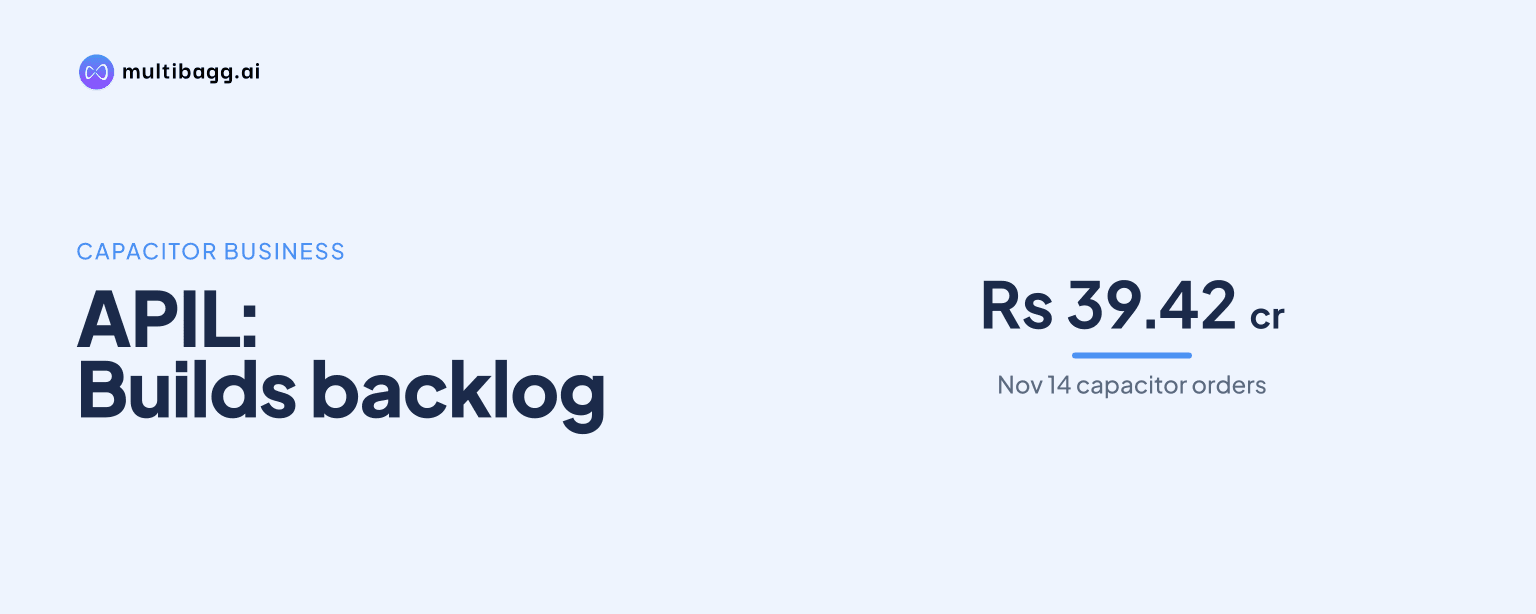
Akanksha Power & Infrastructure Limited reported ₹39.42 crore of unexecuted capacitor orders on 14 November 2026, following commercialisation of its capacitor plant in March 2026. The disclosed order book was built during the first six months of commercial operations, after technology transfer, product testing, approvals, validation and manufacturing-process stabilisation.
Know Akanksha Power & Infrastructure inside out
Results, valuation, peers and who's buying, in one view.
How quickly did APIL build its capacitor order book?
APIL had ₹39.42 crore of unexecuted order bookings in its capacitor business as of 14 November 2026. Management said the bookings reflected progress in the initial commercial phase after the March 2026 plant commercialisation, and presented them as evidence of customer acceptance and market penetration for its power-quality solutions portfolio.
The March 2026 commissioning followed technology transfer, product testing, approvals, validation and manufacturing-process stabilisation. APIL said TDK continued to provide technical handholding for technology integration and process stabilisation while the company worked on product qualification, customer registrations, regulatory approvals and market development in domestic and international markets.
The new operation followed APIL’s acquisition of the APP capacitor manufacturing facility and technology from TDK India. The acquisition broadened the product range beyond conventional low-voltage (LV) and medium-voltage (MV) APP capacitors to specialised, application-specific products, including pulse capacitors and customised capacitors for niche industrial and advanced-technology applications.
Which customers and markets is APIL pursuing for capacitors?
APIL said it progressed product evaluations, approvals and commercial engagements in H1 FY2027 with GE Vernova-France, NEI-Oman, EPKOM-Turkey, Lauritz Knudsen and ELSPAC-Israel. The presentation does not assign an order value, delivery schedule or revenue contribution to any of these named organisations.
Several domestic and international players, including Lauritz Knudsen, other large Indian corporations and global companies, approached APIL to explore long-term associations for its MV capacitor range. Management said its manufacturing processes and product portfolio had stabilised during the first six months of commercial operations, supporting the next stage of customer engagement.
APIL’s segment-wise capacitor strategy targets Steel, Cement, Renewable Energy, Oil & Gas and other power-intensive sectors. The company also plans to extend its geographic reach across India, combining sector coverage with a wider customer base rather than focusing disproportionately on a limited number of large projects or tenders.
How does APIL plan to generate repeat capacitor orders?
APIL’s stated customer-acquisition strategy is to seek smaller, repeat and relationship-driven orders from large industries and public sector undertakings (PSUs). Management contrasts this approach with reliance on a few large individual orders or tenders, while applying the strategy across Steel, Cement, Renewable Energy, Oil & Gas and other power-intensive customer segments.
Management’s priority is to build a diversified and geographically distributed customer portfolio that reduces dependence on a limited number of customers or projects. It expects long-term relationships to create repeat orders and more predictable revenue opportunities, while supporting capacity utilisation, scalability and growth in the capacitor business.
For the second half of FY2027, APIL said its priorities include accelerating commercial utilisation of expanded manufacturing infrastructure, strengthening customer engagement, improving production and delivery efficiencies, expanding the order book and maintaining disciplined working-capital management. Management did not provide a specified capacitor revenue target, production target or timetable for converting the ₹39.42 crore order book into reported sales.
Got a follow-up? Ask IRIS
What do APIL’s H1 FY2027 financials show about the new asset base?
APIL reported sales of ₹45.93 crore in H1 FY2027, up 4.9% year on year, while profit before depreciation, interest and tax (PBDIT) rose 36.6% to ₹7.72 crore. PBDIT margin increased to 17% from 13% in H1 FY2026, an expansion of about 390 basis points, while full-year FY2026 sales were ₹91.61 crore.
Profit after tax (PAT) was ₹2.64 crore in H1 FY2027, up 12.5% year on year, with a 6% margin. APIL said profit before tax grew 9.8%, but depreciation and interest rose following recently commissioned capital expenditure, limiting the rate at which the higher PBDIT translated into net profit.
Depreciation increased from ₹0.54 crore in H1 FY2026 to ₹1.66 crore in H1 FY2027, while interest rose from ₹1.95 crore to ₹2.59 crore. APIL reported interest cover, calculated as PBDIT divided by interest, of about 3.0 times in H1 FY2027 compared with 2.9 times a year earlier.
Management attributed early capacitor-business profitability effects to initial overheads, evolving capacity utilisation, product testing and approval costs, and competitive pricing during market entry. These factors were cited in the presentation alongside the March 2026 commissioning and the first six months of commercial operation.
What other projects support APIL’s wider solutions plan?
APIL is expanding in distribution-company management and digital distribution infrastructure through integrated advanced metering infrastructure (AMI) and Utility Distribution Revenue Analytics and Management (UDReAM) solutions. Alongside its ongoing engagement with MITL, APIL secured a pilot order from SAIL’s Rourkela Steel Plant to extend its AMI capabilities into a large industrial township environment.
Over time, APIL aims to offer smart electricity meters, head-end systems, UDReAM and power-quality monitoring systems to distribution companies and large industrial utilities. Management said the MITL engagement and SAIL pilot could provide execution experience and a platform for wider deployment in utility distribution-management opportunities.
APIL is also developing specialised MV switching equipment, including vacuum circuit breakers and vacuum contactors. Key products are undergoing accelerated stress testing to assess performance, reliability and operational capability before end-customer validation and eventual commercialisation.
Conclusion
APIL’s ₹39.42 crore unexecuted capacitor order book at 14 November 2026 shows that the March 2026 plant commissioning was followed by commercial bookings during its first six months of operation. The company is combining specialised capacitor products, MV applications and a broader customer strategy while H1 FY2027 PBDIT rose 36.6% to ₹7.72 crore on sales growth of 4.9%.
The next disclosures to watch are execution against management’s H2 FY2027 priorities: commercial utilisation of the expanded infrastructure, production and delivery efficiency, order-book expansion and working-capital discipline. APIL has not disclosed a capacitor revenue target, capacity figure or delivery timetable for the ₹39.42 crore of orders, leaving order conversion and utilisation as unresolved measures of the ramp-up.