










APIL capacitor business holds ₹39.42 crore unexecuted orders
Key highlights
- APIL commercialised its capacitor plant in March 2026 after acquiring a facility and technology from TDK India.
- APIL reported ₹39.42 crore of unexecuted capacitor order bookings as of 14 November 2026.
- APIL named five organisations in H1 2026-27 product evaluations, approvals or commercial engagements, including GE Vernova-France and Lauritz Knudsen.
- APIL is targeting steel, cement, renewable energy, oil and gas, and other power-intensive industries for capacitor business.
powered by IRIS
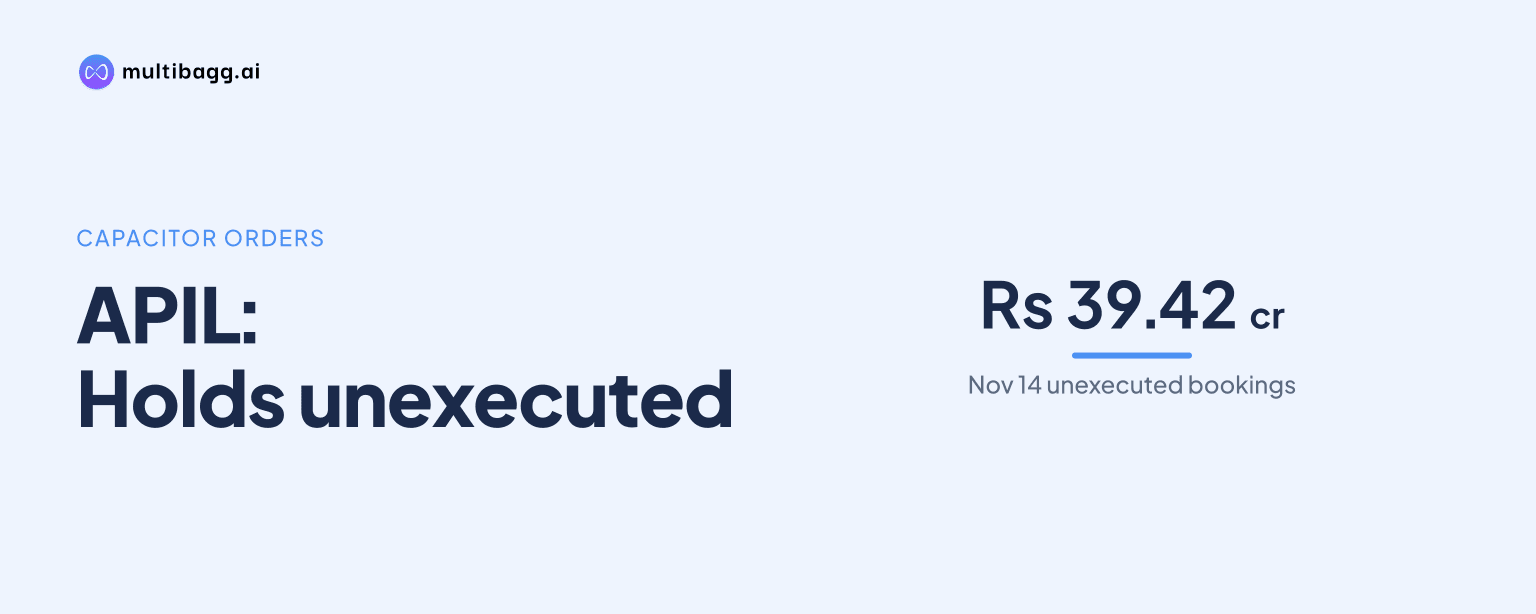
Akanksha Power & Infrastructure Limited (APIL) said its capacitor business held ₹39.42 crore of unexecuted order bookings on 14 November 2026, after its manufacturing plant was commercialised in March 2026. Management presented the backlog as evidence of market acceptance during the business’s initial commercial phase, following technology transfer, product qualification and process stabilisation.
Know Akanksha Power & Infrastructure inside out
Results, valuation, peers and who's buying, in one view.
When did APIL commercialise its capacitor plant?
APIL commercialised its capacitor plant in March 2026 after technology transfer, product testing, approvals, validation and manufacturing-process stabilisation. The operation followed APIL’s acquisition of an APP capacitor manufacturing facility and technology from TDK India, while TDK continued to provide technical handholding for technology integration and process stabilisation.
The March 2026 start followed what management described as an intensive and technically demanding process. APIL said its work included product qualification, customer registrations, regulatory approvals and market development across domestic and international markets. These steps preceded the initial commercial phase in which the company reported the ₹39.42 crore order booking.
APIL said the new operation expands its portfolio beyond conventional low-voltage and medium-voltage APP capacitors. Its stated specialised offerings include pulse capacitors and customised capacitors for niche industrial and advanced-technology applications, broadening the range available to prospective customers.
How large is APIL’s capacitor order book?
APIL reported ₹39.42 crore of unexecuted order bookings in its capacitor business as of 14 November 2026. Management said the orders were booked within the initial phase of commercial operations that began in March 2026 and linked the figure to growing traction for its Power Quality Solutions portfolio.
The presentation does not state when the orders will be delivered, billed or recognised as revenue. It also does not provide customer-wise values, margins or a split between domestic and overseas business. The ₹39.42 crore figure is therefore a dated disclosure of work yet to be executed rather than reported sales.
The order-book disclosure followed management’s statement that APIL had stabilised its manufacturing processes and product portfolio during the first six months of commercial operations. APIL said several domestic and international companies had approached it to explore long-term associations for its medium-voltage capacitor range.
Which customers are evaluating APIL capacitor products?
APIL said it progressed product evaluations, approvals and commercial engagements in H1 2026-27 with GE Vernova-France, NEI-Oman, EPKOM-Turkey, Lauritz Knudsen and ELSPAC-Israel. The presentation does not identify the products being assessed by each organisation or assign order values, approval status or contract terms to any of them.
For medium-voltage capacitors, APIL said Lauritz Knudsen, other large Indian corporations and global companies had approached it to explore long-term business associations. Management described these contacts as reflecting customer confidence in the manufacturing capability established after the March 2026 commercialisation, not as confirmation that every discussion had become an order.
APIL is pursuing the capacitor market across steel, cement, renewable energy, oil and gas, and other power-intensive sectors. This segment-wise approach is intended to widen the customer base across industrial users rather than concentrate the business in a single end market.
Got a follow-up? Ask IRIS
How does APIL plan to generate repeat capacitor orders?
APIL plans to pursue smaller, repeat and relationship-driven orders from large industries and Public Sector Undertakings rather than depend disproportionately on a few large orders or tenders. The company said this approach will be applied across the steel, cement, renewable-energy, oil-and-gas and other power-intensive segments while extending its reach across India.
Management’s stated priority is to build a diversified and geographically distributed customer portfolio. It expects long-term relationships and repeat orders to support capacity utilisation, scalability and more predictable revenue opportunities, although the presentation gives no target for customer numbers, capacity utilisation or repeat-order timing.
APIL said its second-half FY2026-27 priorities include accelerating commercial use of expanded manufacturing infrastructure, improving production and delivery efficiencies, expanding the order book and maintaining disciplined working-capital management. Management also said investments in the business must translate into higher capacity utilisation, sustainable revenue growth, operating margins and returns on capital.
What other power-quality opportunities is APIL pursuing?
APIL began participating in bidding opportunities with solar engineering, procurement and construction companies during H1 2026-27 for harmonic-filter-related Power Quality Solutions opportunities. Management linked the opportunity to government initiatives promoting harmonic-filter installation in the renewable-energy segment and to APIL’s in-house design and engineering capabilities.
APIL is also developing specialised medium-voltage switching equipment, including vacuum circuit breakers and vacuum contactors. The company said key products were undergoing accelerated stress testing to evaluate performance, reliability and operation under demanding conditions, with validation by end customers still representing the next stage before commercialisation.
Separately, APIL has expanded its digital-distribution work through integrated advanced metering infrastructure and Utility Distribution Revenue Analytics and Management solutions. It said it recently secured a pilot order from SAIL’s Rourkela Steel Plant, alongside its ongoing engagement with MITL, but this activity is distinct from the March 2026 capacitor plant commercialisation.
Conclusion
APIL’s ₹39.42 crore unexecuted capacitor order book as of 14 November 2026 is the presentation’s clearest disclosed indicator of commercial traction following the plant’s March 2026 launch. Product evaluations and commercial engagements with named domestic and international organisations, alongside the expanded range of specialised capacitors, show how APIL is seeking to establish the new manufacturing business.
The next measure to watch is execution during the second half of FY2026-27. Management has identified order-book expansion, production and delivery efficiency, commercial use of expanded infrastructure and working-capital discipline as immediate priorities, while the presentation does not provide a delivery schedule for the ₹39.42 crore backlog or a capacity-utilisation target.