










Akanksha Power & Infrastructure Limited margin rises to 17% in first half
Key highlights
- APIL reported Rs 45.93 crore of sales and Rs 7.72 crore of PBDIT in the reported period.
- APIL's PBDIT margin rose to 17% from 13%, an increase of about 390 basis points.
- Depreciation rose 207.4% to Rs 1.66 crore and interest rose 32.8% to Rs 2.59 crore.
- APIL reported Rs 39.42 crore of unexecuted capacitor orders as of 14 November 2026.
powered by IRIS
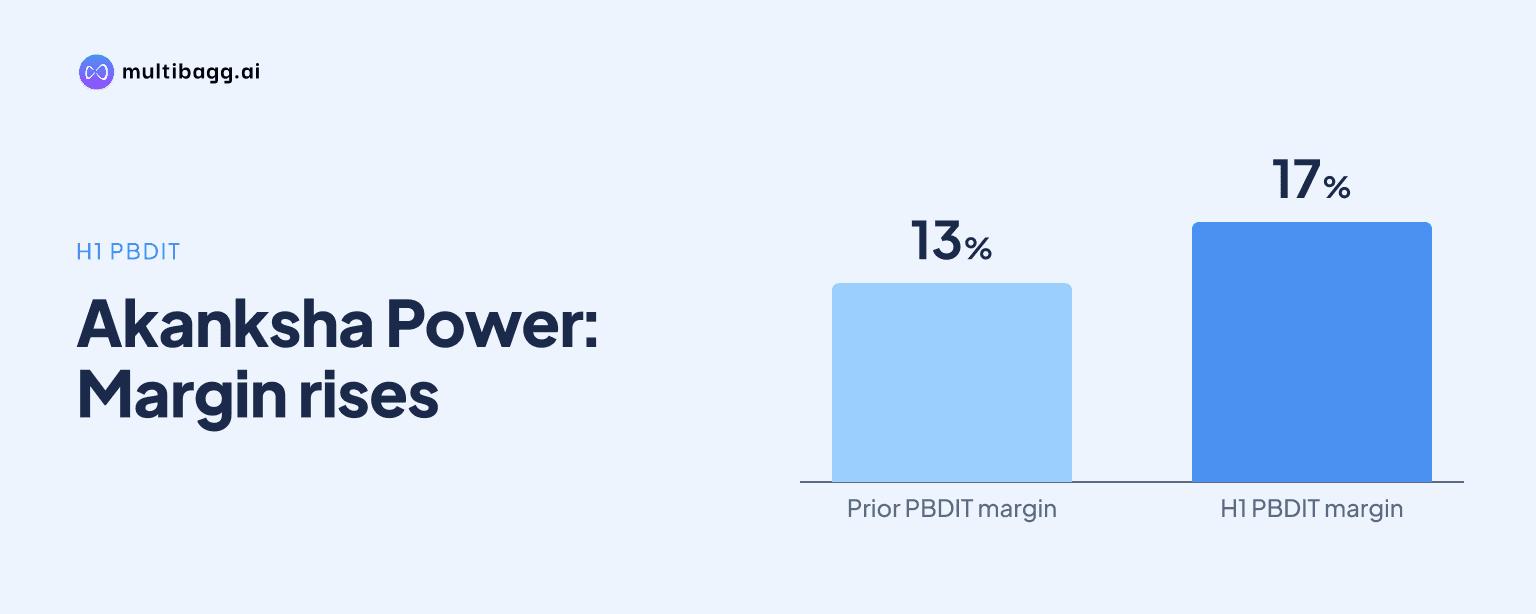
Akanksha Power & Infrastructure Limited reported a 17% profit before depreciation, interest and tax (PBDIT) margin in the first half of FY2026–27, up from 13%, as PBDIT rose 36.6% to Rs 7.72 crore on sales of Rs 45.93 crore. Depreciation then increased 207.4% to Rs 1.66 crore as recently commissioned capital expenditure entered the accounts.
Know Akanksha Power & Infrastructure inside out
Results, valuation, peers and who's buying, in one view.
How did APIL raise its operating margin to 17%?
APIL raised its operating margin to 17% because its Rs 7.72 crore PBDIT grew faster than its Rs 45.93 crore of sales in the reported period. Sales increased 4.9% year on year, while PBDIT increased 36.6%, expanding the margin by about 390 basis points, or bps, from 13% to 17%. One basis point equals one-hundredth of a percentage point.
Management attributes the improvement to operational performance and cost management despite expansion-related depreciation and interest. The financial-performance page describes the figures as H1 FY27, while the detailed summary table labels them Q2 FY25, September 2025, and Q2 FY26, September 2026. APIL does not reconcile that period-label difference in the presentation, although the sales, PBDIT and PAT figures are consistent across its financial pages.
The reported Rs 45.93 crore of sales equalled about half of FY26 sales of Rs 91.61 crore, while Rs 7.72 crore of PBDIT equalled about 60% of FY26 PBDIT of Rs 12.82 crore. The comparison shows operating profit progressed further toward the prior full-year total than revenue did, lifting the reported margin above FY26's 14% PBDIT margin.
Why did capex costs limit APIL's PAT growth?
Capex-related depreciation and higher interest limited APIL's PAT growth to 12.5% despite the 36.6% increase in PBDIT. Depreciation rose from Rs 0.54 crore to Rs 1.66 crore, or 207.4%, and interest increased from Rs 1.95 crore to Rs 2.59 crore, or 32.8%. The presentation links these costs to recently commissioned capacity, working-capital funding and term debt for expansion.
Depreciation and interest together were Rs 4.25 crore, equal to 55% of reported PBDIT of Rs 7.72 crore. Profit before tax, or PBT, consequently rose 9.8% to Rs 3.47 crore from Rs 3.16 crore, a slower increase than the operating-profit movement. PAT reached Rs 2.64 crore and its margin moved to 6% from 5%.
APIL says first-year capacitor operations carried initial overheads, evolving capacity utilisation, product-testing and approval costs, and competitive pricing pressures during market entry. These disclosed factors help explain the gap between the 17% PBDIT margin and the 6% PAT margin. The presentation reports interest cover, calculated as PBDIT divided by interest, at about 3.0 times, compared with 2.9 times a year earlier.
Got a follow-up? Ask IRIS
How does the reported performance compare with FY26?
APIL's reported 17% PBDIT margin was 3 percentage points above its 14% margin for FY26 ended March 2026. Its reported Rs 7.72 crore of PBDIT was 60% of FY26's Rs 12.82 crore, while Rs 2.64 crore of PAT was 45% of FY26's Rs 5.85 crore. This difference reflects the higher depreciation and interest charges in the reported period.
Reported depreciation of Rs 1.66 crore exceeded the Rs 1.36 crore charged for all of FY26, whereas reported interest of Rs 2.59 crore remained below FY26 interest of Rs 3.63 crore. APIL commercialised its plant in March 2026 after technology transfer, product testing, approvals, validation and manufacturing-process stabilisation. The timing provides the stated basis for the changed depreciation profile.
The plant followed APIL's acquisition of the APP capacitor manufacturing facility and technology from TDK India. Management says the product range now extends beyond low-voltage and medium-voltage APP capacitors to pulse capacitors and customised capacitors for specialised applications. During the first six months of commercial operations, product qualification, customer registration and market development were still in progress.
What must APIL execute to convert new capacity into profit?
APIL must improve production and commercial utilisation of its expanded manufacturing infrastructure to spread its higher fixed charges over more revenue. Management's second-half FY2026–27 priorities are customer engagement, production and delivery efficiency, order-book expansion and disciplined working-capital management. The presentation states that utilisation will determine how quickly PAT converges toward PBDIT.
The immediate order indicator is Rs 39.42 crore of unexecuted capacitor orders as of 14 November 2026. Management is seeking smaller, repeat and relationship-driven orders across steel, cement, renewable energy, oil and gas, and other power-intensive sectors. It says this approach is intended to reduce dependence on a limited number of large customers or tenders and support capacity utilisation.
APIL has also begun bidding with solar engineering, procurement and construction companies for power-quality solutions, citing government initiatives supporting harmonic-filter installations in renewable energy. Separately, it secured a pilot order from SAIL's Rourkela Steel Plant for its Utility Distribution Revenue Analytics and Management solution. Its medium-voltage vacuum circuit breakers and vacuum contactors remain in accelerated stress testing, while capacitor products require further customer approvals and registrations.
Conclusion
APIL's reported financials show that operating profitability improved faster than sales: PBDIT rose 36.6% to Rs 7.72 crore and the margin reached 17%, versus 13% in the comparable prior-year period. However, depreciation of Rs 1.66 crore and interest of Rs 2.59 crore absorbed Rs 4.25 crore of operating profit, leaving PAT growth at 12.5% to Rs 2.64 crore.
The next disclosed marker is execution of the Rs 39.42 crore unexecuted capacitor order book reported on 14 November 2026. Management's plan calls for higher capacity utilisation, repeat-order customer development, delivery improvements and working-capital discipline, while product validation and commercialisation continue for specialised capacitors and medium-voltage switching equipment.