










Amber plans Rs 1,800-2,000 crore annual capex through FY28
Key highlights
- Amber plans Rs 1,800-2,000 crore of capex in FY27 and a similar amount in FY28.
- Amber expects incentive cash flows to begin in FY29 after commercial production and application filing.
- Amber reported net debt of Rs 2,572 crore and gross debt of Rs 4,100-4,200 crore.
- Amber recorded net interest cost of Rs 63-64 crore in quarter 2 versus Rs 56 crore in quarter 1.
powered by IRIS
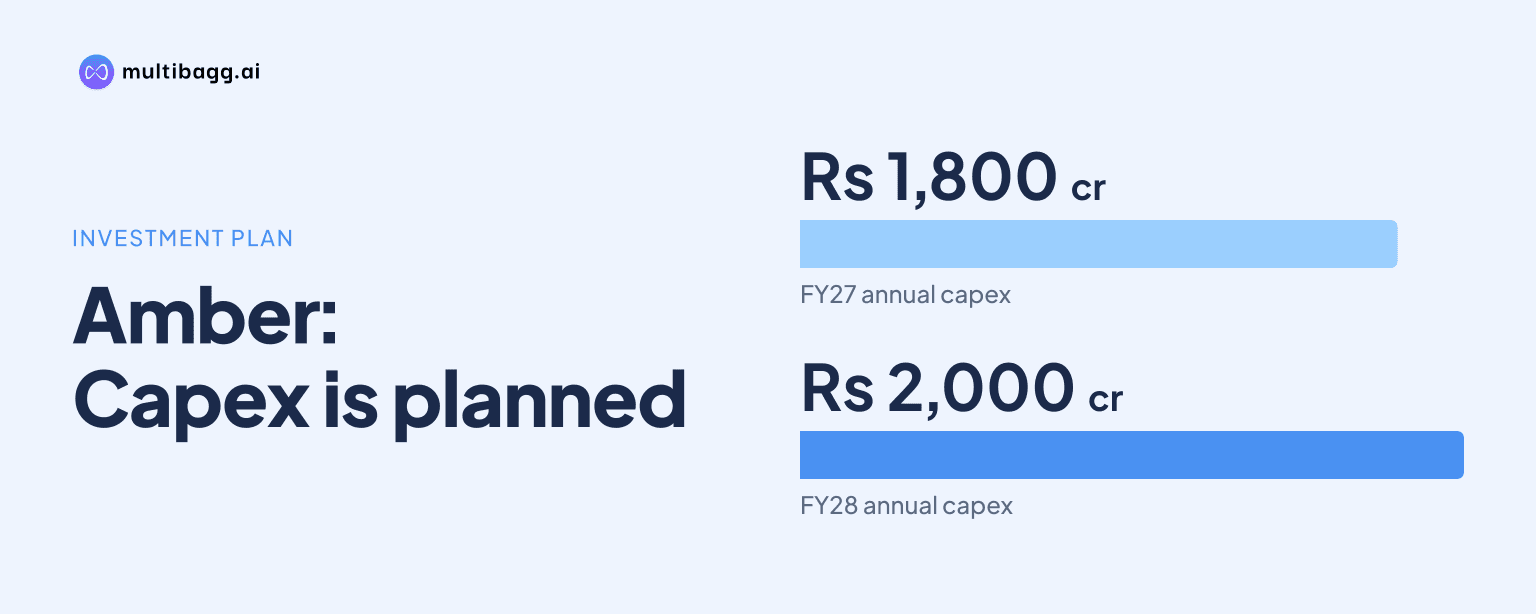
Amber Enterprises India Limited plans Rs 1,800-2,000 crore of capital expenditure in FY27 and a similar annual amount in FY28, while management expects incentive cash flows to begin only in FY29. The programme coincides with reported net debt of Rs 2,572 crore and quarter 2 net interest cost of Rs 63-64 crore.
Know Amber Enterprises India inside out
Results, valuation, peers and who's buying, in one view.
How much capex is Amber planning through FY28?
Amber is planning Rs 1,800-2,000 crore of total capex in the current financial year and a similar range in the following year. If expenditure reaches the stated endpoints in both FY27 and FY28, the two-year programme would total Rs 3,600-4,000 crore.
Management did not provide a division-wise allocation of the Rs 1,800-2,000 crore annual capex across consumer durables, electronics or railway operations. It did identify two project schedules: the Ascent Hosur expansion is expected to start by the first half of calendar 2027, while Korea Circuit is expected to start in calendar 2028.
The disclosed range is an investment plan rather than a project-by-project commissioning forecast. Amber said exact timelines for Ascent Hosur and Korea Circuit would be shared nearer to the commencement of operations, leaving the timing of spending within FY27 and FY28 unspecified.
When does Amber expect incentive cash flows to begin?
Amber expects incentive cash flows to begin in FY29, after commercial production starts and the relevant applications are filed. Management initially said FY27 during its answer, then immediately corrected the expected cash-flow year to FY29.
The sequence creates a timing gap between investment and expected incentive receipts. Amber plans annual capex of Rs 1,800-2,000 crore in FY27 and FY28, but management placed the start of related incentive cash flows in FY29.
The call did not disclose the amount of incentives, the scheme involved or the date by which applications would be submitted. It therefore supports the FY29 expectation for cash receipts but does not establish how much of the Rs 3,600-4,000 crore potential two-year programme could be offset.
How is Amber funding its investment programme?
Amber reported gross debt of about Rs 4,100-4,200 crore and net debt of Rs 2,572 crore while maintaining its FY27-FY28 capex plan. Management did not provide a reconciliation between gross and net debt or a debt target for the end of FY27.
Management said net debt generally rises in quarter 2 and quarter 3 in its seasonal business, then falls in quarter 4 and quarter 1. The Rs 2,572 crore figure was therefore presented as a point within that operating cycle, rather than as a forecast of the next year-end balance.
Amber did not identify a fixed portion of borrowings as inventory-linked. Management said that when commodity prices increase, inventory and creditor values also rise, and inventory can be partly paid and partly unpaid.
Got a follow-up? Ask IRIS
What did Amber say about interest costs and operating cash demands?
Amber expects net interest cost in each of the next two quarters of the current financial year to be similar to the Rs 63-64 crore recorded in quarter 2. Management put quarter 1 net interest cost at about Rs 56 crore, a sequential increase of Rs 7-8 crore.
Management said interest expense should be assessed after adjusting finance cost for interest income included in other income. On that basis, it described the change from Rs 56 crore in quarter 1 to Rs 63-64 crore in quarter 2 as not significant.
The Sri City greenfield facility added operating costs while it was running at around 40% capacity utilisation in quarter 2. Amber expected the facility to return to normal utilisation by quarter 4, which management said would reduce the conversion-cost effect from the ramp-up phase.
For the first half, management estimated minimum-wage costs in the Consumer Durables division at Rs 20-30 crore, non-operational costs at Rs 32-35 crore and extra Sri City 2 plant costs at Rs 15-20 crore. Those items total Rs 67-85 crore, though the call did not state that they were financed through incremental borrowings.
Which operating developments could affect Amber's capex execution?
Amber said its Electronics Division should return to a normalised growth run rate after IL JIN resumed operations following a fire. Management expected the facility to become fully operational in a couple of months and said other IL JIN facilities had supported customer sales during the disruption.
An analyst cited Rs 1,247 crore of Electronics Division revenue for the quarter, but Amber did not provide a separate capex amount for IL JIN restoration or expansion. Management said electronics margins improved as customer pass-throughs began after discussions on commodity-cost pressure.
In consumer durables, Amber maintained that its annual growth should track industry growth, which management estimated at 20-22% for the full year. Management said industry growth was 18% in the first half, while the Consumer Durables division had grown about 41%, though it declined to disclose volume growth.
The railway business has a separate margin recovery timetable that could affect the operating mix. Management expects earnings before interest, tax, depreciation and amortisation margin of 8-10% this year, followed by a gradual return towards 14-16% as older legacy contracts are delivered.
Conclusion
Amber's plan combines Rs 1,800-2,000 crore of annual capex in FY27 and FY28 with net debt of Rs 2,572 crore and quarter 2 net interest cost of Rs 63-64 crore. The central funding timing issue is that management expects incentive cash flows only from FY29, after commercial production and applications, rather than during the two stated investment years.
The next disclosed markers are the planned Ascent Hosur start by the first half of calendar 2027, Korea Circuit's expected start in calendar 2028 and normal Sri City utilisation by quarter 4. Management's expectation that net debt falls in quarter 4 and quarter 1, and that IL JIN becomes fully operational within a couple of months, are further points to watch.