










Amber consumer durables reports Rs 4 crore EBITDA in Q2 FY27
Key highlights
- Amber’s consumer-durables revenue rose 41% year on year to Rs 1,227 crore in Q2 FY27.
- Amber reported Rs 4 crore of Q2 FY27 operating EBITDA in consumer durables.
- Amber recovered 50% of the Q2 FY27 commodity increase from customers and expects the balance from Q3 FY27.
- Sri City operated at about 40% utilisation in Q2 FY27, with normalisation expected by Q4 FY27.
powered by IRIS
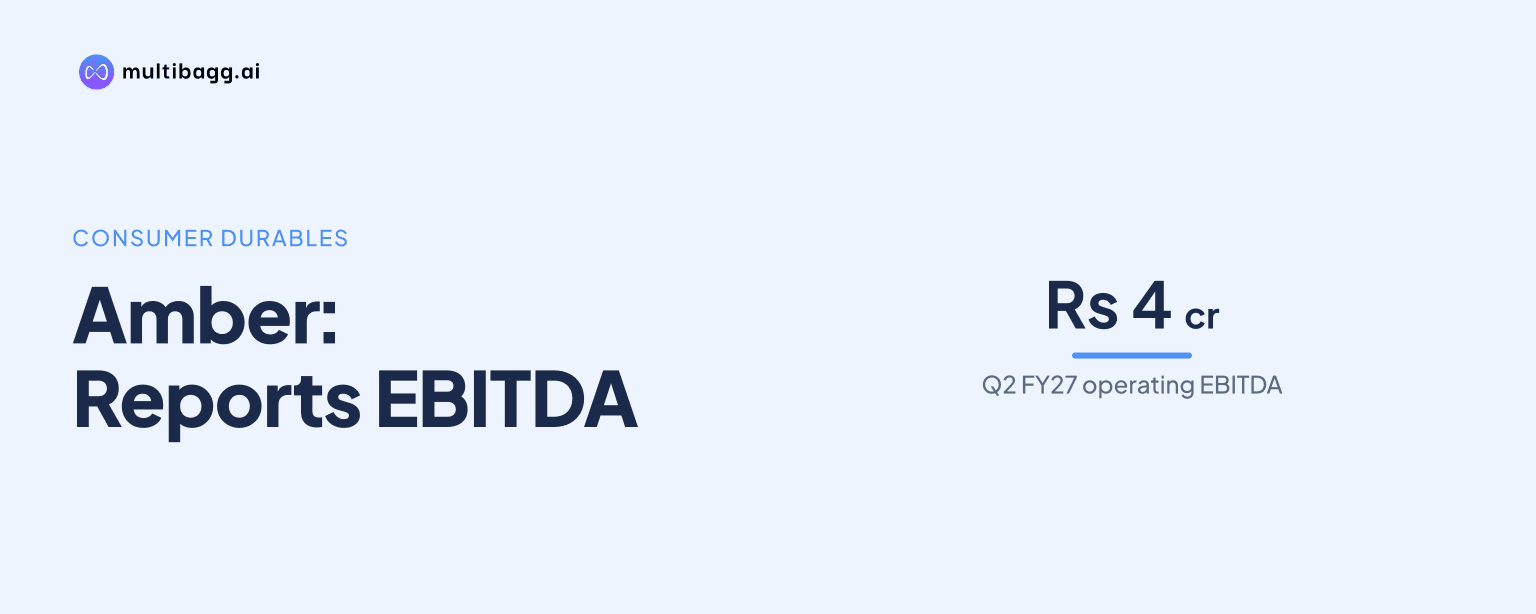
Amber Enterprises India Limited reported Rs 4 crore of operating earnings before interest, tax, depreciation and amortisation (operating EBITDA) in its consumer-durables division in the second quarter of financial year 2027 (Q2 FY27), as revenue rose 41% year on year to Rs 1,227 crore and commodity, wage, currency and Sri City costs narrowed profitability.
Know Amber Enterprises India inside out
Results, valuation, peers and who's buying, in one view.
Why did Amber’s consumer-durables profitability come under pressure in Q2 FY27?
Amber said commodity-price increases, foreign-currency fluctuations, a minimum-wage revision and costs at its new Sri City plant compressed consumer-durables profitability in Q2 FY27. The division generated Rs 4 crore of operating EBITDA on Rs 1,227 crore of quarterly revenue while the Sri City facility remained in its ramp-up phase.
Management separated the pressure into raw-material and conversion-cost effects. It said fixed conversion remained intact, but minimum wages and low utilisation at Sri City increased costs; the facility was operating at about 40% capacity utilisation in Q2 FY27 despite carrying its expense base. Management expects the utilisation-related cost effect to return to normal by Q4 FY27.
Amber’s consumer-durables outcome contrasted with the other divisions reported for Q2 FY27. Electronics produced Rs 116 crore of operating EBITDA on Rs 1,248 crore of revenue, while Railways Subsystems & Defence recorded Rs 7 crore on Rs 152 crore of revenue. Amber said divisional revenue and operating EBITDA are not comparable with its published segmental results.
What drove Amber’s 41% consumer-durables revenue growth?
Amber attributed the consumer-durables division’s 41% Q2 FY27 revenue growth to commercial air-conditioning contribution, commodity and star-rating-table changes, and volume growth. Revenue increased by Rs 354 crore from Rs 873 crore in Q2 FY26 to Rs 1,227 crore in Q2 FY27, although management did not disclose the respective contributions of volume and pricing.
Commercial air conditioning contributed because Amber started that business three years earlier and has since added products and customers, management said. Commodity changes and revisions to the star-rating table also contributed to reported revenue alongside volume. Management declined to provide a numerical volume-growth figure when asked by an analyst.
For the full year, Amber said it remained on track to grow in line with the room-air-conditioner industry, which management expects to expand by about 20% to 22%. Management cited industry growth of 18% in H1 FY27 and said it was not seeing weaker demand in Q2 FY27 or Q3 FY27, though this was an industry outlook rather than a disclosed Amber volume measure.
Got a follow-up? Ask IRIS
How exposed is Amber’s room-air-conditioner business to commodity costs?
Amber said direct commodity exposure represents 40% of a room air conditioner’s bill of materials, rising to 52% when commodities embedded in supplied components are included. Copper, aluminium, steel and resin are the four principal commodity exposures, alongside the US dollar through foreign-exchange costs.
The 52% measure includes inputs used by suppliers, such as steel and copper within compressors, rather than only material bought directly by Amber. That mechanism means price movements can affect purchased component costs as well as Amber’s own material purchases. Management also identified copper as a large part of the bill of materials and described currency as a moving factor.
Amber said customer costing generally works with a quarterly lag. It recovered 50% of the Q2 FY27 commodity increase from customers during the quarter, leaving the other 50% subject to that lag; management said the balance would be recovered from Q3 FY27. The timetable depends on customer discussions and does not remove exposure to further commodity or currency volatility.
Price increases in room air conditioners were 8% in Q2 FY27 versus Q2 FY26, according to management. It explained that commodity inflation does not translate one-for-one into customer pricing because annual cost improvements by suppliers, including compressor and printed-circuit-board assembly suppliers, offset part of the material increase.
When does Amber expect consumer-durables costs to normalise?
Amber expects the Sri City utilisation effect to normalise by Q4 FY27 and retained its prior full-year consumer-durables margin-impact guidance of 50 to 100 basis points, assuming commodity prices remain at H1 FY27 levels. A basis point is one-hundredth of a percentage point. Management said percentage margins could remain suppressed if commodities rise further.
Management described the margin pressure as temporary but did not say the worst had passed. Asked about stable copper and aluminium prices, Amber’s Executive Chairman said it was fair to say the pressure was “partially behind us,” while adding that customer pricing remains a moving part. Amber said it has historically passed commodity and currency changes to customers with a quarterly lag.
At Amber’s standalone level, management quantified the H1 FY27 impact from the wage revision at roughly Rs 22 crore to Rs 25 crore. It described the wage effect as a regular cost rather than a one-off and said it was negotiating with customers to pass on the increase. Separately, management identified about Rs 32 crore at the profit-before-tax level for foreign-exchange fluctuation, employee stock-option-plan impact and other non-operational items at Amber standalone.
The distinction matters because the Rs 4 crore consumer-durables operating EBITDA reflects divisional operating pressures, whereas the Rs 32 crore figure relates to Amber standalone profit before tax and includes more than foreign exchange. Management’s near-term plan is based on higher Sri City utilisation, quarterly customer recoveries and negotiations on wage-related costs, rather than a disclosed fixed margin target.
Conclusion
Amber’s Q2 FY27 consumer-durables result shows that revenue growth did not immediately translate into divisional earnings: Rs 1,227 crore of revenue, up 41%, generated Rs 4 crore of operating EBITDA. Commercial air conditioning, star-rating-table changes and volume supported sales, while commodity exposure, currency, wages and underutilisation at Sri City created a lag between higher costs and customer recoveries.
The next indicators are whether Sri City moves beyond its Q2 FY27 utilisation level of about 40% by Q4 FY27 and whether the remaining 50% of Q2 FY27 commodity increases is recovered from customers in Q3 FY27. Management has retained its FY27 consumer-durables margin-impact range of 50 to 100 basis points, conditional on commodity prices staying at H1 FY27 levels.