










Amber expects Q3-Q4 margin recovery after Rs 85 crore H1 costs
Key highlights
- Amber quantified H1 consumer-durables additional costs at Rs 80-85 crore.
- Non-operating costs, including foreign-currency fluctuation, were Rs 32-35 crore in H1.
- Consumer-durables wage revision was about Rs 25-30 crore in H1, including PICL and Pravartaka.
- Amber expects to recover historical CD division margins in Q3 and Q4.
powered by IRIS
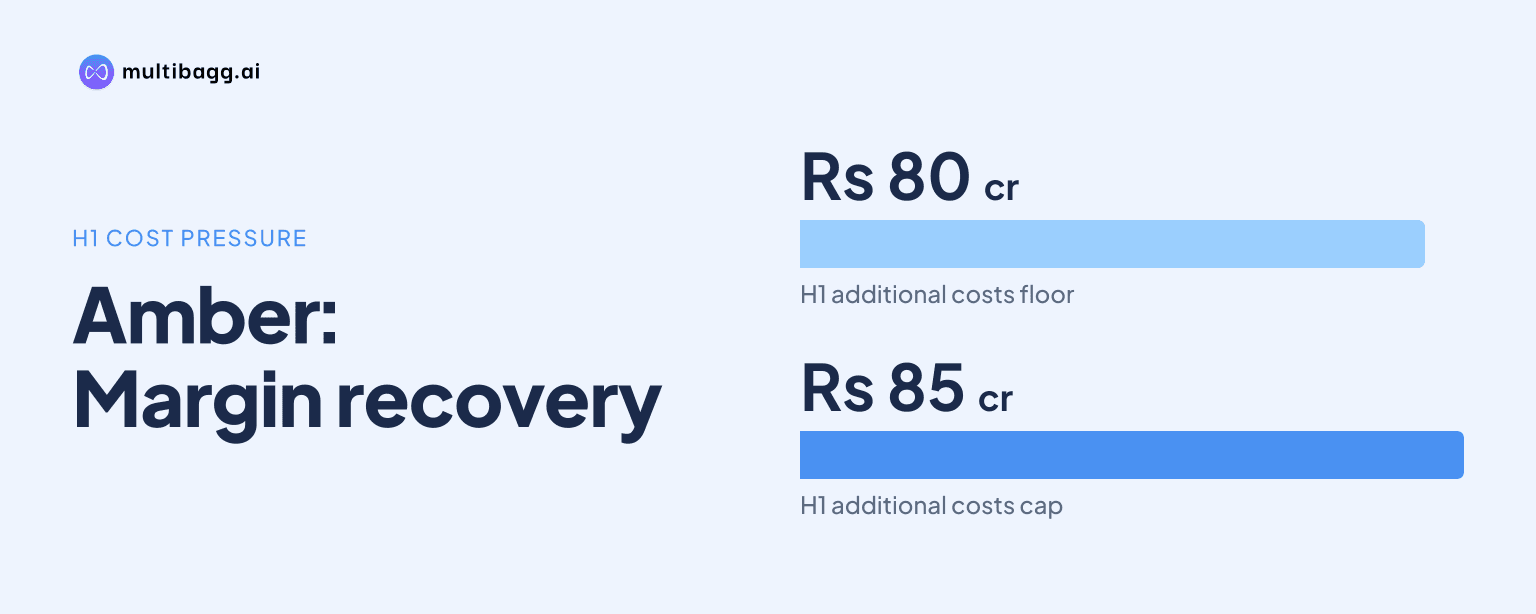
Amber Enterprises India Limited expects its consumer-durables division to recover historical margins in Q3 and Q4 after Rs 80-85 crore of additional H1 costs, including Rs 32-35 crore of non-operating expenses, Rs 25-30 crore of wage revision and Rs 15-20 crore linked to Sri City 2.
Know Amber Enterprises India inside out
Results, valuation, peers and who's buying, in one view.
What costs reduced Amber's H1 consumer-durables margin?
Amber attributed H1 margin pressure in consumer durables to three cost groups totalling Rs 80-85 crore. Management put non-operating expenses at Rs 32-35 crore, including foreign-currency fluctuation and other items; consumer-durables wage revision at Rs 25-30 crore; and extra costs at the Sri City 2 plant at Rs 15-20 crore.
The wage-cost figure has two reported perimeters. For Amber alone, management cited Rs 22-25 crore arising from the Haryana minimum-wage increase. For the wider consumer-durables business, including PICL and Pravartaka, it cited about Rs 25-30 crore. Management confirmed Rs 80-85 crore as the H1 additional-cost total after the analyst combined the three broad categories.
Amber did not describe the Sri City 2 amount as a one-time charge. Responding to a question about one-offs and new-plant expenses, management called the Rs 15-20 crore an extra H1 cost. The call also did not separately quantify foreign-exchange movement within the Rs 32-35 crore non-operating category, so no precise foreign-exchange cost can be derived from the transcript.
Why does Amber expect margins to recover in Q3 and Q4?
Amber said it expects the consumer-durables, or CD, division to recover the historical margins it has delivered in Q3 and Q4. Management said its annual guidance remained intact, but it did not give a numerical margin target for either quarter. The statement is therefore a management outlook for the final two quarters, rather than a reported earnings result.
Amber asked investors to assess the business on an annual basis instead of using a single quarter as the main reference point. Management said seasonality and shifts in original equipment manufacturer, or OEM, product mix can change quarterly results. The Rs 80-85 crore H1 cost burden is a quantified reported management estimate, while the proposed margin recovery depends on the operating pattern management described.
Amber also distinguished its growth outlook from a fixed company target. When asked whether consumer durables would grow 20% in FY27, management said it had not provided a 20% company forecast. It said the business should grow in line with an industry expansion it expects to be about 20-22%, an expectation that does not specify a Q3 or Q4 margin level.
Got a follow-up? Ask IRIS
How do seasonality and product mix affect Amber's margins?
Amber said consumer durables is seasonal and that this is one reason quarterly margin comparisons can be difficult. It also said OEM customer requirements can change the production mix between assembly work, finished goods and indoor-only products. Those changes can affect revenue and margin composition during a quarter even when the annual business outlook remains unchanged.
The Q3-Q4 recovery outlook does not mean each H1 cost will necessarily reverse. Amber did not say that the Rs 25-30 crore wage revision would disappear, and it did not allocate the Rs 32-35 crore of non-operating costs between individual quarters. Instead, management cited the combined effects of seasonality and product mix while maintaining annual guidance.
The distinction also matters for interpreting the Haryana wage figure. The Rs 22-25 crore estimate applied to Amber alone, while the Rs 25-30 crore consumer-durables figure included PICL and Pravartaka. The broader Rs 80-85 crore H1 cost estimate consequently should not be reconstructed by substituting the Amber-only wage amount for the divisional estimate.
How should Amber's inventory accounting be read?
Amber said a Rs 62 crore positive Q2 change in inventory should not be excluded when calculating raw-material consumption, or RMC. An analyst said removing that line could make gross margin appear about 2.5 percentage points higher, from 18.8% to roughly 21%. Management rejected that approach and said the figures must be assessed together.
Amber explained that raw-material consumption uses opening stock plus purchases minus closing stock for raw materials. Changes in semi-finished goods, or SFG, and finished goods, or FG, are separately presented in the profit and loss account. Management said the raw-material and inventory-change lines must be combined to derive RMC.
This clarification limits conclusions from a single gross-margin presentation line. Amber did not say the Rs 62 crore inventory movement related only to consumer durables; management said it was an overall Amber presentation matter. The transcript therefore supports using the Rs 80-85 crore H1 estimate for the identified consumer-durables cost pressures, rather than mechanically adding 2.5 percentage points to gross margin.
Conclusion
Amber’s H1 consumer-durables performance included Rs 80-85 crore of additional costs from non-operating items, Haryana-linked wage revision and Sri City 2 expenses. Management’s view is that annual assessment is more meaningful than a quarterly reading because seasonality and OEM mix can alter the relative contribution from assembly, finished goods and indoor-only products.
The next reported evidence to watch is whether Q3 and Q4 show the historical CD division margin recovery management expects, despite no quarterly percentage target being disclosed. Investors can also track whether Amber continues to describe consumer-durables growth in relation to its stated industry expectation of about 20-22% for FY27.