










Arisinfra says DaaS expansion needs no direct project capital
Key highlights
- Arisinfra said DaaS requires no direct capital investment and does not fund project working capital.
- Management linked about Rs 300 crore of DaaS revenue to roughly Rs 6,000 crore of GDV, versus around Rs 2,800 crore currently.
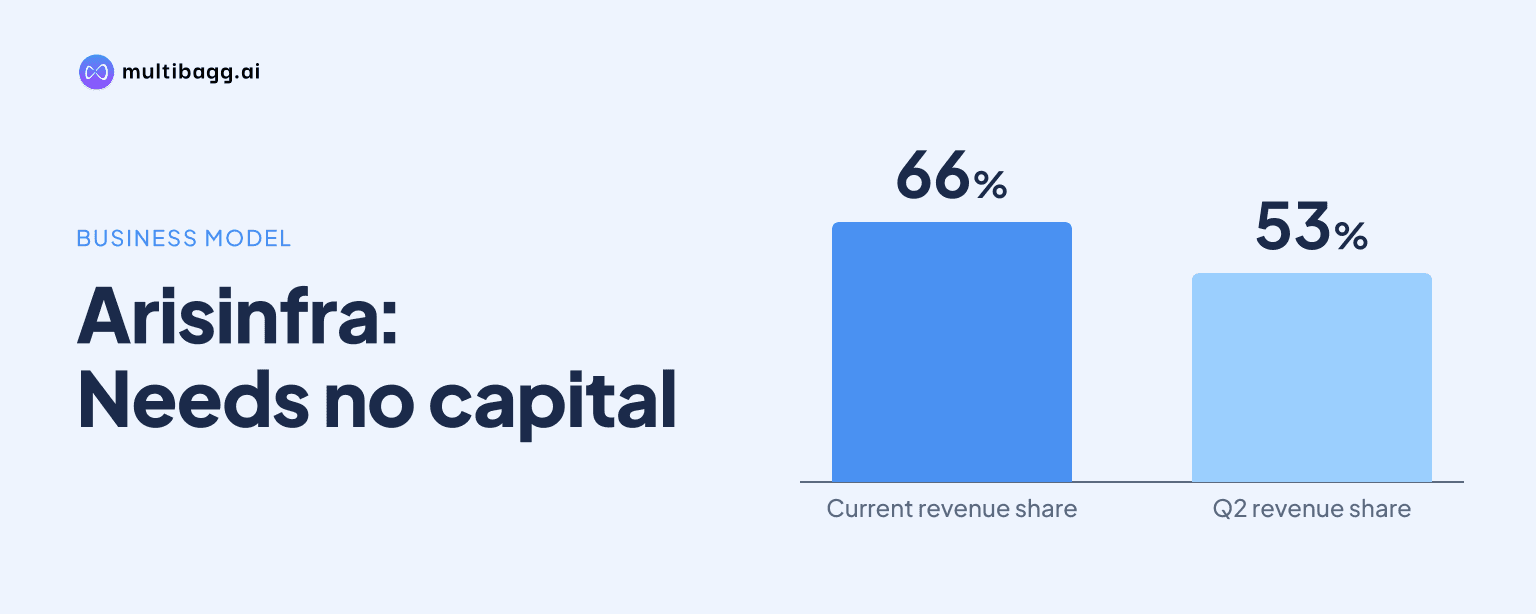
- Contract manufacturing and DaaS represented 66% of revenue, up from 53% in Q2, according to management.
- Arisinfra said plotted developments account for around 45% to 50% of its current DaaS portfolio in one disclosed breakdown.
powered by IRIS
Arisinfra says its DaaS business requires no direct capital investment or project working-capital funding because it earns service fees and arranges external finance. Management made that distinction while discussing DaaS revenue of about Rs 300 crore, which it linked to gross development value of roughly Rs 6,000 crore.
Know Arisinfra Solutions inside out
Results, valuation, peers and who's buying, in one view.
What does Arisinfra’s DaaS model fund?
Arisinfra says DaaS does not fund a customer’s project or provide its own capital for project working capital. Srinivasan Gopalan described DaaS as a “pure service fees” business in which Arisinfra arranges finance for customers from various sources. Under management’s description, Arisinfra coordinates services rather than acting as the principal financier of a real-estate development.
Management directly rejected the suggestion that DaaS finances project working capital. When asked about an earlier presentation that appeared to indicate such funding, Gopalan said Arisinfra had not done this, had never done it, and that the model had no scope for it. The clarification distinguishes the DaaS model from one that would require company capital to rise alongside the working-capital needs of customer projects.
Arisinfra describes DaaS as bringing together the three “M” requirements of real estate: money, materials and management. Management said the company places these services under one roof, while architects, project management consultants, contractors and sales teams are examples of functions that have become outsourced across the real-estate value chain. Management said there is no direct competitor offering the complete package, although individual service elements compete with Arisinfra.
The DaaS funding statement differs from the capital requirement Arisinfra disclosed for its broader growth plan. Management said the company would need about Rs 290 crore to Rs 300 crore to meet its stated growth guidance, funded largely through working-capital lines and internal accruals, with no new equity fund raise planned. That comment applied to the wider plan, while management separately said DaaS itself has no investment requirement.
How large could Arisinfra’s DaaS business become?
Arisinfra linked DaaS revenue of about Rs 300 crore to gross development value, or GDV, of around Rs 6,000 crore, compared with around Rs 2,800 crore currently. Gopalan presented the relationship while answering a question on staffing and technology rather than as a capital-expenditure programme. The comparison indicates the scale of projects that management associates with this level of DaaS revenue.
An analyst referred to DaaS reaching about 10% of Arisinfra’s Rs 3,000 crore FY30 revenue target, or roughly Rs 300 crore. Management did not dispute the Rs 300 crore scale discussed, but focused its response on the GDV required and the operating resources needed. Elsewhere on the call, management said FY30 guidance is built mainly on businesses already operated today and does not include inorganic growth opportunities or acquisitions.
Management sees an addressable DaaS market beyond the largest developers. Ronak Morbia said the top developers account for around 35% to 40% of the real-estate market, leaving the balance as a potential DaaS opportunity. He also identified landowners as a customer group and said Arisinfra has a team evaluating projects, allowing the company to select assignments where management believes it can add significant value.
Got a follow-up? Ask IRIS
How will Arisinfra scale DaaS without matching manpower growth?
Arisinfra says DaaS will require more skilled supervisory talent, while lower-level employees are generally employed by the project and developer. Management therefore does not expect Arisinfra’s employee count to increase in exact proportion to the project portfolio. It acknowledged that DaaS will rely more on talent acquisition than contract manufacturing, even though the underlying site workforce is not expected to sit directly on Arisinfra’s payroll.
The company is developing technology aimed at early project warnings rather than routine processes. Management said a beta version has been deployed with a few customers and is intended to flag when a project moves into a yellow, orange or red zone. This Project Health Index, or PHI, compares project positions with budgets to assess whether timelines, costs and required profitability remain on track.
The DaaS operating model is part of a change in Arisinfra’s revenue mix. Management said contract manufacturing and DaaS, which earn more than the business-to-business, or B2B, supply segment, represented 66% of revenue, up from 53% in Q2. It attributed the Q2 margin of 11.6% to that mix and guided for 11.5% to 12% in FY27 and 12% to 13% by FY30.
Arisinfra expects overall revenue growth of around 30% to 35% year on year. For contract manufacturing, management said secured capacity had an inventory value of more than Rs 1,400 crore to Rs 1,500 crore following additions in higher-value asphalt and ready-mix concrete. Those materials are separate from the service-fee economics that management described for DaaS.
What project mix could affect Arisinfra’s DaaS in a slowdown?
Arisinfra says 60% to 65% of its DaaS exposure is in plots and villas, categories management said are treated differently from taller developments in a real-estate downturn. In a later answer, Gopalan said plotted developments represented around 45% to 50% of the current portfolio, apartments around 30%, and commercial real estate around 20%. The figures came in separate responses, but both identified plotted development as a significant part of the portfolio.
Management said a 10-acre plotted parcel can be completed end to end in six months, including approvals, sales and handover. Arisinfra said it generally takes on 10- to 14-storey towers with turnaround times of 13 to 18 months, rather than projects that could last five or six years. Management said its approach is to favour shorter-duration projects, which could limit exposure to multiple real-estate cycles.
Commercial assignments also include projects taken up partway through construction, according to management. Arisinfra said some work is already completed on these projects, with its role being to complete and accelerate them and help the developer obtain liquidity. Management said it intends to remain selective in choosing projects until DaaS turnover reaches Rs 1,000 crore, leaving the eventual mix and pace of additions to be demonstrated.
Conclusion
Arisinfra has drawn a clear separation between the resources needed for company-wide growth and the DaaS service model. The broader plan may use Rs 290 crore to Rs 300 crore of working-capital lines and internal accruals, while DaaS is described as arranging external finance, materials and management for customers without directly financing their projects. The model’s scale is instead tied to managed GDV, with around Rs 6,000 crore discussed for about Rs 300 crore of DaaS revenue.
The next points to watch are management’s plan to add supervisory talent, extend the PHI beta beyond a few customers and retain selectivity in project intake until DaaS turnover reaches Rs 1,000 crore. Investors can also monitor whether the mix of plotted developments, apartments and commercial projects changes as Arisinfra seeks the GDV required for the revenue scale discussed on the call.