










Arisinfra DaaS pipeline exceeds Rs 2,750 crore in H1 FY27
Key highlights
- Arisinfra’s DaaS GDV under execution exceeded Rs 2,750 crore in Q2 FY27, versus Rs 1,267 crore at FY26-end.
- Active DaaS projects increased to 15 in Q2 FY27 from 10 in the prior quarter.
- Contract manufacturing and DaaS contributed 66% of Q2 FY27 revenue, up from 53% in Q2 FY26.
- Q2 FY27 revenue was Rs 308 crore and EBITDA was Rs 36 crore, with an EBITDA margin of 11.6%.
powered by IRIS
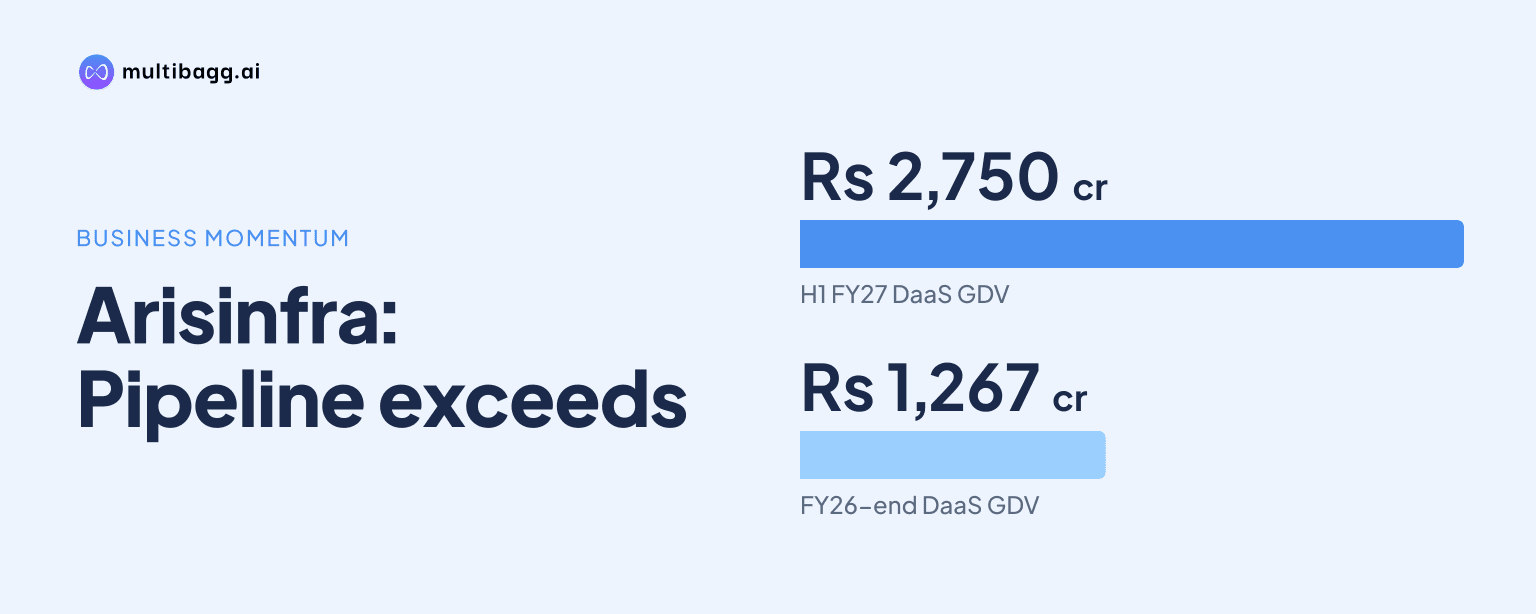
Arisinfra Solutions Limited said its developer-as-a-service, or DaaS, gross development value under execution exceeded Rs 2,750 crore in Q2 FY27, more than doubling from Rs 1,267 crore at FY26-end as active projects rose to 15 from 10 in the preceding quarter.
Know Arisinfra Solutions inside out
Results, valuation, peers and who's buying, in one view.
How much did Arisinfra’s DaaS pipeline grow?
Arisinfra’s DaaS gross development value, or GDV, under execution rose by more than Rs 1,483 crore from FY26-end to exceed Rs 2,750 crore as of the Q2 FY27 call. GDV was Rs 1,839 crore at the end of Q1 FY27, meaning the portfolio added more than Rs 911 crore during the second quarter. Management described the first-half increase as more than a doubling of the execution pipeline.
The project count increased to 15 active projects in Q2 FY27 from 10 in the previous quarter. Arisinfra’s DaaS work covers planning and approvals, funding coordination, material procurement, execution, sales and collections. That scope makes GDV a measure of projects being executed rather than reported DaaS revenue or an order book figure.
Arisinfra said DaaS projects can also generate demand for its materials and contract-manufacturing operations because project requirements are serviced through its supply network. This connection is a stated operating mechanism, rather than a disclosed value of cross-selling from the Rs 2,750 crore-plus portfolio.
When will Arisinfra execute the DaaS portfolio?
Arisinfra management said the current DaaS pipeline is expected to be fully exited over periods ranging from six months to 30 months, depending on the project. The range means revenue from the Rs 2,750 crore-plus GDV will not arrive in a single period and will depend on the progress of individual developments.
Management said the company generally charges gross fees of 10% to 14% of GDV. It also said DaaS had an EBITDA margin of about 59.2% in the preceding quarter, though it did not provide a new Q2 FY27 segment margin or translate the current pipeline into an expected revenue figure.
Revenue recognition has three elements, according to Arisinfra’s chief executive officer: a fixed fee linked to time, a component based on sales achieved, and a component tied to construction milestones. This structure means the timing of sales and construction progress, rather than GDV alone, will determine when the fees are recognised.
How is the larger DaaS portfolio changing Arisinfra’s mix?
Arisinfra said contract manufacturing and DaaS together accounted for 66% of Q2 FY27 revenue, compared with 53% in Q2 FY26. For H1 FY27, the two businesses represented 64% of revenue and about 92% of segment EBITDA before non-cash Indian Accounting Standards, or Ind AS, adjustments, according to management.
The mix shift occurred alongside higher group revenue and profitability. Revenue from operations rose 28% year on year and 6% sequentially to Rs 308 crore in Q2 FY27. Earnings before interest, tax, depreciation and amortisation, or EBITDA, increased 58% year on year to Rs 36 crore, while the EBITDA margin expanded by 220 basis points to 11.6%.
For H1 FY27, revenue from operations grew 32% year on year to Rs 599 crore, EBITDA rose 63% to Rs 66 crore and PAT more than doubled to Rs 43 crore from Rs 20 crore in H1 FY26. Arisinfra attributed the improvement to a stronger mix, particularly the scale-up of contract manufacturing and DaaS, rather than identifying a standalone profit contribution from DaaS.
Got a follow-up? Ask IRIS
What capacity supports Arisinfra’s wider operating plan?
Arisinfra increased partner manufacturing capacity to about 11.7 million tonnes in H1 FY27 from 9.1 million tonnes, covering aggregates, ready-mix concrete and asphalt. The additional capacity is obtained through partnerships rather than investment in plant assets, consistent with the company’s asset-light model.
Management clarified that it counted about 15 plants at June 30, 2026, after previously reporting 10 partner entities at the end of Q1 FY27. It added about eight plants in Q2 FY27, with many being ready-mix concrete and asphalt facilities that carry higher value per tonne but lower tonnage capacity than aggregates.
Current utilisation of the 11.7 million-tonne capacity is between 42% and 45%, according to the chief financial officer. Management said this provides headroom for at least the next six to nine months without additional capacity, while also saying it does not guide to a specific future capacity number and has discussions under way for further additions.
The partner network spans four markets and 11 partners, with no single partner accounting for more than one-quarter of total capacity. Arisinfra also said vendor deposits fell by Rs 13 crore even as it expanded capacity, although it did not disclose the absolute deposit balance at Q2 FY27.
How is Arisinfra funding growth and managing working capital?
Arisinfra reported net working-capital days of 54 in H1 FY27, down from 84 days in the prior September comparison. Operating cash flow was Rs 60 crore, equal to 91% of H1 EBITDA of Rs 66 crore, as the company cited better payables and broadly flat receivables.
Management’s stated steady-state expectation is 60 to 70 working-capital days as the business grows, even though the current 54 days is below that range. It said primary funding needs will be materials purchases and receivables, while security or trade deposits are the other category of investment.
On capital allocation, management said the Rs 60 crore investment in subsidiaries was the only investment planned in the current financial year and that no investments were planned in the next financial year as of the call. It said cash generation would largely be deployed into working capital, rather than outlining a new plant-capex programme.
Conclusion
The expansion of Arisinfra’s DaaS portfolio to more than Rs 2,750 crore and 15 projects adds scale to a business that management says supports both fees and demand for its materials and manufacturing network. The portfolio increase came as contract manufacturing and DaaS lifted their combined revenue share to 66% in Q2 FY27, alongside Rs 308 crore of quarterly revenue and a 11.6% EBITDA margin.
The next measures to watch are the pace at which the six-to-30-month DaaS projects reach sales and construction milestones, the conversion of the 42% to 45% utilised manufacturing capacity, and working-capital days against management’s 60-to-70-day steady-state range. Management also said it aims to scale DaaS, ramp partner capacity and expand beyond core markets, without giving numerical capacity guidance.