










Arisinfra shifts deposits to bank-backed partner facilities
Key highlights
- Aris said long-term deposits fell by about Rs 13 crore while reserve capacity rose from 9.1 million metric tons in March to 11.7 million metric tons by Q2.
- Aris reported about Rs 114 crore of fixed deposits held as security for borrowing facilities, bank guarantees and a corporate guarantee.
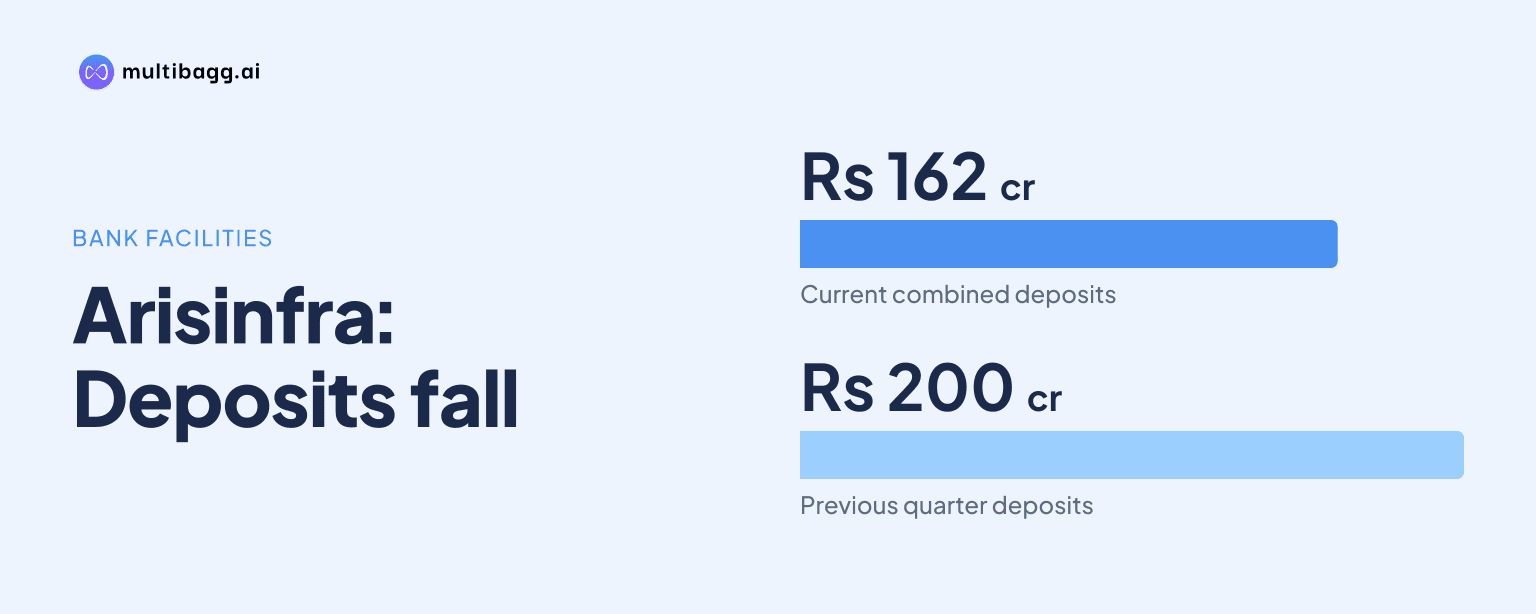
- Aris stated current combined deposits at about Rs 162 crore, compared with about Rs 200 crore in the previous quarter.
- Contract-manufacturing revenue grew 22% in H1 FY27, with an EBITDA margin of about 10.5%.
powered by IRIS
Arisinfra has started replacing fresh direct deposits to manufacturing partners with bank facilities secured by its fixed deposits, and management said long-term deposits fell by about Rs 13 crore while reserve capacity increased from 9.1 million metric tons in March to 11.7 million metric tons by Q2.
Know Arisinfra Solutions inside out
Results, valuation, peers and who's buying, in one view.
What has Aris changed in its partner-deposit model?
Aris has begun moving from direct cash deposits with partners to bank facilities backed by fixed deposits, management said. Instead of placing additional cash deposits directly with a partner, Aris places a fixed deposit with a bank and enables a partner or subsidiary to draw a facility from its own bank against that security. Management described this as its first step from cash-based support to non-fund-based support.
The mechanism had been working since March, according to management. Over that period, long-term deposits declined by about Rs 13 crore while reserve capacity rose by 2.6 million metric tons, from 9.1 million metric tons to 11.7 million metric tons. Management said the capacity increase occurred without an additional investment.
Management's rounded long-term and short-term figures do not precisely add to its stated current total of about Rs 162 crore. The company did not disclose how much of the deposit balance had already been converted into bank-backed facilities, but said it had started the process and intended to expand it over the next few quarters.
How do bank-backed facilities reduce Aris's direct deposit exposure?
The structure reduces direct exposure because fresh cash is not newly deposited with the manufacturing partner, management said. Instead, the partner or subsidiary borrows from its own bank, with Aris's fixed deposit serving as security. Management said this reduces the open risk attached to deposits held directly with partners while continuing to support capacity arrangements.
Aris said the fixed-deposit cash remains on its balance sheet and earns interest. Management therefore characterised the conversion of open deposits into fixed deposits as making them earning assets. The facility remains secured by the fixed deposit, so the arrangement changes the form of support rather than removing the company's role in enabling partner funding.
Aris reported about Rs 114 crore of fixed deposits within cash and bank balances. Management said those fixed deposits secured its own borrowing facilities, bank guarantees and a corporate guarantee to a third party. That figure is not identified solely as partner-related support, but it indicates the existing use of fixed deposits in Aris's security arrangements.
Got a follow-up? Ask IRIS
What capacity did Aris add as deposits fell?
Aris said its reserve capacity reached 11.7 million metric tons by Q2, compared with 9.1 million metric tons in March. Management said it achieved the increase while reducing long-term deposits by about Rs 13 crore and without an additional investment. It does not provide guidance on the absolute volume of future capacity additions.
The capacity is used in contract manufacturing across stone aggregates, ready-mixed concrete, and asphalt and bitumen. Management said it is focused on raising capacity in those three existing product categories rather than adding a new category. In H1 FY27, contract-manufacturing revenue grew 22% and its earnings before interest, tax, depreciation and amortisation, or EBITDA, margin was about 10.5%.
Management said improved utilisation of reserved capacity and economies of scale should allow Aris to sustain and potentially improve that margin. This was management's expectation, not a stated margin target. The deposit change is tied to this operating plan because it is intended to secure capacity without adding direct cash deposits at the same pace.
What does the structure mean for contracts and cash flow?
Aris said its manufacturing arrangements are mostly long-term contracts of five years. Management said Aris retains the customer relationship, buying material from manufacturing facilities or entities and selling it to customers. It also said partners are contractually restricted from independently approaching the same customer set.
The company does not use minimum-offtake guarantees, according to management. It said capacity can be increased with existing partners, not only one partner, without such commitments. This approach combines the bank-backed deposit structure with flexibility over volumes purchased from the manufacturing base.
Management identified working capital and cash flow as the principal uncertainty requiring planning in its business model. It cited credit structuring, real-time data technology, industry experience and customer selection as its tools for managing that exposure. For material sales, it said commitments generally cover limited quantities for periods ranging from a couple of weeks to about a month.
Management also said revenue had grown 32% so far, versus its 35% to 40% full-year growth expectation, with the remaining growth expected in the second half. Its FY30 guidance is based on the current businesses and a 29% compound annual growth rate, or CAGR, and excludes inorganic growth or acquisitions, according to management.
Conclusion
Aris is restructuring how it supports manufacturing partners rather than stepping back from capacity reservation. The disclosed evidence is a roughly Rs 13 crore decline in long-term deposits alongside a 2.6 million-metric-ton increase in reserve capacity from March to Q2, while management says fixed deposits can earn interest and support partner borrowing.
The next measure to watch is the planned conversion of more fund-based deposits into non-fund-based structures over the next few quarters. Management has not disclosed the amount already converted, so future deposit balances, reserve capacity and utilisation of the 11.7 million metric tons will indicate how far the model is progressing.