










Arisinfra adds 2.6 million tonnes as vendor deposits decline
Key highlights
- Arisinfra increased secured partner capacity by 2.6 million tonnes to 11.7 million tonnes in H1 FY27.
- Vendor deposits declined by Rs 13 crore in Q2 FY27 despite the capacity expansion.
- Arisinfra reported utilisation of 42% to 45% of its 11.7 million-tonne partner capacity.
- Contract manufacturing revenue rose 72% year on year to Rs 329 crore in H1 FY27.
powered by IRIS
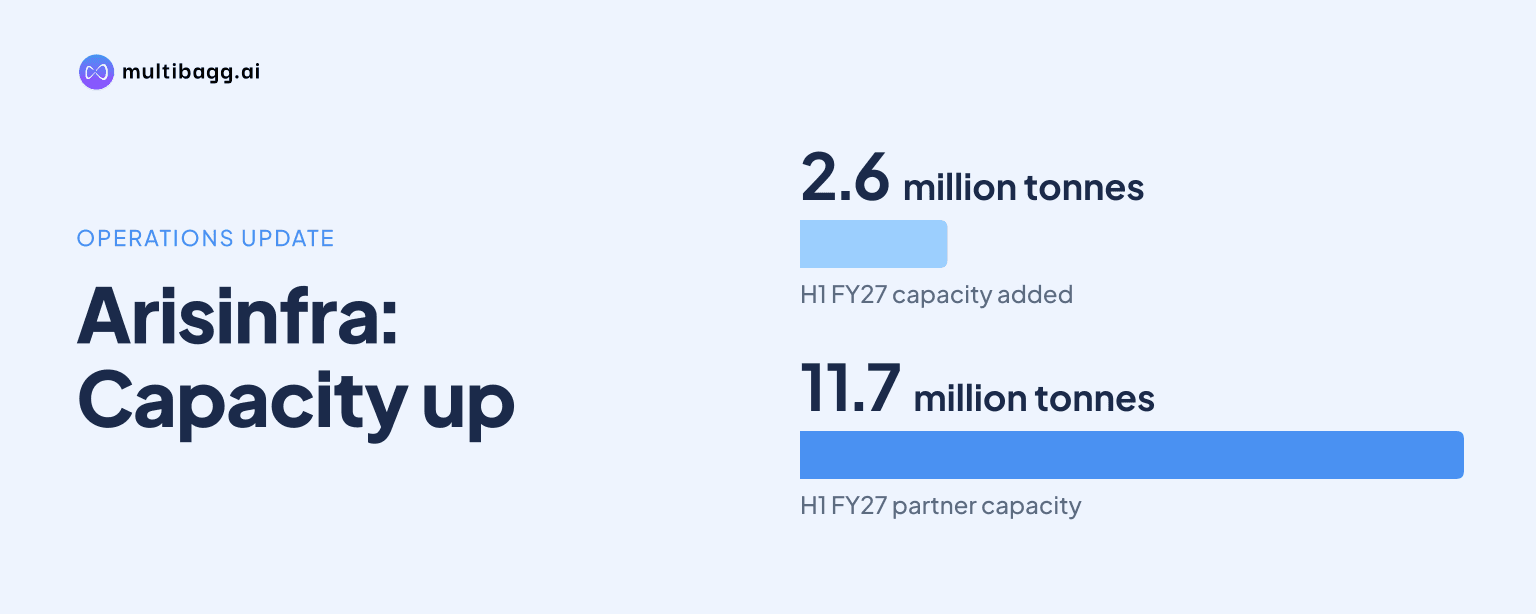
Arisinfra Solutions Limited expanded secured partner capacity to 11.7 million tonnes in H1 FY27 from 9.1 million tonnes, while vendor deposits fell by Rs 13 crore during Q2 FY27. Management said the partnership-led expansion avoided investment in owned plants and left capacity utilisation at 42% to 45%.
Know Arisinfra Solutions inside out
Results, valuation, peers and who's buying, in one view.
What capacity did Arisinfra add in H1 FY27?
Arisinfra added 2.6 million tonnes of secured partner manufacturing capacity in H1 FY27, increasing the total to about 11.7 million tonnes from 9.1 million tonnes. The capacity covers aggregates, ready-mix concrete and asphalt, and management said it creates supply headroom as demand and volumes increase.
Management clarified that the Q1 FY27 figure of 10 partner plants referred to partner entities rather than individual facilities. Arisinfra had about 15 physical plants on June 30, 2026, because certain partner entities operate more than one plant, and it added about eight plants in Q2 FY27. The company’s broader network was stated to include 23 partner plants across 23 states and union territories.
The plant count increased faster than capacity measured in tonnes because many additions were ready-mix concrete and asphalt facilities. Management said these plants generally have lower tonnage than aggregate plants but higher value per tonne, so additional facilities do not produce a proportionate rise in tonne-based capacity.
How did Arisinfra increase capacity while deposits fell?
Arisinfra increased capacity by 2.6 million tonnes while vendor deposits declined by Rs 13 crore in Q2 FY27. Chairman and Managing Director Ronak Morbia said this was the model the company intended to follow in the next few quarters, although management did not disclose the closing vendor-deposit balance.
The mechanism is Arisinfra’s use of manufacturing partnerships rather than ownership of plant assets. Management said this secures supply without corresponding investment in its own factories; growth funding instead principally supports material purchases and the related receivables, while security or trade deposits are a second category of funding.
In response to a question on investment, management said a Rs 60 crore investment in subsidiaries was the only investment planned for FY27 and that no investments were planned in the following financial year at the time of the call. That statement does not remove working-capital requirements, since Arisinfra said purchases of construction materials continue to require funding as revenue grows.
How much unused capacity does Arisinfra have?
Arisinfra was using between 42% and 45% of its 11.7 million-tonne partner capacity at the Q2 FY27 call. Chief Financial Officer Bhavik Khara said this gave the company headroom for at least six to nine months without needing to add capacity, based on capacity already secured.
Management nevertheless said capacity additions would run ahead of demand to ensure supply availability when volumes arrive. Arisinfra did not provide a numerical target for capacity over one or two years, but said it was in several discussions to increase capacity in the next few quarters.
The partner network operates across four markets with 11 partners, and no individual partner accounts for more than one-quarter of total capacity, according to management. This means the reported 11.7 million tonnes are distributed across multiple supply relationships rather than concentrated in one partner.
Got a follow-up? Ask IRIS
How does partner capacity support Arisinfra’s business mix?
Arisinfra’s contract manufacturing revenue rose 72% year on year to Rs 329 crore in H1 FY27, representing 55% of total revenue. Management positioned the 11.7 million tonnes of partner capacity as the supply base for this segment, alongside aggregates, ready-mix concrete and asphalt demand.
Contract manufacturing and Developer as a Service, or DaaS, together represented 66% of Q2 FY27 revenue, compared with 53% in Q2 FY26. In H1 FY27, the two businesses contributed 64% of revenue and approximately 92% of segment earnings before interest, tax, depreciation and amortisation, or EBITDA, before non-cash Indian Accounting Standards adjustments.
The group’s Q2 FY27 revenue from operations was Rs 308 crore, up 28% year on year and 6% sequentially. EBITDA rose 58% year on year to Rs 36 crore, while EBITDA margin increased by 220 basis points to 11.6%; management attributed part of the profitability change to the growing contribution from contract manufacturing and DaaS.
What does working capital show about Arisinfra’s model?
Arisinfra reported net working-capital days of 54 in Q2 FY27, compared with 84 days in September of the prior year. Operating cash flow for H1 FY27 was Rs 60 crore, equal to 91% of H1 EBITDA of Rs 66 crore, with management citing better payables and almost flat receivables.
The 54-day result was below management’s previously stated steady-state range of 60 to 70 days as the business expands. Management said faster growth still requires financing for receivables and material purchases, so declining vendor deposits address one use of capital rather than eliminating the need for working capital.
Arisinfra also linked execution discipline to its proprietary technology platform, which had read more than 14 lakh delivery notes by the call date, including handwritten documents. The platform connects purchase orders, goods receipt notes, challans and invoices, and management said it provides real-time visibility into delivery-level margins and credit exposure.
Conclusion
Arisinfra paired a 2.6 million-tonne H1 FY27 increase in secured partner capacity with a Rs 13 crore reduction in vendor deposits during Q2 FY27. The combination supports management’s asset-light approach: expand access to aggregates, ready-mix concrete and asphalt through partners while directing capital primarily toward materials purchases and receivables.
The next issues to watch are the ramp-up of the 11.7 million tonnes at 42% to 45% utilisation, further partnership discussions in the next few quarters, and working-capital days against management’s 60-to-70-day steady-state range. Management also said contract manufacturing and DaaS could together approach 75% of anticipated sales, without providing a period-specific target.