










Arisinfra says plotted DaaS mix limits property-cycle exposure
Key highlights
- Arisinfra said 45-50% of its DaaS portfolio is plotted development.
- Management said a 10-acre plotted parcel can be completed in about six months.
- Apartments account for about 30% and commercial real estate about 20% of Arisinfra's disclosed DaaS mix.
- Arisinfra said DaaS GDV may need to rise from about Rs 2,800 crore to Rs 6,000 crore to support Rs 300 crore of revenue.
powered by IRIS
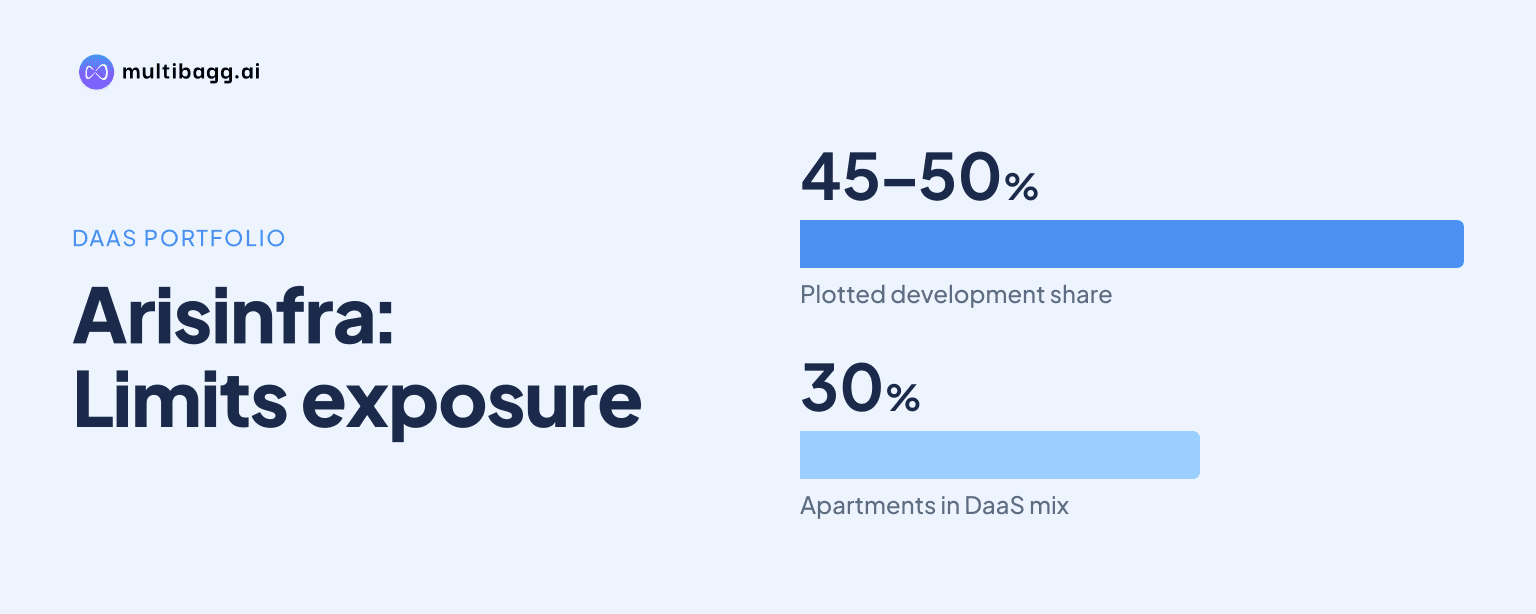
Arisinfra said 45-50% of its Development as a Service (DaaS) portfolio is plotted development, where a 10-acre parcel can be completed in about six months from approvals to final sale and handover. Management said this mix, and its avoidance of very tall and five-to-six-year projects, is intended to limit property-cycle exposure.
Know Arisinfra Solutions inside out
Results, valuation, peers and who's buying, in one view.
How does Arisinfra limit DaaS exposure to a real-estate downturn?
Arisinfra limits stated DaaS risk by selecting shorter-duration projects and maintaining material exposure to horizontal development. In response to an analyst's scenario of property prices falling 30-40%, management said a severe downturn would affect every business, but said plotted development has different cycle characteristics from high-rise construction.
Management said its focus includes plots and villas, particularly in Chennai, Bangalore and Hyderabad. It cited the 2007-08 and 2015-2020 real-estate slumps, when, according to management, even large developers moved into plotted development. The company did not provide DaaS revenue or profitability data for those periods, so this was management's description of the category's historical behaviour rather than a quantified comparison.
The risk-control mechanism is project selection, not insulation from a downturn. Management said apartments and commercial real estate would be affected in line with the wider industry if demand weakened. It also said Arisinfra would remain cautious in choosing shorter-term projects while DaaS turnover remains below Rs 1,000 crore.
Why does plotted development shorten Arisinfra's project cycle?
Arisinfra said a 10-acre plotted parcel can be completed in about six months, covering approval, final sale and handover. Management identified this end-to-end timing as the first advantage of plotted development because a shorter execution period gives a project less time to encounter a change in the real-estate cycle.
Arisinfra said it does not undertake towers of 30 or 100 storeys. Its apartment projects generally involve towers of 10-14 storeys, for which management cited turnaround periods of between 18 and 13 months. It also said it avoids projects expected to run for five or six years because such developments can span two property cycles.
Commercial assignments have a separate risk profile within the portfolio. Management said these projects are generally picked up halfway through execution, with Arisinfra seeking to complete and accelerate the work and help the developer obtain liquidity. The company did not disclose the number, gross development value or remaining construction duration of these commercial projects.
What is Arisinfra's DaaS portfolio mix?
Arisinfra said plotted development represents about 45-50% of the DaaS portfolio, apartments account for about 30%, and commercial real estate makes up about 20%. This makes plotted development the largest single disclosed category, while apartments and commercial projects together represent about half of the portfolio.
Management earlier described plots and villas together as accounting for around 60-65% of exposure, and said this could leave 40-45% of the business showing normal movement in a slowdown. That differs from the later 45-50% figure for plotted development alone. The transcript does not reconcile the measures, so it is unclear whether the earlier figure uses a broader definition or a different portfolio base.
Management said the balance of 50-55% comprising some apartments and commercial real estate would be exposed to industry conditions in a downturn. The disclosed mix therefore does not indicate that DaaS is unaffected by a property correction; it indicates that Arisinfra is concentrating a large category of its portfolio in projects with a stated six-month completion example.
Got a follow-up? Ask IRIS
How will Arisinfra scale DaaS while managing project risk?
Arisinfra said gross development value, or GDV, would probably need to increase from about Rs 2,800 crore to about Rs 6,000 crore for DaaS revenue to reach Rs 300 crore. An analyst referred to DaaS revenue of about Rs 80-90 crore, but management did not independently confirm that starting figure in its response. The Rs 6,000 crore GDV and Rs 300 crore revenue relationship was management's operating framework.
Management said DaaS does not require Arisinfra to invest capital in development projects because it earns service fees and arranges financing for developers from various sources. It said Arisinfra has not financed DaaS working capital and that the operating model has no scope for it. This means the stated controls are based on selecting projects, supervising execution and arranging finance rather than funding project construction itself.
Arisinfra said DaaS will require more skilled supervisory staff as projects expand, although employee numbers should not rise in direct proportion to GDV. Management said lower-level personnel are employed by the developer and individual project, while Arisinfra provides supervision. That leaves talent acquisition as a stated operational requirement even though the company does not employ the full on-site workforce.
The company is also developing a Project Health Index, or PHI, to flag projects moving into yellow, orange or red zones. Management said the beta version has been deployed with a few customers and is designed to compare a project's position with budget, schedule and required profitability. It did not disclose the number of beta users, implementation timetable or financial effect of the tool.
Arisinfra placed DaaS within a wider FY30 plan based on businesses it already operates. Management said revenue growth was 32% so far against a 35-40% target for the year, with the remaining growth expected in the second half, and described the FY30 plan as targeting a 29% compound annual growth rate. It said the plan excludes inorganic growth opportunities and acquisitions.
Conclusion
Arisinfra's stated approach to DaaS cycle management is to keep a 45-50% share in plotted development, avoid 30-storey and 100-storey towers, and reject projects that could take five or six years. A six-month completion example for a 10-acre plotted parcel contrasts with the 10-14-storey apartment projects that management said take between 18 and 13 months.
The next issue is whether Arisinfra retains this shorter-duration mix as it works toward the Rs 1,000 crore DaaS turnover level and the Rs 6,000 crore GDV framework for Rs 300 crore of DaaS revenue. Investors can also watch for progress beyond PHI's deployment with a few customers, supervisory hiring disclosures, and clarification of the difference between the 60-65% plots-and-villas exposure comment and the later 45-50% plotted-development figure.