










Astra plans one-for-one ASTL share distribution in demerger
Key highlights
- Astra plans to distribute one ASTL share for every Astra share when the demerger scheme is completed.
- Management projects ASTL cumulative revenue of Rs 2,250 crore to Rs 2,500 crore over the next four years.
- ASTL has an order book of around Rs 900 crore and a weather inquiry pipeline of around Rs 2,000 crore.
- Astra's consolidated order book stood at Rs 4,708 crore as of September 30, 2026.
powered by IRIS
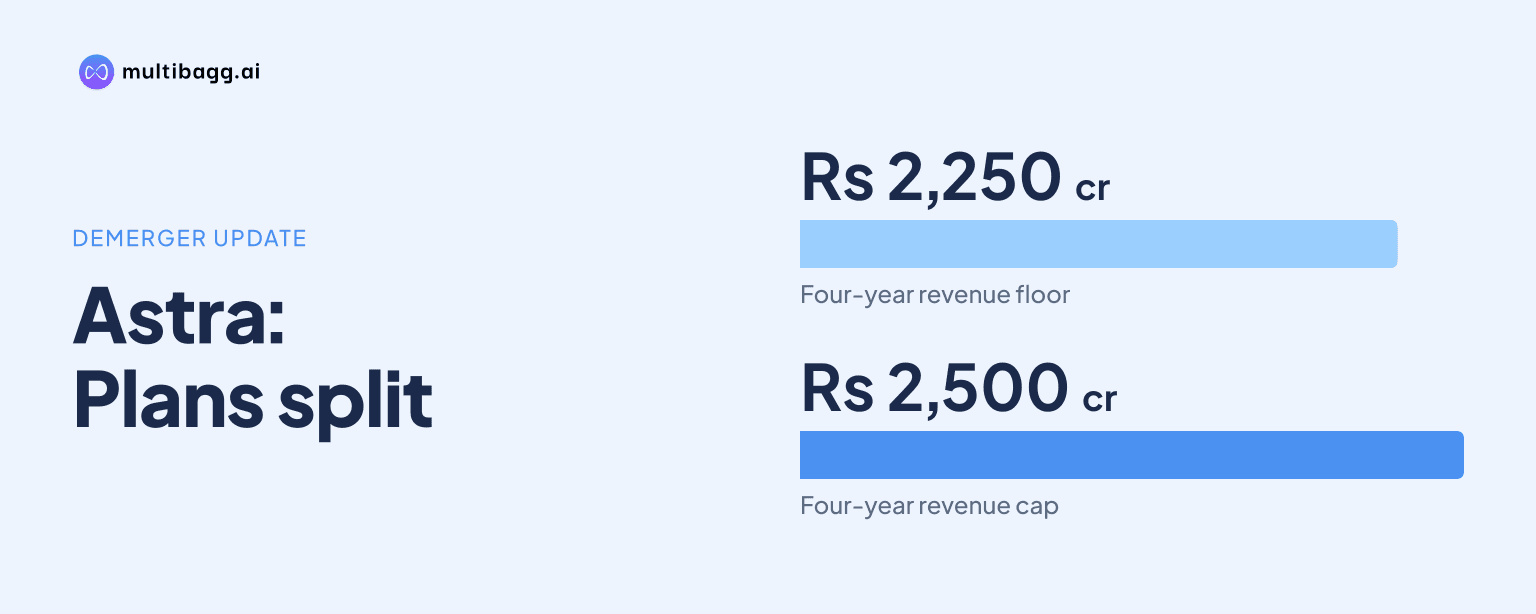
Astra Microwave Products Limited said on November 13, 2026 that shareholders will receive one Astra Space Technologies Limited, or ASTL, share for every Astra share held when the demerger is completed, with management projecting Rs 2,250 crore to Rs 2,500 crore of cumulative ASTL revenue over the next four years.
Know Astra Microwave Products inside out
Results, valuation, peers and who's buying, in one view.
What will Astra shareholders receive in the demerger?
Astra shareholders will receive one ASTL share for each Astra share they hold when the scheme is completed. Director of Strategy and Business Development Atim Kabra said shareholders would not have to pay for the ASTL shares, and their ownership percentage in ASTL would mirror their ownership percentage in Astra.
The proposal separates the space, meteorology and hydrology activities from Astra's defence and aerospace operations. Managing Director M.V. Reddy, who assumed the role on October 1, 2026, said the separation is intended to create two focused businesses with their own priorities and capital allocation, while allowing shareholders to hold each business directly.
What businesses will ASTL contain after the separation?
ASTL will contain the space, meteorology and hydrology businesses, including space-grade components, subsystems, assembly, integration and testing, ground stations, satellite-bus design, satellite assembly, and space-data analytics. Kabra said ASTL will not enter the launch business, leaving launches to partners while pursuing payload electronics, radio-frequency subsystems and ground infrastructure.
Management said Astra has held Indian Space Research Organisation, or ISRO, certifications for nearly two decades. It estimated its hardware contributes 30% to 40% of hardware in ISRO remote-sensing payloads and 25% to 35% in communication payloads; these are management estimates rather than audited market-share figures.
The weather business includes Doppler weather radars, wind profilers and automatic weather stations, with more than 1,700 installations in Indian Meteorological Department networks. Management said its longer-term plan is to develop radar software and artificial intelligence-driven forecasting as a service, combining satellite, ground and atmospheric data for agriculture, disaster management and aviation.
What revenue and order targets has Astra outlined for ASTL?
Management expects ASTL to generate Rs 2,250 crore to Rs 2,500 crore of cumulative revenue over the next four years and annual revenue of about Rs 800 crore to Rs 900 crore by FY31. Kabra said the FY31 range reflects current visibility and does not include revenue from potential global supply-chain business.
ASTL starts with an order book of around Rs 900 crore and a weather inquiry pipeline of around Rs 2,000 crore. The inquiry pipeline is not a confirmed order book, and management did not disclose a conversion rate or timing, leaving future revenue dependent on execution and the conversion of weather opportunities.
The targets contrast with Astra's reported first-half FY27 financial performance. For the six months ended September 30, 2026, Astra reported consolidated revenue of Rs 437 crore, earnings before interest, tax, depreciation and amortisation of Rs 120 crore, and profit after tax of Rs 57 crore, producing margins of 27.4% and 13%, respectively.
Got a follow-up? Ask IRIS
What business will remain with Astra after the demerger?
Astra will retain its core defence and aerospace operations, including radar, electronic warfare, telemetry and internal-security products and solutions. Its standalone order book stood at Rs 3,937 crore as of September 30, 2026, compared with a consolidated order book of Rs 4,708 crore, including Rs 251 crore of service orders.
Quarterly order inflows of Rs 2,036 crore in Q2 FY27 were dominated by radar orders of Rs 1,967 crore, versus Rs 36 crore from electronic warfare, Rs 17 crore from telemetry and Rs 16 crore from space. The largest disclosed award was a Rs 1,844 crore Uttam order from Hindustan Aeronautics Limited, showing that Astra's near-term backlog remains primarily defence-led.
Astra also delivered a counter-drone radar to the Defence Research and Development Organisation for final integration and trials during Q2 FY27. Management said several projects, including surveillance and tracking radars, radio-frequency seekers, broadband jammers, ammunition electronics and enhanced Doppler weather radar, were expected to enter field trials from the next quarter.
How does the demerger fit Astra's wider growth plan?
Astra is positioning the separation as a way to provide dedicated management attention to the two businesses while retaining its defence production base. For FY27, management guided for approximately 15% top-line growth, targeting revenue of Rs 1,300 crore to Rs 1,350 crore and a steady-state earnings before interest, tax, depreciation and amortisation margin of 26% to 28%.
Management also said it was targeting turnover near Rs 2,000 crore, plus or minus Rs 100 crore, in FY29 and aimed to be near debt-free within one to one-and-a-half years. It expects the consolidated order book to reach around Rs 5,500 crore to Rs 5,600 crore in FY28, excluding the main quick-reaction surface-to-air missile order.
The company cited visibility for Rs 200 crore of further orders in FY27 and said Rs 600 crore of concluded orders were expected by the following month. These figures were not linked specifically to ASTL, while management said discussions with global space-sector players were under way but had not resulted in a disclosed contract.
Conclusion
The proposed one-for-one distribution would give Astra shareholders direct ownership of ASTL without a stated cash payment, while Astra retains defence, radar, electronic warfare and telemetry activities. The disclosed commercial bases differ: Astra had a Rs 4,708 crore consolidated order book at September 30, 2026, while ASTL had an order book of around Rs 900 crore and a Rs 2,000 crore weather inquiry pipeline.
The next developments are completion of the demerger scheme, conversion of ASTL's weather inquiries and progress toward management's FY31 revenue expectation of Rs 800 crore to Rs 900 crore. Astra also expects several development programmes to enter field trials from the next quarter, while global space discussions remain at an undisclosed stage.