










Astra Microwave targets Rs 3,000-5,000 crore counter-drone market
Key highlights
- Astra estimates a Rs 3,000-5,000 crore counter-drone market over the next five years.
- Astra hopes to win at least 30% of the counter-drone market that opens up.
- Astra's current counter-drone product uses jammer-based soft kill, with hard-kill options planned for future years.
- Astra sees at least Rs 1,000 crore of LLLR opportunity over five years.
powered by IRIS
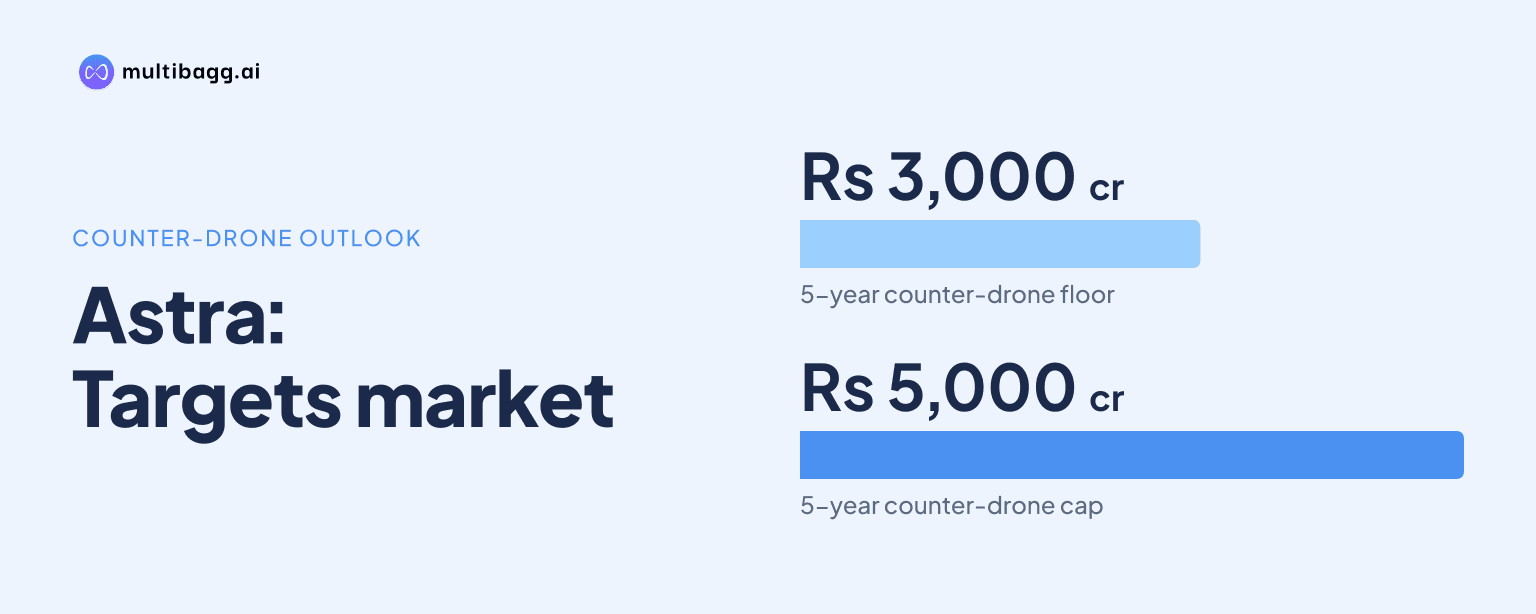
Astra Microwave said its radar-led counter-drone system addresses a Rs 3,000-5,000 crore market over the next five years, with a jammer-based soft-kill product already demonstrated to customers and hard-kill options under development. Management said Astra has entered several competitive inquiries and hopes to secure at least 30% of the market that opens up.
Know Astra Microwave Products inside out
Results, valuation, peers and who's buying, in one view.
What is Astra's counter-drone market opportunity?
Astra estimates the counter-drone market for its offering at Rs 3,000-5,000 crore over the next five years, making it the largest stated opportunity among its three newly introduced products. Management said the company is hopeful of winning a minimum 30% of the market that opens up, while noting that current inquiries are competitive bids.
The counter-drone estimate exceeds the Rs 200-300 crore opportunity Astra identified for its bird-detection radar over the next two to three years and the at-least-Rs 1,000 crore potential it sees for its low-level lightweight radar, or LLLR, over five years. The company has started participating in requests for proposal, or RFPs, for the bird-detection radar, while the LLLR is being developed against an Army requirement.
Management separately referred to indications and reports of a Rs 30,000-50,000 crore opportunity for India's overall counter-drone space. It said that broader estimate depends on available funding, procurement timing and products purchased, and did not present it as Astra's own revenue opportunity or order pipeline.
How does Astra's counter-drone system work?
Astra's current counter-drone offering combines its detection radar with a jammer-based soft-kill solution, while hard-kill options are being developed for future years. Management said the radar, referred to as the D4 radar in its product presentation, is the backbone of the complete system that Astra has demonstrated to a couple of customers.
The radar was developed using technology transfer, or TOT, from the Defence Research and Development Organisation, or DRDO, which Astra said it optimised for customer requirements and competitiveness. The jammer is designed to identify frequencies within a specified band and attempt to negate them, including non-standard frequencies that management said could be used by damaging drones.
Management said soft kill may not work against fibre-guided drones or drones that turn off radio-frequency communications. In those cases, the company expects radar detection and tracking to help align a physical response. Astra is integrating remote weapon firing systems, gun-mounted servo platforms and kamikaze drones with its radars, but disclosed no commercial launch date, customer or order value for a hard-kill configuration.
Why does Astra consider its radar-led system different?
Astra says it is among the few providers with a complete independent radar of its own, which management described as an important distinction for counter-drone applications. The company said a radar-led configuration can provide detection and tracking before a jammer or hard-kill layer responds, giving operators response time against incoming drones.
Management did not specify a target-detection count, frequency-band range or performance comparison with competing systems. Instead, it argued that the ability to detect drones that are not using standard advertised communication frequencies, or are not using radio-frequency communications at all, makes the radar central to the system's intended adaptability.
Astra also cited its DRDO TOT position. Management said the earlier licence was issued to seven companies apart from Bharat Electronics Limited, or BEL, but that Astra is, apart from BEL, the only company currently making the product using that TOT. It said Astra has demonstrated the counter-drone radar and booked sales, without disclosing the customer, sales value or delivery schedule.
Got a follow-up? Ask IRIS
How does counter-drone fit Astra's wider product plan?
Astra places counter-drone systems within a three-product programme it said was completed by Diwali, alongside its bird-detection radar and LLLR. The LLLR has a stated range of about 40-50 kilometres, and management said more than 25 kilometres had already been demonstrated before participation in forthcoming tenders.
For the bird-detection radar, Astra said demonstrations are under way and it has submitted a bid under its first RFP. Management expects further domestic and export inquiries. It estimated Rs 200-300 crore of business from this radar over two to three years, compared with at least Rs 1,000 crore of visibility for LLLR over five years.
Management said the product programme reflects a shift from supplying subsystems to selling complete, branded systems with intellectual property, or IP, owned by Astra. The company said it is using in-house digital signal processing and radar data processing, while filling product gaps one at a time across radio-frequency, microwave and radar technology.
This strategy sits within management's expectation of an Rs 8,000-10,000 crore defence order base building over coming years, with a substantial part already in hand. That is an outlook for Astra's broader defence business rather than a counter-drone revenue forecast. Management also expects ARC, its 50% joint venture with Rafael of Israel, to close the year with revenue of around Rs 600-700 crore.
What could determine Astra's conversion into orders?
Astra's counter-drone revenue will depend on whether the inquiries it has entered turn into awards, because management described them as competitive bids and did not disclose their number or value. The company's stated 30% share objective therefore cannot yet be compared with a disclosed counter-drone order book.
Product development is another variable. Astra currently offers soft kill through a jammer, whereas the remote weapon systems, servo platforms and kamikaze-drone integrations are planned for future years. Management's rationale is that changing drone technology, including fibre guidance, could require responses beyond radio-frequency jamming.
The wider execution plan also involves inventory and cash conversion. Management said it expects year-end revenue of Rs 1,300-1,350 crore and that substantial deliveries in the next two quarters explain inventory build-up. It also said some components have longer lead times, leading Astra to stockpile material for even the first quarter of the next financial year.
Management targets a working-capital cycle of around 350 days by year-end, compared with 374 days cited by an analyst, and around 360-370 days thereafter. It expects receivables and inventory to be more or less in line with sales over the next 18 months. These targets cover the wider business, not counter-drone operations alone.
Conclusion
Astra's Rs 3,000-5,000 crore counter-drone estimate is based on a product strategy that starts with its own radar and a jammer-based soft-kill system rather than a stand-alone jammer. The category is larger than the opportunities management quantified for its bird-detection radar and LLLR, but its commercial outcome remains dependent on competitive procurement awards.
The next items to watch are conversion of the disclosed counter-drone inquiries into orders, customer demonstrations and progress on hard-kill integrations planned for future years. Management also plans to participate in forthcoming LLLR tenders, expects additional bird-radar inquiries, and targets Rs 1,300-1,350 crore of year-end revenue alongside a working-capital cycle of around 350 days.