










Astra Microwave Products Limited Reports 27.4% H1 Margin
Key highlights
- Astra reported H1 FY27 revenue of ₹437 crore.
- H1 FY27 EBITDA was ₹120 crore, translating into a 27.4% margin.
- H1 FY27 profit after tax was ₹57 crore, with a 13% PAT margin.
- Astra previously disclosed a total order book of ₹4,300 crore after a strategic order.
powered by IRIS
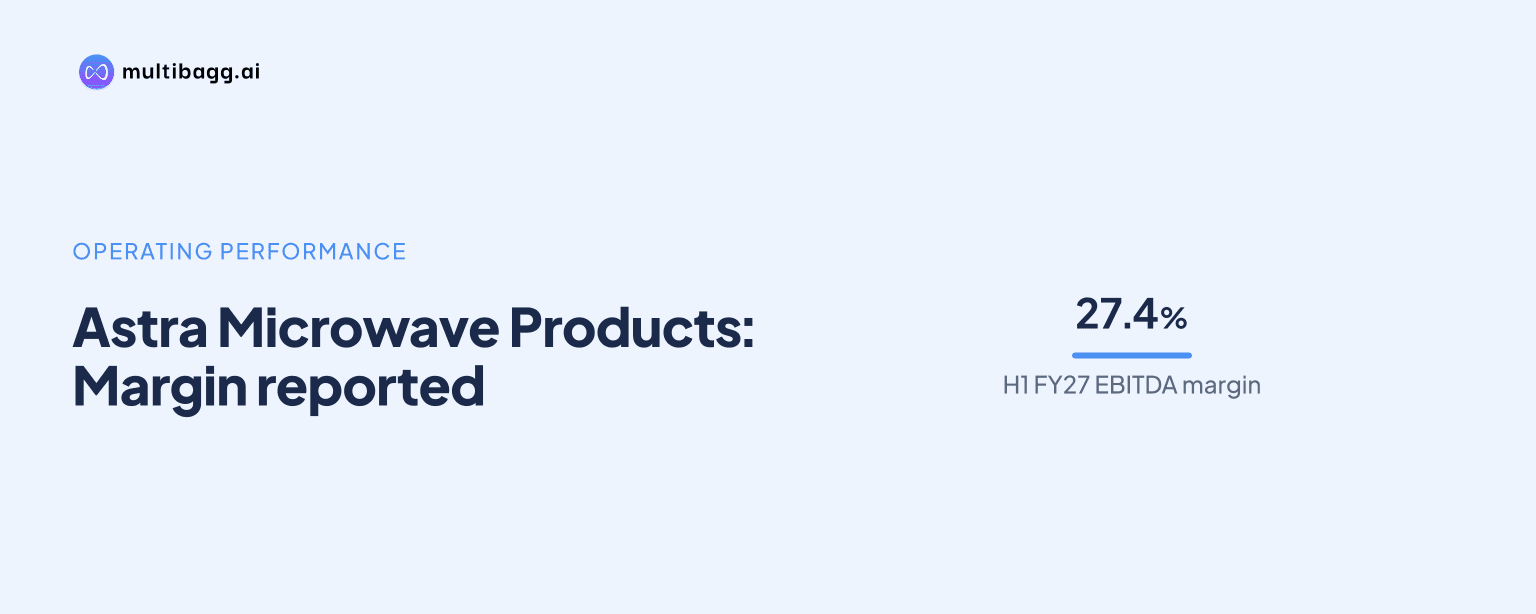
Astra Microwave Products Limited reported H1 FY27 revenue of ₹437 crore, EBITDA of ₹120 crore and an EBITDA margin of 27.4%, its highest reported half-year EBITDA and PAT performance in both absolute terms and margins. Management attributed the result to domestic defence production-order execution, a favourable product mix and tighter operating-expense control.
Know Astra Microwave Products inside out
Results, valuation, peers and who's buying, in one view.
What did Astra report for H1 FY27?
Astra reported revenue of ₹437 crore for the first half of FY27, with EBITDA of ₹120 crore and profit after tax of ₹57 crore. The EBITDA margin was 27.4%, while the PAT margin stood at 13%. Management described both EBITDA and PAT as the highest yearly numbers the company has reported, in absolute terms as well as margins.
The H1 figures were presented during Astra’s post-results earnings call on November 13, 2026. The company said the half-year performance was strong, led by execution of domestic defence production orders. It also linked the margin improvement to a favourable product mix and better control over operating expenses.
The disclosed figures indicate that profitability grew faster than revenue during the half year, reflected in the 27.4% EBITDA margin. However, the call excerpt does not provide a separate Q2 revenue, EBITDA or PAT figure, or a year-on-year comparison for the H1 FY27 financial metrics. Investors therefore have a half-year view of the reported performance rather than a full quarter-by-quarter comparison from the supplied material.
Why did Astra’s profitability improve in H1 FY27?
Astra said its profitability improved because of a favourable product mix from domestic defence production orders and better operating-expense management. These factors helped the company report a 27.4% EBITDA margin and a 13% PAT margin in the first half of FY27.
Product mix can materially affect margins for engineering and defence-electronics companies because different programmes may carry different levels of manufacturing complexity, development work and value addition. In this case, management specifically identified domestic defence production-order execution as the main contributor to the reported H1 outcome.
The company maintained EBITDA-margin guidance of 26% to 28%. The reported H1 margin of 27.4% falls within this range. This matters because it places the half-year result within the profitability band management has communicated rather than indicating a change to its stated operating target.
Management also referred to large-order visibility, new owned radar products and the ASTL demerger as factors shaping the company’s growth outlook. The supplied call material does not disclose financial terms, timing or transaction details for the demerger, so its direct earnings effect cannot be quantified from the available information.
Got a follow-up? Ask IRIS
How does the order book support Astra’s operations?
Astra’s earlier FY27 call disclosed a standalone order book of ₹2,156 crore at the end of Q1, with 66% related to defence and 34% to space, meteorology and hydrology. Management subsequently said a major strategic order had lifted its total order book to ₹4,300 crore as of that call date.
The Q1 order-book update provides context for the H1 performance. A substantial defence share supports management’s explanation that domestic defence production orders drove the half-year product mix. The order book also offers visibility into work that is yet to be executed, although it does not establish the timing of revenue recognition or future margins.
During the Q1 call, Astra said it had received new orders worth ₹195 crore in the quarter and reported Q1 revenue of ₹182 crore. Management also described a strategic order received at the end of July 2026 as the largest in the company’s history. These disclosures preceded the H1 earnings call and show the operating backdrop entering the second quarter.
What does the H1 result mean for investors and the defence sector?
The H1 result shows that Astra converted domestic defence production activity into a 27.4% EBITDA margin while retaining its 26% to 28% margin guidance. For investors, the key reported indicators are the ₹437 crore half-year revenue base, ₹120 crore EBITDA and ₹57 crore PAT, alongside the order-book disclosures made earlier in FY27.
The company operates in an environment where India’s defence industry is increasingly focused on indigenous design, development and manufacturing of advanced subsystems and systems. Astra had previously said businesses with established engineering capabilities could benefit from this transition. The H1 performance offers evidence of demand translating into production execution, but the supplied transcript does not provide a revised full-year revenue target.
The result also has relevance for industry operations because domestic production programmes can support order flow for specialised electronic and radar-system suppliers. Still, the reported figures should be assessed alongside execution schedules, customer approvals and the composition of future orders. In an earlier FY27 call, management had cited temporary delays in customer approvals and the closure of technical issues as factors affecting quarterly performance.
Conclusion
Astra Microwave Products Limited delivered H1 FY27 revenue of ₹437 crore, EBITDA of ₹120 crore and PAT of ₹57 crore, with margins of 27.4% and 13%, respectively. Management linked the record profitability to domestic defence production orders, a favourable mix and operating-expense discipline, while its stated EBITDA-margin guidance remained unchanged at 26% to 28%.
The next areas to watch are execution against the large order book, progress on new owned radar products and developments related to the ASTL demerger. The company has also highlighted large-order visibility, but the supplied disclosure does not specify the timing or financial impact of those opportunities.