










Augmont Enterprises Limited expects NSE EGR launch this quarter
Key highlights
- Augmont expects the NSE electronic gold receipt product to start this quarter.
- Augmont estimates Indian households hold around 31,000 tonnes of privately held gold.
- Augmont's recycling contribution rose to 24.5% from 3% after an eightfold year-on-year increase.
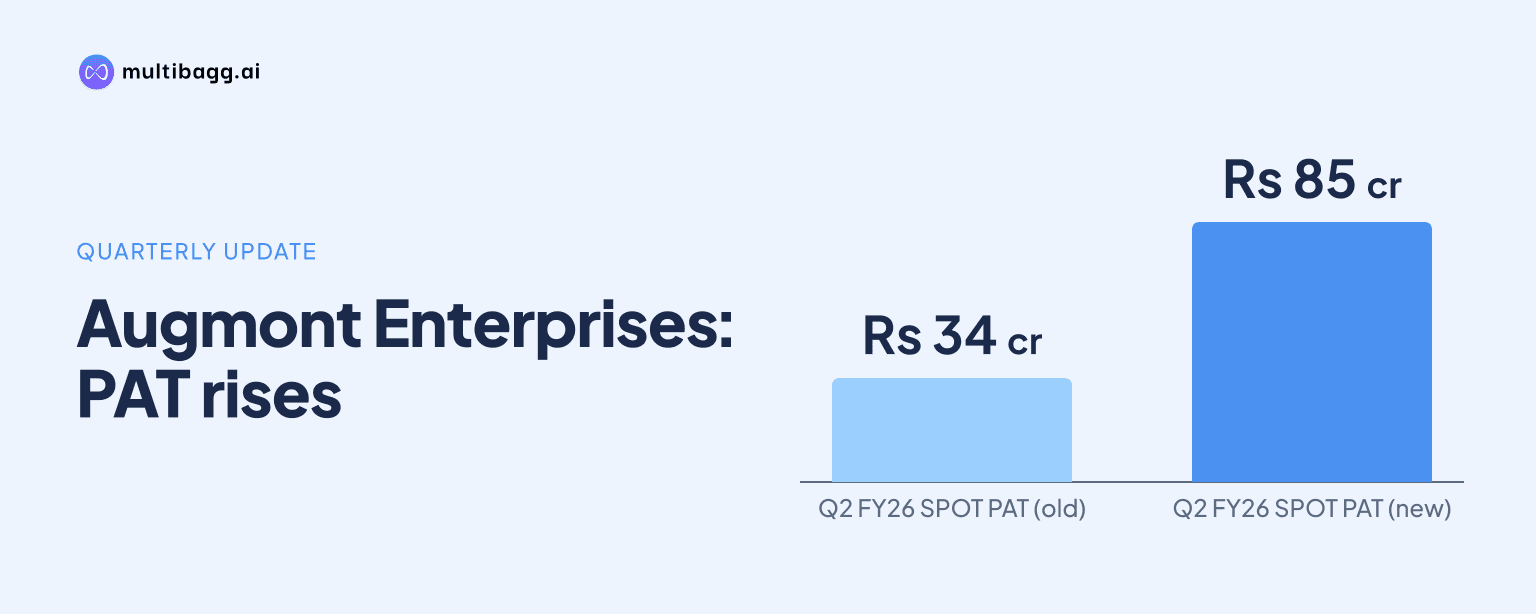
- Augmont's SPOT platform PAT rose to Rs 85 crore from Rs 34 crore in Q2 FY26.
powered by IRIS
Augmont Enterprises Limited expects the National Stock Exchange electronic gold receipt product to start this quarter, with Augmont serving as an authorised EGR liquidity provider, collection-centre service and physical-delivery provider. Management did not estimate revenue or profit, despite citing 31,000 tonnes of privately held gold in Indian households.
Know Augmont Enterprises inside out
Results, valuation, peers and who's buying, in one view.
When will Augmont's NSE EGR product go live?
Augmont expects the electronic gold receipt, or EGR, product to begin this quarter, although integrations and go-live work remain under way. Sachin Kothari described EGR as a new category launched by the National Stock Exchange, or NSE, and said the immediate focus is establishing the ecosystem rather than projecting an early financial contribution.
The timing was provided after an analyst asked about the opportunity's topline, bottom-line value and longer-term timetable. Management said it was too early to quantify the EGR opportunity or provide a specific outlook, but said Augmont's refining, sourcing, technology and distribution capabilities position it to participate. The disclosed target is therefore a launch within the current quarter, not a revenue, profit, volume or adoption target.
NSE chose Augmont as its partner for the product, according to the presentation, and the company said it has been working with the exchange on the technology stack. Augmont's existing ETF activity includes authorised-participant and market-making roles in gold and silver exchange-traded funds, or ETFs, covering primary-market creation and redemption as well as secondary-market bid and ask liquidity.
How will Augmont EGRs convert physical gold into demat holdings?
Augmont says physical gold will be deposited and verified at a vault before an EGR is created and held in a demat account. The receipt can then be bought or sold on the exchange, while holders may pledge it, redeem it as physical gold coins from 1 gram, or lend it through the securities lending and borrowing platform for annual interest.
The process is intended to accept old gold as well as other physical gold. Augmont says old gold can be converted into EGRs at its outlets, and that the receipt can then be lent to manufacturers for manufacturing use. Management presented this route as a means of putting some of India's estimated 31,000 tonnes of household gold into productive use and reducing reliance on imports.
EGRs differ from digital gold and ETFs in Augmont's description. EGRs are backed by physical gold and exchange traded, whereas digital gold is not exchange traded. The company also said ETF units do not have a 1:1 gold ratio because fund houses maintain a cash component for expenses, while EGRs provide 1-gram physical redemption and a lending mechanism.
What will Augmont do and earn in the EGR market?
Augmont will act as an authorised gold liquidity provider, authorised EGR liquidity provider and collection-centre service in the EGR segment. Its role will include converting old gold into EGRs at its outlets and providing physical delivery, using its refineries, licences, distribution infrastructure and technology platform.
Management said Augmont will earn spreads, delivery charges and minting charges. It compared this model with digital gold, where Augmont handles pricing and partnerships while custody is held by a third-party independent custodian and verified daily. The EGR route adds small-unit physical delivery, which management said is unavailable in gold ETFs.
The company has 20 delivery centres, more than 5,300 dealers on its platform and around 250 fintech partnerships, according to the presentation. It also said its technology systems reached 54 million retail customers, up from 28 million in FY24, while employee cost fell to 0.03% from 0.06% as costs were spread over a larger customer base. These are existing-platform metrics rather than EGR forecasts.
Got a follow-up? Ask IRIS
What supports Augmont's old-gold collection opportunity?
Augmont's recycling business increased eightfold year on year, and recycling's contribution to sourcing rose to 24.5% from 3%. That sourcing capability is relevant to EGR because the proposed collection model allows customers to bring old gold to Augmont outlets for conversion into demat-held receipts.
Management said its two refineries and multiple centres allow it to refine old jewellery into pure bars. It also said higher recycling provides a cushion if imports become difficult and supports relationships with jewellers seeking India Good Delivery bars. The company did not disclose how much recycled gold will enter the EGR system after the expected launch this quarter.
The recycling mix also affects working capital and reported revenue. Management said imported gold can have a working-capital cycle of less than two days, compared with as much as four days for scrap gold. As capital remains committed for longer when sourcing scrap, revenue rotation can decline even as Augmont earns margins on both procurement and the sale of refined finished goods.
How does Augmont's recent performance frame the EGR plan?
Augmont reported that its SPOT platform profit after tax, or PAT, rose to Rs 85 crore from Rs 34 crore in Q2 FY26, while PAT margin increased to 0.65% from 0.18% despite lower revenue. Management attributed the revenue decline partly to the higher share of recycling, which lengthened the working-capital cycle relative to imported gold.
The presentation also said SPOT platform PAT of Rs 85 crore was 3.9 times Q1 FY27, while earnings before interest, tax, depreciation and amortisation, or EBITDA, rose to Rs 113 crore from Rs 50 crore a year earlier. For the first half, PAT was Rs 107 crore, 75% higher than FY26 and about 70% of the Rs 153 crore full-year PAT cited for FY26.
Augmont said the Rs 620 crore fresh issue was used according to the objectives in its red herring prospectus. Management separately outlined plans to add SPOT delivery centres and jewellers beyond the existing 20 centres, expand consumer partnerships and add products including diamonds, alloys and chemicals. These plans concern the wider business and do not amount to EGR financial guidance.
Conclusion
Augmont's EGR plan combines an exchange-traded demat format with physical-gold collection, liquidity provision and 1-gram redemption. Its recycling expansion, two refineries and existing delivery network could support old-gold conversion, while the 31,000-tonne household-gold estimate explains why management views formalisation as a significant longer-term opportunity.
The next event to watch is whether the NSE product starts this quarter after the stated integration work is completed. Management has not set EGR revenue, profit, volume or adoption targets, so subsequent disclosures on launches, collection-centre activity, liquidity provision and physical redemptions will be needed to assess the commercial rollout.