










Augmont scrap mix reaches 24.5% as Q2 EBITDA margins expand
Key highlights
- Augmont raised scrap’s procurement share from about 3% in Q2 FY26 to roughly 24.5% in Q2 FY27.
- Q2 FY27 consolidated EBITDA rose 16% year on year to Rs 181 crore and EBITDA margin reached 1.14%.
- Q2 FY27 consolidated PAT was Rs 120 crore, up 7% year on year, while revenue declined 27% to Rs 15,836 crore.
- Scrap takes three to four days of working capital, compared with 1.8 to two days for regular procurement flows.
powered by IRIS
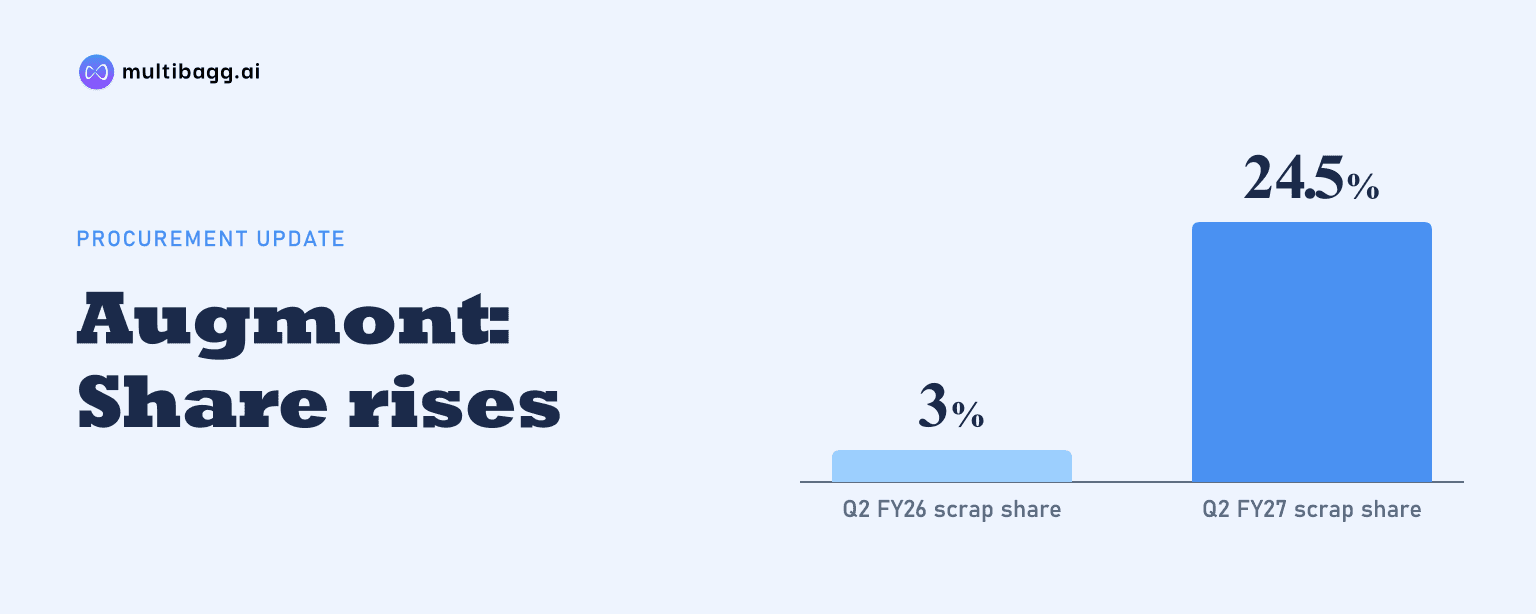
Augmont Enterprises Limited increased scrap’s share of total procurement to roughly 24.5% in Q2 FY27 from about 3% in Q2 FY26, while consolidated EBITDA margin rose to 1.14% from 0.72%. Management said the higher-margin scrap mix lengthened working-capital cycles but supported profitability despite a 27% fall in revenue.
Know Augmont Enterprises inside out
Results, valuation, peers and who's buying, in one view.
Why did Augmont increase scrap procurement?
Augmont increased scrap procurement to expand domestic sourcing and reduce dependence on imported gold. Scrap’s share of total procurement rose about eightfold, from approximately 3% in Q2 FY26 to roughly 24.5% in Q2 FY27. Management said the change supports India’s objective of reducing gold-import dependence, retailer relationships and a formal gold value chain.
The recycling route brings gold and silver scrap from retailers into Augmont’s refining system. Its two refineries, in Rudrapur and Mumbai, have combined capacity of 284 tonnes per annum, or TPA, which the company describes as India’s second-largest refining capacity. The refineries process scrap and doré, or semi-refined gold, into high-purity bullion.
Scrap sits alongside four other stated supply routes: nominated Indian banks, international banks, doré-bar imports and India International Bullion Exchange, or IIBX, imports through GIFT City. Augmont said its SPOT platform enables market-linked buying from verified counterparties across these channels. The company’s multi-source model was also relevant when silver faced import restrictions during H1 FY27.
How did the scrap mix affect Augmont’s Q2 FY27 earnings?
Augmont said the higher-margin scrap mix contributed to consolidated EBITDA, or earnings before interest, tax, depreciation and amortisation, rising 16% year on year to Rs 181 crore in Q2 FY27. EBITDA margin increased by 42 basis points, or bps, to 1.14% from 0.72% in Q2 FY26. Consolidated profit after tax, or PAT, rose 7% to Rs 120 crore from Rs 113 crore.
The sequential comparison showed a similar change in margins. Q2 FY27 EBITDA margin was 1.14%, compared with 0.44% in Q1 FY27, while PAT margin was 0.76%, compared with 0.32%. EBITDA increased from Rs 84 crore in Q1 FY27 to Rs 181 crore, and PAT rose from Rs 61 crore, although revenue declined from Rs 18,946 crore.
Revenue from operations fell 27% year on year to Rs 15,836 crore in Q2 FY27, which management attributed partly to softer demand, government measures affecting gold and silver flows, and the sourcing decision. Management said the company accepted lower reported revenue and fewer capital turns in exchange for higher-margin procurement. This explanation distinguishes the earnings outcome from a simple sales-volume expansion.
Got a follow-up? Ask IRIS
What working-capital cost did Augmont accept for scrap?
Augmont accepted a longer working-capital cycle because scrap takes three to four days, compared with 1.8 to two days for regular flows. Management said the additional time ties up more capital, reduces capital turns and lowers reported revenue. It nevertheless described the decision as a trade-off for improved earnings mix and domestic sourcing depth.
The SPOT enterprise platform is working-capital-intensive, and Augmont says bank debt cannot fund gold purchases, requiring equity-funded working capital for growth. Higher metal prices further reduced the quantity of bullion that available capital could buy in Q2 FY27. Gold enterprise volume fell to 7.6 metric tonnes from 15.9 metric tonnes in Q2 FY26, while silver volume declined to 113.0 metric tonnes from 315.4 metric tonnes.
Higher price realisations did not offset the volume change in enterprise revenue. Gold realisation increased to Rs 14,839 per gram in Q2 FY27 from Rs 10,351 per gram a year earlier, while silver realisation rose to Rs 228 per gram from Rs 122 per gram. Enterprise revenue declined 32% year on year to Rs 13,852 crore, whereas consumer revenue increased 47% to Rs 1,984 crore.
The half-year comparison was less pronounced than the quarterly result. H1 FY27 revenue was Rs 34,781 crore, 4% below Rs 36,244 crore in H1 FY26, while EBITDA rose 2% to Rs 265 crore from Rs 259 crore. PAT was Rs 181 crore, compared with Rs 185 crore, and management cited moderation in international sales in discussing the period.
Can Augmont sustain the margin benefit from scrap?
Augmont expects the higher-margin contribution from scrap to carry forward, with management calling the benefit structural rather than a one-quarter effect. Standalone Q2 FY27 PAT was Rs 85 crore, about 2.5 times Q2 FY26 and 3.9 times Q1 FY27. Standalone EBITDA rose to Rs 113 crore from Rs 50 crore a year earlier.
Management identified silver as the second contributor to standalone profitability, but characterised that gain as situational. It said Augmont obtained a Directorate General of Foreign Trade licence and imported through IIBX after silver became a restricted commodity, while some market participants faced supply constraints. The company said this benefit depends on current import restrictions and should not be treated as a sustainable run-rate factor.
Augmont’s agreement with the National Stock Exchange for Electronic Gold Receipts, or EGRs, provides another stated route for formalising physical gold. The presentation says EGR holders can trade, pledge, redeem or lend through securities lending and borrowing, while old gold can be exchanged for EGRs. Augmont lists authorised gold liquidity provider, authorised EGR liquidity provider and collection-centre services among its EGR roles.
The consumer-facing Gold For All platform can also feed the recycling ecosystem through its sell-old-gold offering, which returns metal to the refinery. Gold For All accounted for 7.1% of FY26 revenue, compared with 92.9% for SPOT. As of 30 September 2026, Augmont reported 245 digital-gold partner brands, 751 channel partners for coins and bars, and 52.3 million registered consumers.
Conclusion
Augmont’s shift from about 3% scrap procurement in Q2 FY26 to roughly 24.5% in Q2 FY27 changed the balance between revenue turnover and margins. Consolidated revenue fell to Rs 15,836 crore, while EBITDA rose to Rs 181 crore and PAT reached Rs 120 crore. Management’s stated rationale is that a longer three-to-four-day scrap cycle can support a more profitable domestic sourcing mix than regular flows.
The next disclosed issues to watch are whether scrap remains a structural contributor, as management expects, and whether its longer working-capital cycle continues to constrain capital turns. Investors can also track the distinction management makes between recurring scrap economics and the situational silver-import benefit, along with operating progress under the National Stock Exchange EGR agreement.