










Augmont Q2 EBITDA rises 16% as quarterly revenue declines 27%
Key highlights
- Augmont reported Q2 FY27 revenue of ₹15,836 crore, down 27% year-on-year.
- Q2 FY27 EBITDA increased 16% year-on-year to ₹181 crore and EBITDA margin reached 1.14%.
- Consumer revenue rose 47% year-on-year to ₹1,984 crore, while enterprise revenue declined 32% to ₹13,852 crore.
- Domestic scrap procurement reached roughly 24.5% of Q2 FY27 procurement, compared with about 3% in Q2 FY26.
powered by IRIS
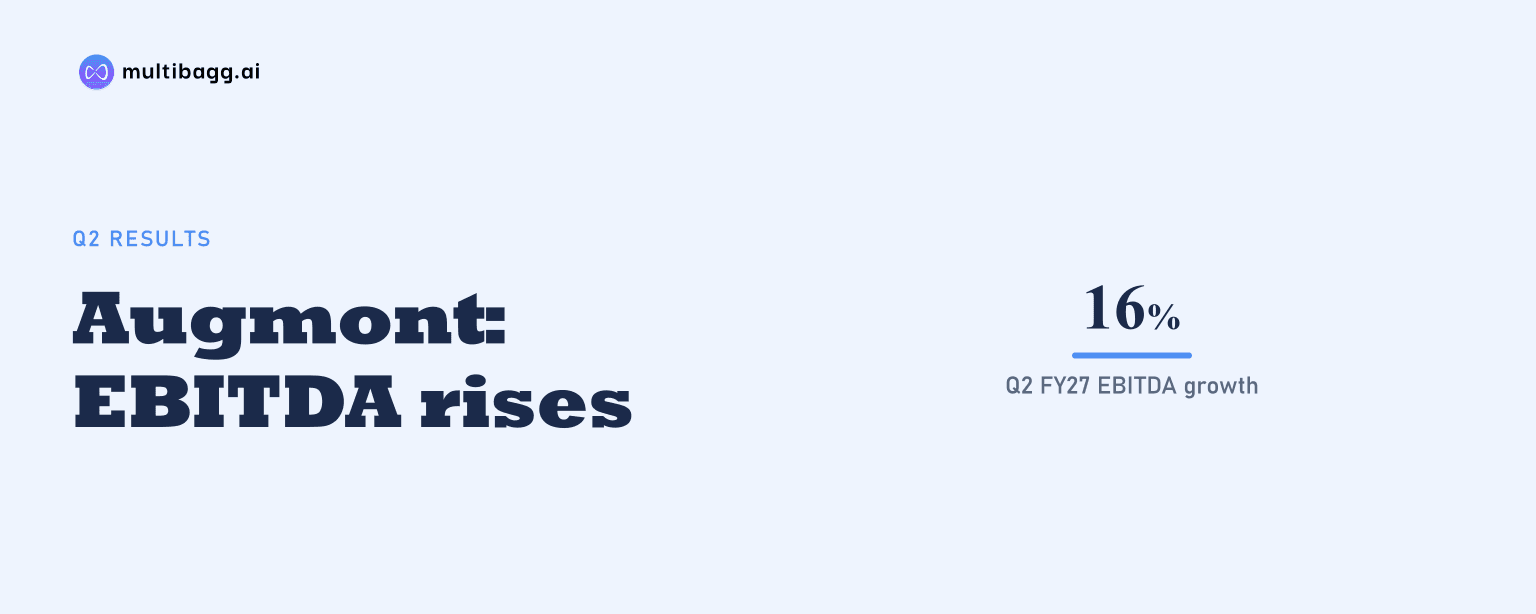
In Q2 FY27, Augmont Enterprises Limited increased EBITDA 16% year-on-year to ₹181 crore even as revenue from operations declined 27% to ₹15,836 crore, as EBITDA margin rose to 1.14% from 0.72% and consumer revenue grew 47% to ₹1,984 crore. Profit after tax increased 7% to ₹120 crore.
Know Augmont Enterprises inside out
Results, valuation, peers and who's buying, in one view.
Why did Augmont’s Q2 FY27 revenue decline?
Augmont’s Q2 FY27 revenue declined because enterprise bullion volumes fell as higher gold and silver prices reduced the tonnes that available working capital could buy, while management increased domestic scrap procurement. Revenue from operations was ₹15,836 crore, versus ₹21,692 crore in Q2 FY26 and ₹18,946 crore in Q1 FY27, a decline of 27.0% year-on-year and 16.4% quarter-on-quarter.
Enterprise revenue fell 32% year-on-year to ₹13,852 crore, whereas consumer revenue increased 47% to ₹1,984 crore. The half-year comparison was less pronounced: H1 FY27 revenue was ₹34,781 crore, 4% below ₹36,244 crore in H1 FY26. The Q2 change therefore reflected a sharp decline in the larger enterprise segment rather than an overall contraction in consumer sales.
Augmont SPOT, which management said accounts for most of the enterprise business, is working-capital-intensive. Gold enterprise volume fell to 7.6 metric tonnes in Q2 FY27 from 15.9 metric tonnes in Q2 FY26, while silver volume declined to 113.0 metric tonnes from 315.4 metric tonnes. Gold realisation increased to ₹14,839 per gram from ₹10,351 per gram, and silver realisation rose to ₹228 per gram from ₹122 per gram.
How did Augmont raise profit despite lower revenue?
Augmont raised profit because its Q2 FY27 EBITDA margin reached 1.14%, compared with 0.72% in Q2 FY26 and 0.44% in Q1 FY27. EBITDA, calculated in the presentation as profit before tax plus finance costs and depreciation and amortisation, was ₹181 crore, versus ₹156 crore a year earlier and ₹84 crore in the preceding quarter.
Profit after tax, or PAT, was ₹120 crore in Q2 FY27, compared with ₹113 crore in Q2 FY26 and ₹61 crore in Q1 FY27. PAT margin rose to 0.76% from 0.52% a year earlier and 0.32% in the previous quarter. Profit before tax increased to ₹161 crore from ₹154 crore year-on-year, while tax expense declined to ₹40 crore from ₹41 crore.
The lower revenue base was accompanied by lower purchases of stock-in-trade, which declined to ₹10,907 crore in Q2 FY27 from ₹15,593 crore in Q2 FY26. Finance costs were ₹18 crore in Q2 FY27, compared with nil in both comparative quarters. For H1 FY27, EBITDA increased 2% to ₹265 crore, while PAT declined 2% to ₹181 crore from ₹185 crore in H1 FY26.
Got a follow-up? Ask IRIS
What did domestic scrap procurement contribute to Augmont’s margins?
Domestic scrap procurement contributed to margin expansion because management said scrap earns higher margins than regular flows. Scrap represented roughly 24.5% of total procurement in Q2 FY27, compared with about 3% in Q2 FY26, an increase management described as about eight times.
Management said the higher scrap share also lowered reported revenue because its working-capital cycle is three to four days, compared with 1.8 to two days for regular flows. Fewer capital turns reduce revenue generated from the same capital base. Management described the trade-off as a move toward higher-margin sourcing and said it expects the scrap benefit to continue.
On a standalone basis, Augmont reported Q2 FY27 PAT of ₹85 crore, about 2.5 times Q2 FY26 and 3.9 times Q1 FY27. Standalone EBITDA rose to ₹113 crore from ₹50 crore in Q2 FY26, while PAT margin was 0.65%, compared with 0.18% a year earlier. H1 FY27 standalone PAT of ₹107 crore was 75% above H1 FY26 and about 70% of FY26 PAT of ₹153 crore.
Management identified a separate silver-related benefit as situational rather than recurring. It said Augmont secured a Directorate General of Foreign Trade licence and imported through India International Bullion Exchange after silver became a restricted commodity, while other market participants faced supply constraints. Management said this benefit depends on current import restrictions.
Is Augmont’s consumer business reducing its reliance on enterprise revenue?
Augmont’s consumer business reduced, but did not eliminate, the effect of enterprise weakness in Q2 FY27, with consumer revenue rising 47% to ₹1,984 crore while enterprise revenue fell 32% to ₹13,852 crore. Enterprise revenue remained about seven times consumer revenue, showing that quarterly consolidated revenue was still chiefly determined by enterprise trading volumes.
Augmont said it served more than 52.3 million registered consumers and has an agreement with NSE for Electronic Gold Receipts, or EGR. The presentation did not state a revenue contribution, launch timetable or financial target for the EGR agreement. Management said the arrangement supports the formalisation of India’s gold ecosystem.
The balance sheet expanded between March 2026 and September 2026, with total assets increasing to ₹2,038 crore from ₹1,257 crore and total equity rising to ₹1,728 crore from ₹933 crore. Trade receivables increased to ₹749 crore from ₹182 crore, while inventories were largely unchanged at ₹341 crore from ₹342 crore. Cash and cash equivalents rose to ₹171 crore from ₹87 crore.
Management said a ₹620 crore fresh issue expanded the equity base ahead of capital deployment. The capital-efficiency table reported annualised return on equity of 27.1% and annualised return on capital employed of 24.6% for H1 FY27, while debt to equity was 0.002 times. Management said future return ratios will reflect the pace at which fresh-issue proceeds are deployed.
Conclusion
Augmont’s Q2 FY27 performance showed that profitability can increase while reported revenue declines when procurement mix, capital turns and segment growth change. The 16% increase in EBITDA to ₹181 crore and 7% rise in PAT to ₹120 crore coincided with lower enterprise volumes, a 47% increase in consumer revenue and a larger share of higher-margin domestic scrap.
The next disclosures should show whether scrap remains close to 24.5% of procurement, whether consumer revenue maintains its Q2 FY27 growth rate, and how quickly the ₹620 crore fresh-issue proceeds are deployed. Management has also said the silver-import benefit is situational, leaving its continuation dependent on the current restrictions and related sourcing conditions.