










Augmont Enterprises Limited: scrap at 24.5%, cash cycle lengthens
Key highlights
- Augmont said scrap gold rose from about 3% of procurement in Q2 FY26 to approximately 24.5% in Q2 FY27.
- Management said the working-capital cycle increased to about four days from roughly two days as scrap suppliers receive advances.
- Augmont's Rs 825 crore IPO included Rs 625 crore of primary proceeds intended for working capital.
- Augmont plans to increase SPOT delivery centres from 20 to 35, with 10 identified for launch in the current financial year.
powered by IRIS
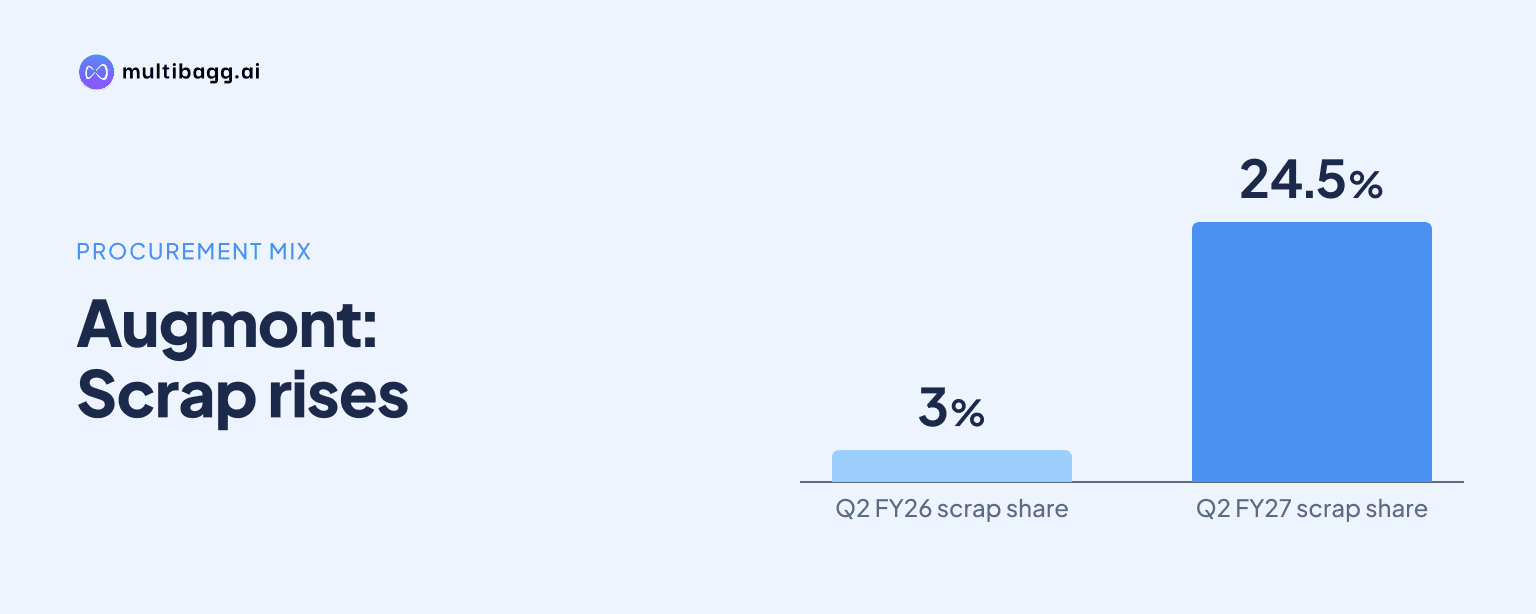
Augmont Enterprises Limited increased scrap gold to approximately 24.5% of procurement in Q2 FY27 from about 3% in Q2 FY26, while management said the higher-margin sourcing mix lengthened its working-capital cycle to about four days from roughly two days. The shift reflects expanded domestic recycling infrastructure and jeweller relationships.
Know Augmont Enterprises inside out
Results, valuation, peers and who's buying, in one view.
Why did Augmont increase scrap-gold procurement?
Augmont increased scrap-gold procurement because it has been building recycling infrastructure and sees domestic old gold as a more stable sourcing channel. Management said the company had focused more on recycling infrastructure during the last couple of quarters, enabling the increase from about 3% of procurement in Q2 FY26 to approximately 24.5% in Q2 FY27.
The old-gold supply is relationship-driven, according to management, coming from jewellers and customers across Augmont's ecosystem rather than only imported material. Management said jewellers are increasingly offering old-gold-for-new-jewellery exchange programmes, which can bring household gold into the organised system. It did not provide a numerical target for scrap's future share because the mix depends on market conditions.
The change means scrap's procurement share was more than eight times higher between the two reported quarters. Management said Augmont has two refineries and is expanding centres to support recycling, but it did not disclose scrap volumes, refinery throughput or a specific margin differential against imports.
How does scrap gold improve Augmont's margins?
Scrap gold can improve Augmont's margins because it earns a spread when it procures old gold and can also earn a margin when refined bars are sold. Management said the spread reflects the difference between bid and ask prices for old gold, alongside handling and refining fees; refined-bar sales have their own margins.
The material reaches Augmont as old jewellery or as an ingot already melted in a jeweller's showroom. Management said the ingots cannot be directly remade into jewellery because they contain impurities, so they must be refined into pure bars first. This refining process creates the procurement and processing mechanism behind recycled sourcing.
Management did not quantify the incremental margin from recycling. It said gold and silver margins can vary with metal prices, demand and supply, procurement opportunities, business mix and supply mix. Therefore, the Q2 FY27 margin improvement associated with scrap sourcing does not establish a fixed future margin level.
Got a follow-up? Ask IRIS
Why has Augmont's working-capital cycle moved to four days?
Augmont's working-capital cycle moved to about four days because it pays advances to scrap suppliers before receiving money from customers, versus roughly two days previously. Management said customer funds generally arrive in three to four days, requiring the company to fund goods during that interval.
The longer cycle affected revenue rotation in the quarter. Management said available balance-sheet capital could be rotated four times under the scrap-led model, and revenue declined as the company focused on this channel. It said margins improved because scrap provides income at both procurement and refined-product sale, creating a trade-off between turnover and spread capture.
Management also said gold businesses cannot leverage their balance sheets through bank funding, making equity-funded working capital important. Augmont's initial public offering was for Rs 825 crore, including Rs 625 crore of primary proceeds. The company said it received the primary proceeds net of issue expenses and had utilised the funds for working capital as set out in its red herring prospectus.
Trade receivables were discussed separately on the call. Management attributed the September-quarter increase to sales on the final day of the period, saying collections were realised in the first week of October. It said this would not necessarily recur each quarter because customers sometimes pay advances instead of leaving a final-days billing balance.
What is Augmont planning to do with the additional capital?
Augmont plans to use working capital to expand its physical delivery network, add jewellers and offer more products through its SPOT platform. Management said it had been constrained at 20 delivery centres and aims to increase that number to 35 over the next couple of years, with 10 identified centres planned to start in coming quarters during the current financial year.
The product plan includes diamonds, alloys and chemicals for the same jeweller base, alongside a larger consumer business. Gold for All accounted for 13% of overall revenue in the reported quarter, compared with 7% for the entire prior financial year. Management did not provide volume data for that business but described the 13% figure as a value contribution.
Augmont also said it intends to pursue more consumer-business partnerships and increase Gold for All centres. It has an aspiration to improve refinery accreditations, including becoming a London Bullion Market Association, or LBMA, accredited refinery. Management did not provide FY27 revenue, profit or margin guidance, saying deployment depends on market opportunities, available spreads and returns available at the time.
Conclusion
Augmont's Q2 FY27 sourcing mix moved materially toward recycled gold, with scrap reaching approximately 24.5% of procurement from about 3% a year earlier. Management said the route produces income at procurement and refined-bar sale, while supplier advances extend the working-capital cycle to about four days and reduce capital turnover.
The next operating markers are execution of the 10 identified delivery centres in the current financial year and progress toward the longer-term target of 35 centres from 20. Investors will also need to watch whether scrap procurement remains at management's described healthy level, as Augmont gave no fixed sourcing, margin, revenue or profitability target for FY27.