










Augmont lifts Q2 margins as scrap sourcing reaches 24.5%
Key highlights
- Augmont increased domestic scrap sourcing to about 24.5% of procurement in Q2FY27 from about 3% in Q2FY26.
- Q2FY27 EBITDA rose 16.0% year on year to Rs 181 crore, and EBITDA margin increased to 1.14% from 0.72%.
- Q2FY27 revenue from operations declined 27% year on year to Rs 15,836 crore, while PAT rose 6.8% to Rs 120.3 crore.
- Consumer business revenue grew 47.3% to Rs 1,984 crore, while Enterprise business revenue declined 32% to Rs 13,852 crore.
powered by IRIS
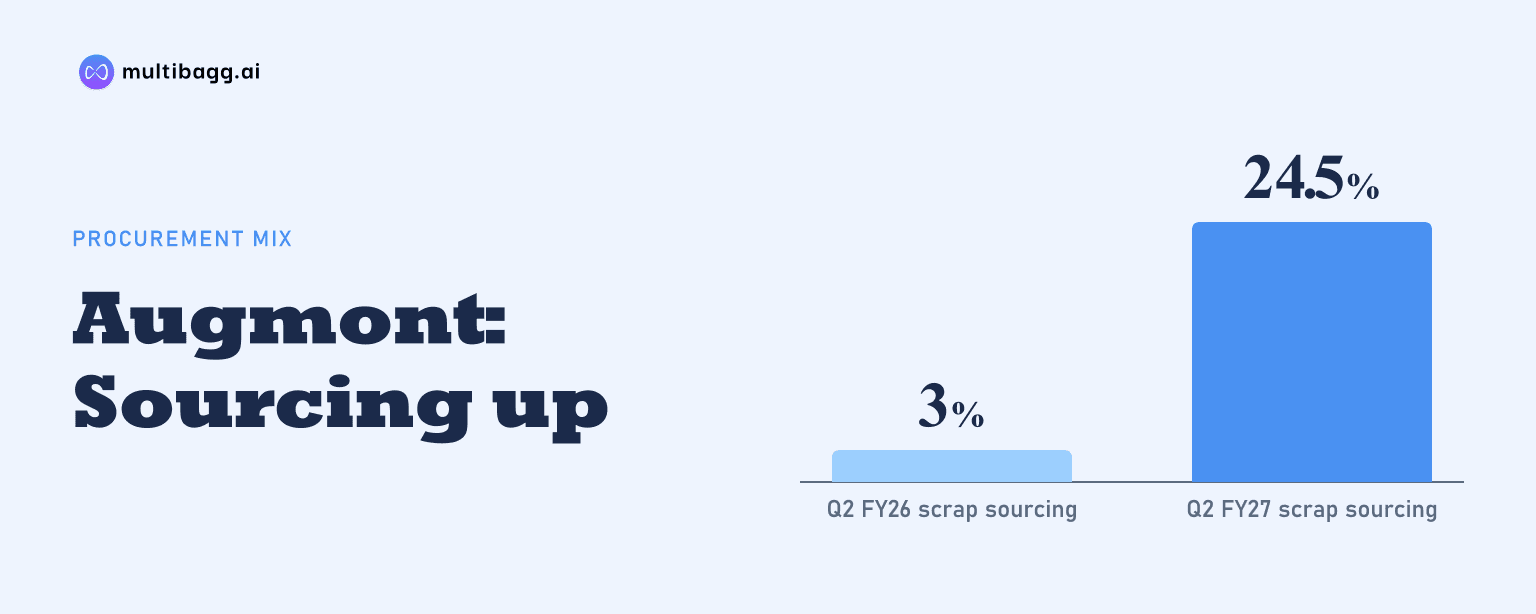
Augmont Enterprises Limited increased its Q2FY27 EBITDA margin to 1.14% from 0.72% in Q2FY26 as domestic scrap sourcing rose to about 24.5% of total procurement from about 3%, while revenue from operations declined 27% year on year to Rs 15,836 crore. The company said scrap sourcing provides better margins despite a longer working-capital cycle.
Know Augmont Enterprises inside out
Results, valuation, peers and who's buying, in one view.
Why did Augmont’s Q2FY27 margins increase?
Augmont said Q2FY27 margin expansion reflected a better business mix, including its deliberate shift towards higher-margin domestic scrap sourcing. Earnings before interest, tax, depreciation and amortisation, or EBITDA, rose 16.0% year on year to Rs 181 crore from Rs 156 crore, while EBITDA margin increased by 42 basis points to 1.14% from 0.72%.
Profit after tax, or PAT, reached Rs 120.3 crore in Q2FY27, up 6.8% year on year and 97.7% sequentially, according to management. PAT margin rose by 24 basis points to 0.76% from 0.52% in Q2FY26. Management described the quarter’s consolidated PAT as an all-time high and attributed the result to improved mix and its focus on quality of earnings.
The difference between the income and profit trends was pronounced in Q2FY27. Total income fell to Rs 15,852 crore from Rs 21,754 crore, but EBITDA increased by Rs 25 crore and PAT increased by Rs 7.3 crore. Augmont’s release links that outcome to sourcing mix rather than to higher revenue throughput.
How much did Augmont shift to domestic scrap sourcing?
Augmont increased domestic scrap sourcing to around 24.5% of total procurement in Q2FY27 from around 3% in Q2FY26. The company said the move responded to concerns around higher gold imports and supported its broader objective of reducing dependence on imported gold.
Augmont said the scrap business has a relatively longer working-capital cycle, which affects reported revenue throughput, but contributes better margins and strengthens its sourcing ecosystem. The release did not disclose scrap procurement volumes, rupee purchases, working-capital balances or a target share for domestic scrap in future quarters.
The company described its sourcing and distribution capabilities as spanning banks, refiners, recycled gold, imports, the India International Bullion Exchange, or IIBX, and exchange-traded fund redemptions. Although the release does not quantify the share contributed by each channel, it identifies the wider network as supporting sourcing optimisation during changing market conditions.
Got a follow-up? Ask IRIS
Why did Augmont’s revenue decline while profitability rose?
Augmont reported Q2FY27 revenue from operations of Rs 15,836 crore, down 27% year on year, partly because of softer demand and partly because of the move towards domestic scrap. The company said the longer working-capital cycle in scrap sourcing affects revenue throughput, while the channel earns better margins.
Enterprise business revenue was Rs 13,852 crore in Q2FY27, down 32% year on year, while Consumer business revenue increased 47.3% to Rs 1,984 crore. Consumer business represented 12.5% of quarterly revenue. The disclosed segment figures show that the Enterprise decline outweighed Consumer growth in the quarter’s total revenue outcome.
For H1FY27, total income declined 4.1% to Rs 34,829 crore from Rs 36,308 crore, while EBITDA increased 2% to Rs 265 crore. The EBITDA margin rose to 0.76% from 0.71%. PAT declined to Rs 181 crore from Rs 185 crore, although PAT margin increased by 1 basis point to 0.52%.
What did Augmont disclose about silver and its core business?
Augmont said it used its Directorate General of Foreign Trade, or DGFT, licence to source silver through IIBX while domestic availability was constrained by import restrictions. The company said this supported product availability and led to higher margins in Q2FY27, but management characterised the benefit as situational and tied to prevailing import restrictions.
In its core business, Augmont reported Q2FY27 PAT of Rs 85 crore, around 2.5 times the prior-year level, and EBITDA of Rs 113 crore, compared with Rs 50 crore in Q2FY26. These core-business figures are separate from consolidated Q2FY27 EBITDA of Rs 181 crore and PAT of Rs 120.3 crore reported for the wider group.
As of September 30, 2026, Augmont reported 52.3 million registered consumers, 245 fintech partners and 5,309 registered SPOT members. Its network included two refineries, 20 SPOT delivery centres, 5,558 retail touchpoints and 122 Gold For All centres. The company also said its agreement with the National Stock Exchange of India for Electronic Gold Receipts formed part of its effort to participate in the formalisation of India’s precious-metals market.
Conclusion
Augmont’s Q2FY27 results show that a lower-revenue quarter can coincide with higher profitability when sourcing mix changes. Revenue from operations declined 27% to Rs 15,836 crore, while domestic scrap’s procurement share increased to about 24.5%, EBITDA rose to Rs 181 crore and EBITDA margin expanded to 1.14%. The Consumer business grew 47.3%, but its Rs 1,984 crore revenue did not offset the 32% Enterprise business decline.
The next results will indicate whether domestic scrap remains near the Q2FY27 share of 24.5% and how its longer working-capital cycle affects revenue throughput and margins. Management has also identified silver sourcing through IIBX as situational because it depended on import restrictions, while the September 30, 2026 operating base of 52.3 million registered consumers, 245 fintech partners and 5,309 SPOT members provides further measures to track.