










Awfis says GCCs generate 24% of rental revenue as mandates grow
Key highlights
- GCCs generated approximately 24% of Awfis rental revenue as of September 30, 2026.
- Awfis served more than 105 unique GCC clients across 9 cities as of September 30, 2026.
- A disclosed GCC customer scaled from 100 seats to 2,000 FTE operations with Awfis.
- Awfis reported co-working revenue of Rs 376 crore in Q2 FY27, up 31% year-on-year.
powered by IRIS
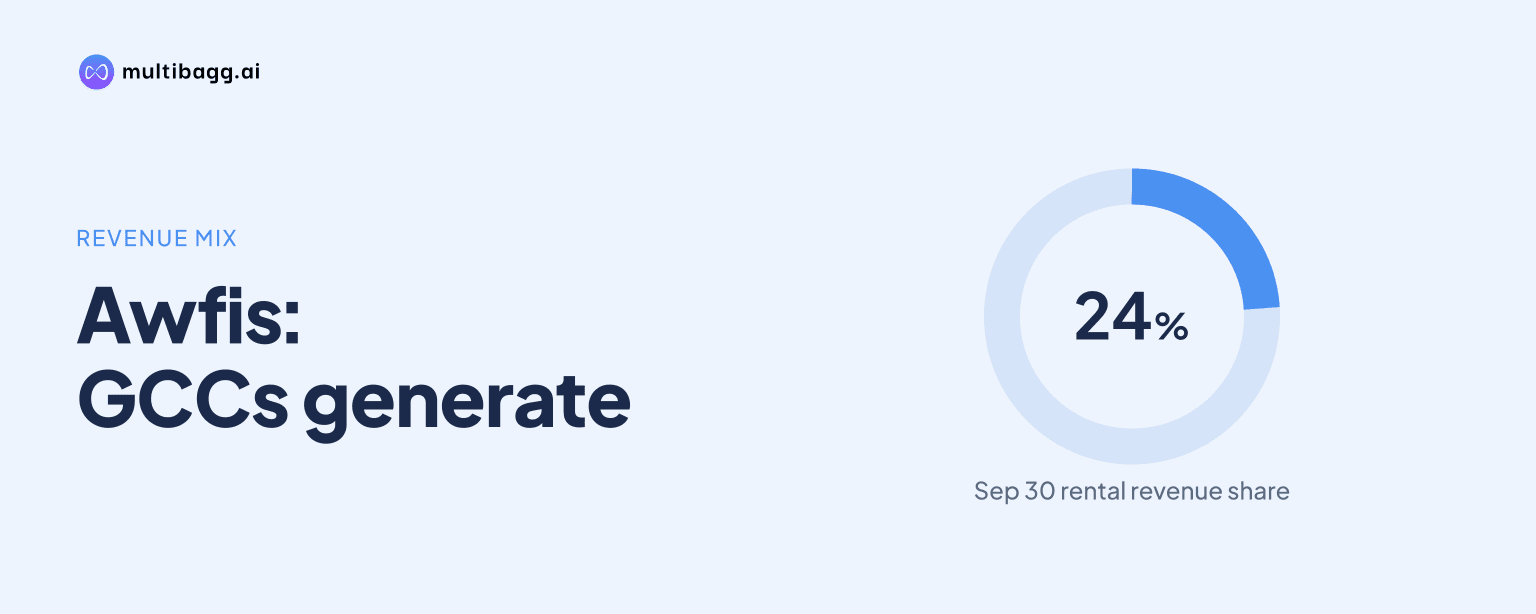
Awfis Space Solutions Limited said global capability centres, or GCCs, generated approximately 24% of rental revenue as of September 30, 2026, supported by more than 105 GCC clients across nine cities. Management cited accounts expanding from 100 seats to 2,000 full-time equivalents, or FTEs, and a new mandate exceeding 1,000 FTEs.
Know AWFIS Space Solutions inside out
Results, valuation, peers and who's buying, in one view.
How much rental revenue do GCCs contribute to Awfis?
GCCs contributed approximately 24% of Awfis rental revenue, according to management’s operational update as of September 30, 2026. Awfis did not disclose the rupee value of that rental-revenue share, but said it served more than 105 unique GCC clients in nine cities, linking the contribution to a broad client base rather than one disclosed contract.
The contribution sits within a co-working business that generated Rs 376 crore of revenue in Q2 FY27, up 31% year-on-year, and Rs 740 crore in H1 FY27, up 34%. Total normalized revenue rose 26% year-on-year to Rs 451 crore in the quarter, while cash earnings before interest, tax, depreciation and amortisation, or cash EBITDA, increased 45% to Rs 49 crore.
Management positioned GCCs as customers that can use co-working, managed offices, design and build, and allied services. Its stated model is to begin with a requirement of as few as 25 seats and support a client through a multi-city managed-office mandate, extending the relationship beyond an initial flex workspace requirement.
Which mandates show GCC accounts can grow with Awfis?
Awfis said a US-headquartered global e-commerce company entered India with 100 seats at an Elite by Awfis location in Bangalore that opened in 35 days, and later scaled to 2,000 FTE captive operations with Awfis as its single partner. The company did not disclose revenue, contract duration or the number of locations associated with that account.
In Chennai, a Fortune 500 group signed a GCC mandate for more than 1,000 FTEs, with the first site scheduled to go live in Q4 FY27. The Bangalore customer has already moved from an initial flex requirement into a larger operating presence, while the Chennai mandate remains a planned launch.
The examples sit alongside a portfolio mix in which customers with 500 or more seats accounted for 37% of Awfis seats as of September 30, 2026. Clients with up to 100 seats represented a further 35%, creating what management described as a funnel of smaller accounts that can grow into managed-office mandates.
Awfis reported an active client base of more than 3,700 clients, with enterprises and multinational corporations accounting for 64%, compared with 25% for small and medium enterprises and 10% for startups. Technology represented 39% of the client mix, followed by professional services at 20%, manufacturing at 13%, banking, financial services and insurance at 12%, and healthcare and life sciences at 7%.
Got a follow-up? Ask IRIS
What demand conditions does Awfis link to GCC growth?
Management linked GCC demand to India’s office leasing activity, saying GCCs leased about 8.7 million square feet in the September quarter and approximately 28 million square feet in the first nine months of 2026. Those figures represented 41% and 42%, respectively, of the market space taken in the periods cited by management.
The geographic mix overlaps with Awfis’s network priorities. Hyderabad accounted for 37% of quarterly GCC leasing and Bangalore for 28%, while Chennai and the National Capital Region, or NCR, each accounted for 11%; management said its network was deepest in these cities. Awfis operated 244 centres across 18 cities as of September 30, 2026, with another 10 centres under fit-out.
Management also cited its report with Zinnov, which found GCCs accounted for 40% to 45% of enterprise flex uptake, compared with 37% to 39% in 2022. The report said two-thirds of GCCs plan to hold more than one-tenth of their portfolios in flexible space, though this is an industry-intent measure rather than a booking forecast for Awfis.
Quality is another part of management’s demand argument. It said 58% of GCC leasing during the first nine months of 2026 was in Grade A+ assets, where Awfis places its Gold and Elite portfolio. Gold and Elite locations increased to 39 centres, comprising 29 Gold and 10 Elite centres, from 26 centres a year earlier, while premium seats rose 58% year-on-year to more than 33,000.
How is Awfis building capacity for enterprise and GCC demand?
Awfis had total supply of approximately 174,000 seats across 254 operational and under-fit-out centres as of September 30, 2026, including more than 164,000 operational seats. This was up from approximately 159,000 operational seats at the end of June, after the company added about 7,000 gross seats and opened six centres during Q2 FY27.
The quarter also included exits of around 2,200 seats across four centres as part of portfolio optimisation. For H1 FY27, Awfis added approximately 12,000 gross seats and 13 centres, all in Grade A or A+ assets in high-demand micro-markets, showing that gross expansion and selective closures occurred together.
Occupancy increased despite the seat additions. Mature-centre occupancy, covering centres operational for more than 12 months, rose to 84.1% from 83.0% in Q1 FY27, while blended portfolio occupancy increased to 76.2% from 76.0%. Management said the movement in both measures reflected faster filling at newer locations, though it did not provide centre-level occupancy for GCC customers.
Customer contract metrics also changed. Weighted average client tenure was 38 months and portfolio lock-in tenure was 27 months as of September 30, 2026, versus 26 months at the end of June; for clients with more than 100 seats, lock-in tenure was 33 months, up three months year-on-year. Awfis said 77% of seats had a tenure of at least 24 months and another 18% had tenure of 12 to 23 months.
Conclusion
Awfis’s GCC exposure is supported by a network of 244 operational centres, a premium portfolio of 39 Gold and Elite centres, and a client base in which 37% of seats are held by customers with at least 500 seats. Management’s examples indicate that flex workspace can be used both for an initial India entry and for a subsequent managed-office operating requirement.
The next operating test is execution in H2 FY27, including the Chennai Fortune 500 GCC site due to go live in Q4 FY27. Management reiterated plans to add approximately 22,000 to 25,000 gross seats in FY27, target co-working revenue growth of 23% to 25%, and deliver total revenue above Rs 1,800 crore, while expecting newer centres and the premium cohort to build occupancy.