










Awfis premium portfolio tops 33,000 seats at 35% premium
Key highlights
- Awfis had more than 33,000 Gold and Elite seats across 39 centres in Q2 FY '27.
- Premium seats increased 58% year-on-year and incremental seats carried around 35% higher pricing than Awfis's flagship product.
- Awfis reported Q2 FY '27 normalised revenue of Rs 451 crore and cash EBITDA of Rs 49 crore.
- Cash EBITDA margin reached 10.8% in Q2 FY '27, up 140 basis points year-on-year.
powered by IRIS
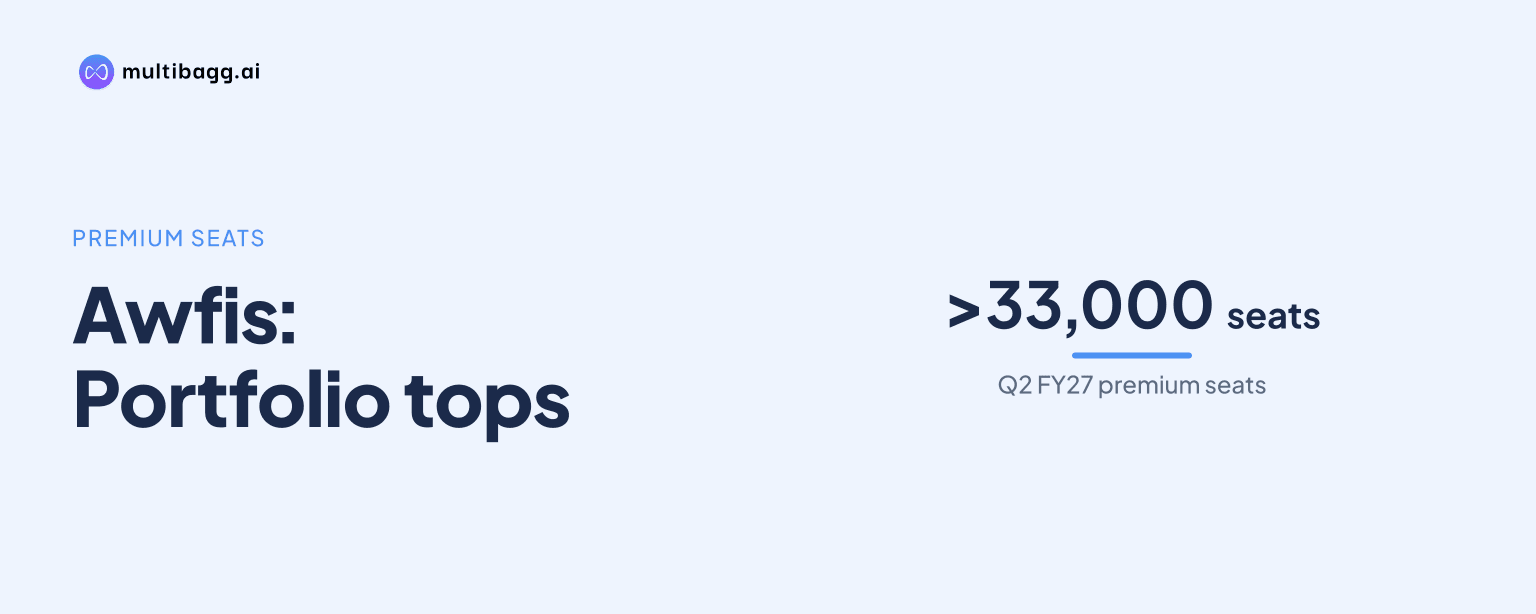
Awfis Space Solutions Limited said its Gold and Elite portfolio exceeded 33,000 seats in Q2 FY '27, with incremental seats signed at around 35% higher pricing than its flagship product. Awfis expanded the premium network to 39 centres, from 26 a year earlier, as it added Grade A+ capacity in five markets.
Know AWFIS Space Solutions inside out
Results, valuation, peers and who's buying, in one view.
How large is Awfis's premium workspace portfolio?
Awfis's Gold and Elite portfolio comprised 39 centres and more than 33,000 seats at the end of Q2 FY '27. The portfolio included 29 Gold centres and 10 Elite centres, compared with 37 premium centres at the end of June 2026 and 26 centres a year earlier. Premium seats rose 58% year-on-year.
The premium format accounted for roughly one-fifth of Awfis's total supply of approximately 174,000 seats, including centres under fit-out, as of September 30, 2026. Awfis operated 244 centres across 18 cities and had another 10 centres under fit-out, taking total supply to 254 centres. Including signed letters of intent, supply stood at 270 centres and about 188,000 seats across 9.4 million square feet.
During H1 FY '27, Awfis added new Grade A+ centres in Pune, Bangalore, Mumbai, Delhi and the National Capital Region. Management said its 6.0 centre design improves space utilisation and supports higher realisation per seat. Managed aggregation, in which Awfis increasingly works through developer partnerships, represented 57% of the network's centres.
Why do Awfis's Gold and Elite seats command higher pricing?
Awfis said incremental seats at Gold and Elite centres are being signed at around 35% higher pricing than its flagship product. Management linked that difference to Grade A+ assets, core micro-markets and enterprise-grade fit-outs, although it did not disclose an absolute price per premium seat. It also described premium centres as an entry point for larger enterprise mandates.
Global capability centres, or GCCs, are a key demand source for the format. GCC clients contributed approximately 24% of Awfis rental revenue, and the company served more than 105 unique GCC clients in nine cities as of September 30, 2026. Management cited industry data showing that 58% of GCC leasing in the first nine months of 2026 was in Grade A+ assets.
A US-headquartered e-commerce company entered India with 100 seats at an Elite by Awfis centre in Bangalore, which Awfis said it opened in 35 days. The client subsequently scaled to 2,000 full-time-equivalent captive operations, with Awfis as its single partner. Separately, a Fortune 500 group signed a Chennai GCC mandate for more than 1,000 full-time equivalents, with the first site due to go live in Q4 FY '27.
Premium supply is also being paired with longer customer commitments. Awfis reported a portfolio-wide lock-in tenure of 27 months in Q2 FY '27, up four months year-on-year and one month from June 2026. Clients with more than 100 seats had a 33-month lock-in, while 95% of the seat base had a commitment of at least 12 months.
Got a follow-up? Ask IRIS
How has premiumisation coincided with Awfis's financial performance?
Awfis reported cash earnings before interest, tax, depreciation and amortisation, or cash EBITDA, of Rs 49 crore in Q2 FY '27, up 45% year-on-year. Its cash EBITDA margin reached 10.8%, rising 140 basis points year-on-year and 70 basis points from the prior quarter. Management said the premium cohort's maturation would continue to contribute to realisation and margins.
Normalised revenue increased 26% year-on-year to Rs 451 crore in Q2 FY '27. Co-working revenue grew 31% to Rs 376 crore, faster than Transform, Awfis's design-and-build business, where revenue increased 8% to Rs 75 crore. Reported revenue was Rs 439 crore, with the difference from normalised revenue reflecting adjustments for certain long-term lease arrangements under Indian Accounting Standard 116.
For H1 FY '27, normalised revenue rose 30% year-on-year to Rs 888 crore, while cash EBITDA increased 40% to Rs 93 crore and produced a 10.5% margin. By comparison, reported H1 revenue was Rs 864 crore and reported EBITDA was Rs 336 crore under Indian Accounting Standard accounting. Awfis reported operating profit before tax of Rs 25 crore on its cash EBITDA basis and reported profit before tax of Rs 56 crore.
Occupancy improved while Awfis expanded capacity during the quarter. Occupancy at centres operating for more than 12 months increased to 84.1% from 83.0% in Q1 FY '27, while blended portfolio occupancy rose to 76.2% from 76.0%. The company added approximately 7,000 gross seats and launched six centres in Q2, while exiting around 2,200 seats across four centres under portfolio optimisation.
What is Awfis planning for premium capacity and margins?
Awfis reiterated its FY '27 plan to add about 22,000 to 25,000 gross seats, with additions tilted towards premium formats. Management expects about 5,500 seat closures during the year, of which almost 4,000 had already been closed in H1 FY '27. It said operational capacity should exceed 174,000 seats by the end of March.
For FY '28, management did not give formal seat-addition guidance. It said that, if the macro environment remains unchanged, gross additions could be at least 20% to 25% higher than in FY '27, with the mix still weighted towards premium capacity. This is management's conditional outlook rather than a reported operating result.
Management maintained FY '27 guidance for co-working revenue growth of 23% to 25%, Transform growth of around 20%, and total revenue above Rs 1,800 crore. It also reiterated a full-year cash EBITDA target of Rs 190 crore to Rs 200 crore. Management expects H2 FY '27 to be stronger than H1 as newer centres build occupancy and the premium portfolio matures.
Awfis further expects cash EBITDA margin to rise sequentially through H2 FY '27. Management said it expects margin of at least around 11.5% in Q4 FY '27 and about 12% in the March exit month, supported by occupancy gains and premium capacity. Its Q2 FY '27 margin of 10.8% was already above the 10.5% recorded for H1 FY '27.
Conclusion
Awfis has expanded its Gold and Elite estate to more than 33,000 seats across 39 centres, making premium capacity a material part of its approximately 174,000-seat supply. The 35% disclosed incremental pricing premium, 58% increase in premium seats and 31% growth in Q2 co-working revenue are the reported indicators behind management's premiumisation strategy and its stated margin expectations.
The next measures to watch are Awfis's FY '27 target of 22,000 to 25,000 gross seat additions, operational capacity above 174,000 seats by March and cash EBITDA of Rs 190 crore to Rs 200 crore. Management also expects the first Chennai site under the more than 1,000-full-time-equivalent GCC mandate to open in Q4 FY '27 and the March exit cash EBITDA margin to approach 12%.