










Awfis targets over 174,000 operational seats by March
Key highlights
- Awfis targets more than 174,000 operational seats by the end of March FY ’27.
- Awfis plans 22,000 to 25,000 gross seat additions and approximately 5,500 closures in FY ’27.
- Awfis had more than 164,000 operational seats across 244 centers on September 30, 2026.
- Mature-center occupancy rose to 84.1% in Q2 FY ’27 from 83.0% in Q1 FY ’27.
powered by IRIS
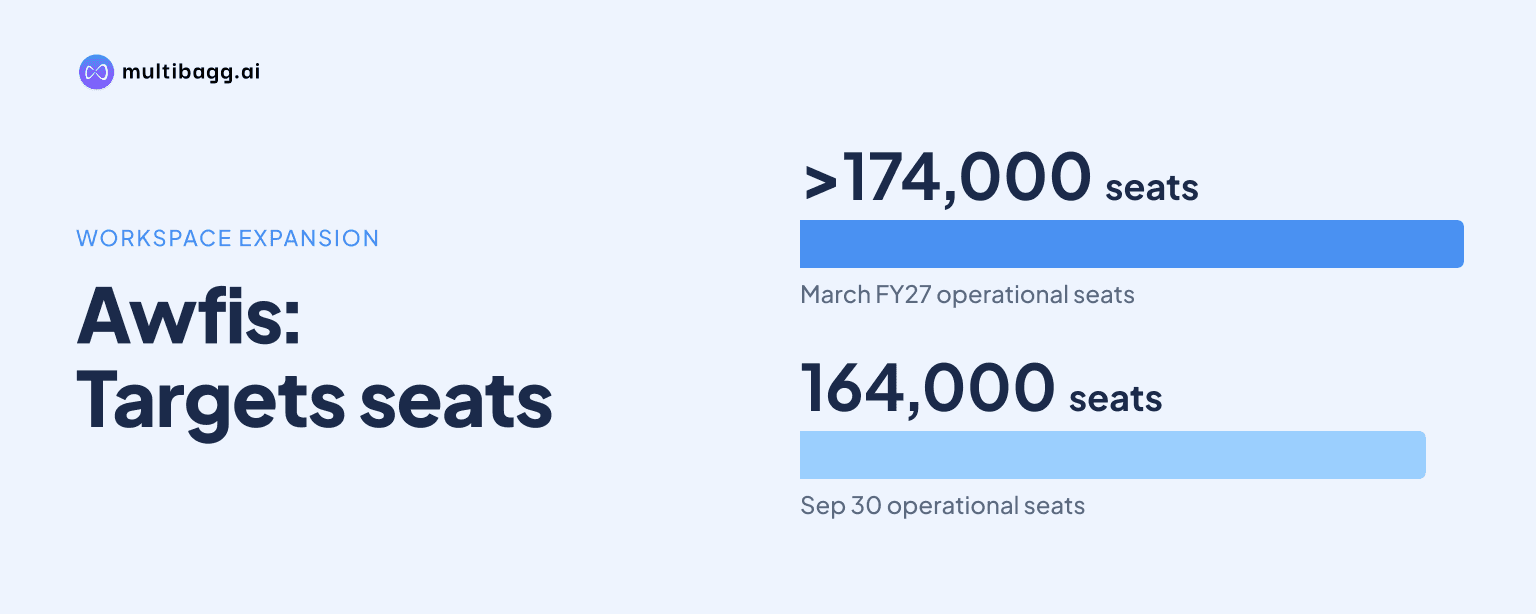
Awfis expects more than 174,000 operational seats by the end of March FY ’27 after adding 22,000 to 25,000 gross seats and closing about 5,500 seats during the year. As of September 30, 2026, Awfis operated more than 164,000 seats across 244 centers, while another 10 centers were under fit-out.
Know AWFIS Space Solutions inside out
Results, valuation, peers and who's buying, in one view.
How many operational seats is Awfis targeting by March?
Awfis is targeting more than 174,000 operational seats at the end of March FY ’27. Management gave the target alongside its plan for 22,000 to 25,000 gross seat additions and approximately 5,500 closures during FY ’27, distinguishing operating capacity from locations under fit-out and signed letters of intent.
As of September 30, 2026, Awfis had 244 operational centers across 18 cities and more than 164,000 operational seats. Adding 10 centers under fit-out took total supply to 254 centers and approximately 174,000 seats across 8.7 million square feet. Including signed letters of intent, signed supply stood at 270 centers and approximately 188,000 seats across 9.4 million square feet.
The March target is therefore an operational-capacity target rather than a target for the entire signed pipeline. Awfis had approximately 10,000 more seats in signed supply than in total supply including fit-outs at September-end, showing that some future capacity remained at the letter-of-intent stage.
Why is Awfis closing 5,500 seats while expanding?
Awfis says the expected 5,500 seat closures are part of portfolio optimization while new additions are concentrated in Grade A and A+ assets in high-demand micro-markets. In Q2 FY ’27, the company launched six centers and added approximately 7,000 gross seats, while exiting approximately 2,200 seats across four centers.
Management said nearly 4,000 of the planned closures had already occurred in H1 FY ’27. Over the same six-month period, Awfis added approximately 12,000 gross seats and opened 13 centers, all in Grade A or A+ assets. The transcript does not provide a location-level reconciliation of gross additions, closures and the March operating-seat target.
Awfis uses three supply formats to shape its network. Managed aggregation accounted for 57% of centers at September-end and increasingly involves developers funding capital expenditure while Awfis runs the center. Straight leases are reserved for selected ultra-premium assets, while partial managed offices require an enterprise customer to commit to at least half of seats before Awfis signs a new center.
Is Awfis filling its expanded network?
Awfis reported higher occupancy in Q2 FY ’27 despite its additions and exits, with occupancy at centers operating for more than 12 months rising to 84.1% from 83.0% in Q1 FY ’27. Blended portfolio occupancy rose to 76.2% from 76.0% over the same period.
The active client base exceeded 3,700 at September-end, with enterprises and multinational corporations accounting for 64% of clients. Small and medium enterprises represented 25% and startups 10%, while clients with 500 or more seats accounted for 37% of occupied seats and clients with up to 100 seats accounted for a further 35%.
Awfis also reported a 27-month portfolio lock-in tenure at September-end, compared with 26 months at the end of June. For clients with more than 100 seats, lock-in tenure was 33 months, up three months year on year. The company said 77% of seats had tenure of at least 24 months and another 18% had tenure of 12 to 23 months, meaning 95% were committed for at least one year.
Got a follow-up? Ask IRIS
How does premium capacity affect Awfis’s seat strategy?
Awfis is prioritising premium-seat additions, with its Gold and Elite portfolio reaching 39 centers and more than 33,000 seats, up 58% year on year. The September-end portfolio comprised 29 Gold centers and 10 Elite centers, compared with 26 premium centers a year earlier.
Management said incremental seats at Gold and Elite centers are being signed at around 35% higher pricing than Awfis’s flagship product. Gold centers increased to 29 from 21 a year earlier, with seats increasing to 20,100 from 14,800. Elite centers doubled to 10 from five, while Elite seats rose to 13,000 from 6,200.
The premium network is linked to demand from global capability centers, or GCCs. Awfis served more than 105 unique GCC clients in nine cities, contributing approximately 24% of rental revenue. One United States-headquartered e-commerce client began with 100 seats at an Elite by Awfis center in Bengaluru and subsequently scaled to a 2,000 full-time-equivalent captive operation.
What financial targets accompany Awfis’s network plan?
Awfis reiterated FY ’27 guidance for total revenue of more than Rs 1,800 crore and cash earnings before interest, tax, depreciation and amortisation, or cash EBITDA, of Rs 190 crore to Rs 200 crore. Management expects coworking revenue to grow 23% to 25% and Transform design-and-build revenue by around 20% during the year.
For Q2 FY ’27, normalized revenue was Rs 451 crore, up 26% year on year, while cash EBITDA was Rs 49 crore, up 45%, producing a 10.8% margin. In H1 FY ’27, normalized revenue was Rs 888 crore, up 30%, and cash EBITDA was Rs 93 crore, up 40%, with a 10.5% margin.
Management expects the second half to be stronger than the first as recently launched centers build occupancy and the premium cohort matures. It said Q4 FY ’27 cash EBITDA margin should be at least around 11.5%, and the March exit-month margin should be around 12%, supported by occupancy and premium-seat mix.
Awfis remained net cash positive at September-end, with negative net debt of Rs 73 crore and net debt-to-equity of negative 0.12 times, compared with negative 0.08 times at the end of June. H1 FY ’27 capital expenditure was Rs 113 crore, while Awfis said it had added close to 64,000 net operational seats since its Q1 FY ’25 listing.
Conclusion
Awfis’s target of more than 174,000 operational seats by March FY ’27 combines gross network expansion with planned pruning. The company added approximately 7,000 gross seats in Q2 FY ’27, exited approximately 2,200 seats, and increased mature-center occupancy by 1.1 percentage points from Q1, indicating that its capacity plan is based on both opening and closing locations.
The next indicators are the conversion of 10 fit-out centers into operating capacity, the remaining approximately 1,500 planned seat closures after nearly 4,000 closures in H1, and occupancy at recently opened premium centers. Management’s stated H2 FY ’27 plan also calls for stronger cash EBITDA than H1 and a Q4 margin of at least around 11.5%.