










Bajaj Finance asset quality improved despite gold-loan shift
Key highlights
- Bajaj Finance reported GNPA of 1.06% in Q2 FY2027, versus 1.24% in Q2 FY2026.
- Gold-loan stage 2 and 3 assets increased by Rs 1,047 crore in Q2 FY2027.
- Loan loss to average AUF declined to 1.56% from 1.88% a year earlier.
- Consolidated AUM grew 26.5% year on year to Rs 584,624 crore in Q2 FY2027.
powered by IRIS
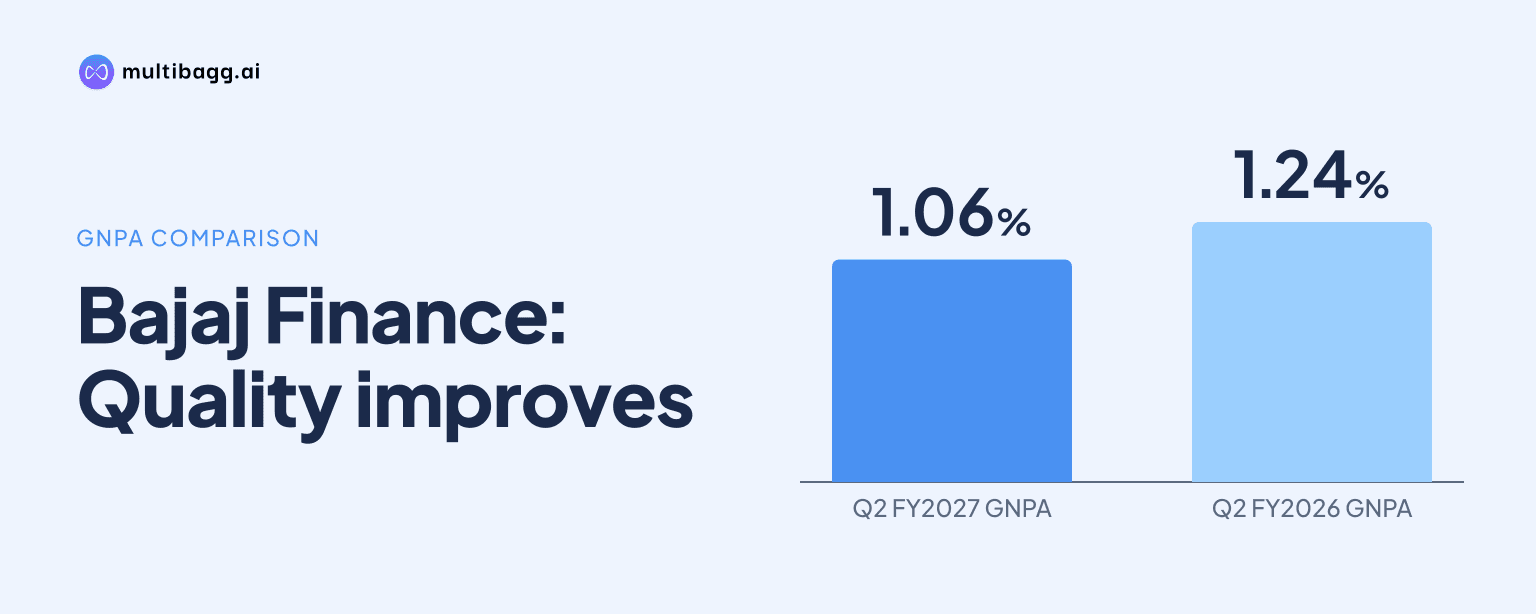
Bajaj Finance Ltd. reported gross non-performing assets of 1.06% in Q2 FY2027, down from 1.24% a year earlier, but gold-loan stage 2 and 3 assets increased by Rs 1,047 crore as short-tenor schemes moved through a transition. Total stage 2 and 3 assets rose to 2.02% of loans from 1.87% in Q1 FY2027.
Know Bajaj Finserv inside out
Results, valuation, peers and who's buying, in one view.
Did Bajaj Finance's reported asset quality improve in Q2 FY2027?
Yes, Bajaj Finance's reported asset quality improved year on year in Q2 FY2027, with gross non-performing assets, or GNPA, declining to 1.06% from 1.24% in Q2 FY2026. Net non-performing assets, or NNPA, fell to 0.42% from 0.60% over the same period. Each ratio was lower by 18 basis points, with one basis point equal to one-hundredth of a percentage point.
The year-on-year improvement sits alongside a higher ratio than at the end of FY2026. GNPA was 1.01% in FY2026 before reaching 1.06% in Q2 FY2027, while NNPA was 0.41% in FY2026 and 0.42% in Q2 FY2027. The presentation therefore shows lower NPA ratios than a year earlier, but modestly higher ratios than the FY2026 closing levels.
Bajaj Finance's consolidated assets under management, or AUM, were Rs 584,624 crore in Q2 FY2027, up 26.5% from Rs 462,261 crore in Q2 FY2026. The company reported annualised return on assets of 4.6%, compared with 4.5% a year earlier, and annualised return on equity of 20.6%, compared with 19.1%.
Why did Bajaj Finance's stage 2 and 3 assets increase?
Bajaj Finance said stage 2 and 3 assets increased by Rs 1,601 crore in Q2 FY2027, including a Rs 1,047 crore increase in the gold-loan business. The company attributed the gold-loan movement to short-tenor schemes that are no longer being offered. It described the increase in gold-loan stage 2 assets as transitional.
Stage 2 and 3 assets reached 2.02% of loans in Q2 FY2027, compared with 1.87% in Q1 FY2027, a rise of 15 basis points. Bajaj Finance said it does not expect the transitional increase in gold-loan stage 2 assets to affect credit cost. The presentation does not disclose separate stage 2 and stage 3 ratios for the gold-loan portfolio.
The Rs 1,047 crore gold-loan movement accounted for about two-thirds of the Rs 1,601 crore total increase in stage 2 and 3 assets during the quarter. The disclosed movement identifies gold loans as the main contributor to the quarterly change, while the company did not provide equivalent product-level figures for the remaining Rs 554 crore increase.
Got a follow-up? Ask IRIS
How did Bajaj Finance's provisions and profitability change?
Bajaj Finance reported loan losses and provisions of Rs 2,166 crore in Q2 FY2027, compared with Rs 2,080 crore in Q2 FY2026. Although the absolute charge was Rs 86 crore higher, loan loss to average assets under finance, or AUF, declined to 1.56% from 1.88% a year earlier. AUF is the asset base used by the company for this ratio.
Net total income rose 23.0% to Rs 15,974 crore in Q2 FY2027 from Rs 12,982 crore in Q2 FY2026. Profit attributable to owners increased 28.5% to Rs 6,267 crore from Rs 4,876 crore. Operating expenditure was 33.0% of net total income, compared with 33.1% a year earlier.
Cost of funds was 7.31% in Q2 FY2027, improving by 9 basis points from Q1 FY2027, according to Bajaj Finance. For H1 FY2027, net total income was Rs 31,198 crore, up 22.6% from Rs 25,441 crore in H1 FY2026, while profit attributable to owners rose 28.0% to Rs 12,252 crore.
What growth, funding and capital measures did Bajaj Finance report?
Bajaj Finance added 44.2 lakh customers in Q2 FY2027 and booked 1.35 crore new loans, compared with 1.22 crore new loans in Q2 FY2026. Its customer franchise was 12.88 crore in Q2 FY2027, up from 11.06 crore a year earlier. The franchise table separately reports total franchise of 12.89 crore, including 8.23 crore cross-sell customers.
Cross-sell customers represented 63.9% of total franchise in Q2 FY2027, compared with 64.5% in Q2 FY2026, even as the number of cross-sell customers rose from 7.13 crore to 8.23 crore. Non-delinquent customers increased to 9.46 crore from 8.07 crore over the same comparison, and the credit segment filter rose to 11.11 crore from 9.43 crore.
The deposit book was Rs 69,754 crore in Q2 FY2027, nearly unchanged from Rs 69,766 crore in Q2 FY2026. Deposits represented 14% of consolidated borrowings as of 30 September 2026. The borrowing mix was 52% money markets, 29% banks, 14% deposits and 5% external commercial borrowings.
Capital adequacy was 20.33% as of 30 September 2026, including Tier-1 capital of 19.43%. Bajaj Finance's consolidated lending AUM mix at that date was 30% urban, 12% rural, 13% micro, small and medium enterprises, 13% commercial and 32% mortgages. Management's long-term strategy seeks a sustainable return on assets of 4.3% to 4.7% and return on equity of 19% to 21%.
Conclusion
Bajaj Finance's Q2 FY2027 figures show year-on-year improvement in reported NPA ratios alongside a specific increase in early and later-stage gold-loan classifications. GNPA fell to 1.06% from 1.24%, NNPA declined to 0.42% from 0.60%, and loan loss to average AUF fell to 1.56% from 1.88%. At the same time, stage 2 and 3 assets increased by Rs 1,601 crore, led by the Rs 1,047 crore gold-loan movement.
The next disclosed issue to watch is whether the discontinuation of short-tenor gold-loan schemes supports management's view that the transitional rise in gold-loan stage 2 assets will not affect credit cost. Progress against management's long-term return targets also remains measurable against Q2 FY2027 annualised return on assets of 4.6% and annualised return on equity of 20.6%.