










Bajaj General profit falls 19% as claims, losses worsen
Key highlights
- Bajaj General’s Q2 FY27 profit after tax fell 19% to Rs 420 crore from Rs 517 crore.
- Bajaj General’s claim ratio rose to 83.7% in Q2 FY27 from 75.8% a year earlier.
- Bajaj General’s combined ratio increased to 104.5% in Q2 FY27 from 102.3%.
- Bajaj General’s gross written premium rose 10% to Rs 7,056 crore in Q2 FY27.
powered by IRIS
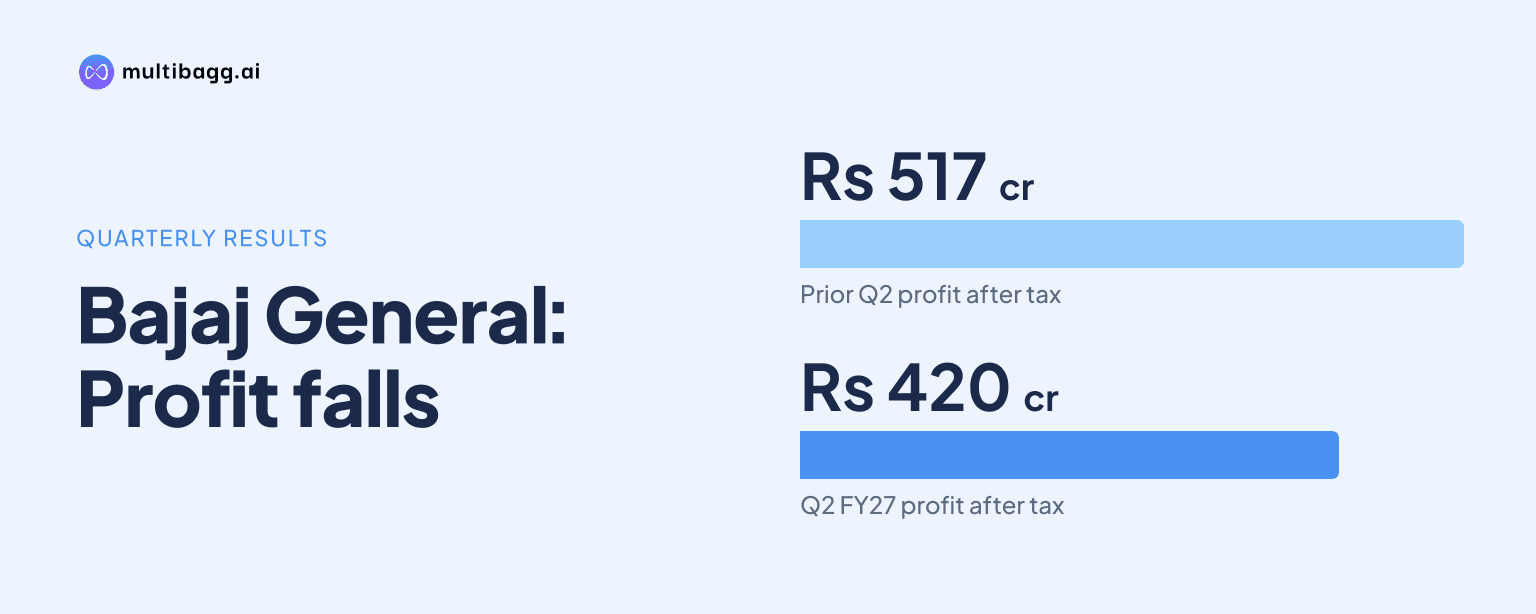
Bajaj General Insurance Limited reported Q2 FY27 profit after tax of Rs 420 crore, down 19% from Rs 517 crore in Q2 FY26, as its claim ratio climbed to 83.7%, underwriting loss widened to Rs 115 crore and net investment and other income fell to Rs 675 crore.
Know Bajaj Finserv inside out
Results, valuation, peers and who's buying, in one view.
Why did Bajaj General’s Q2 FY27 profit decline?
Bajaj General’s quarterly profit declined because underwriting losses widened and investment income fell year on year. Profit before tax decreased to Rs 560 crore in Q2 FY27 from Rs 696 crore in Q2 FY26, while profit after tax fell by Rs 97 crore to Rs 420 crore.
The underwriting result was a loss of Rs 115 crore in Q2 FY27, compared with a Rs 92 crore loss a year earlier. Investment and other income, net, declined by Rs 113 crore to Rs 675 crore from Rs 788 crore, which Bajaj General attributed to lower capital gains and a reduced investable asset base.
The reduced investable asset base followed a Rs 3,515 crore distribution to shareholders, according to Bajaj General. The company specifically linked the lower Q2 FY27 investment and other income to that distribution as well as lower capital gains, separating this factor from the deterioration in underwriting.
How did Bajaj General’s premiums grow in Q2 FY27?
Bajaj General grew gross written premium by 10% to Rs 7,056 crore in Q2 FY27 from Rs 6,413 crore in Q2 FY26. Net earned premium increased faster, rising 23% to Rs 2,947 crore from Rs 2,404 crore.
Premium growth was higher after removing bulky tender-driven crop and government health business. On that basis, gross written premium increased 21% to Rs 5,636 crore in Q2 FY27 from Rs 4,647 crore in Q2 FY26, compared with the reported 10% increase including those categories.
For H1 FY27, gross written premium was Rs 12,845 crore, up from Rs 11,615 crore in H1 FY26. Net earned premium over the same half-year period rose to Rs 5,616 crore from Rs 4,632 crore, an increase of Rs 984 crore even as quarterly profitability declined.
The distinction between reported premium and premium excluding tender-driven crop and government health business is central to Bajaj General’s disclosure. Bajaj General reported Rs 7,056 crore of total Q2 FY27 gross written premium and Rs 5,636 crore excluding those categories, but did not provide a separate profitability figure for the excluded portfolio.
Got a follow-up? Ask IRIS
What happened to Bajaj General’s claim and combined ratios?
Bajaj General’s claim ratio increased to 83.7% in Q2 FY27 from 75.8% in Q2 FY26, a rise of 7.9 percentage points. Its combined ratio increased to 104.5% from 102.3%, showing a higher ratio of claims and management expenses, including net commission, relative to the applicable premium measures.
Bajaj General defines the combined ratio under the Insurance Regulatory and Development Authority of India, or IRDAI, Master Circular. It is net claims incurred divided by net earned premium plus expenses of management, including net commission, divided by net written premium; the Q2 FY27 reading was 2.2 percentage points above Q2 FY26.
Bajaj General reported Rs 75 crore of net natural catastrophe, or NATCAT, claims in Q2 FY27. Excluding those claims and the tender-driven crop and government health business, the claim ratio was 74.2% in Q2 FY27, compared with 73.9% a year earlier, a narrower increase of 0.3 percentage points.
The H1 FY27 figures show the same direction of change. The claim ratio was 79.2% against 73.5% in H1 FY26, while the combined ratio was 104.7% against 102.9% and the underwriting loss widened to Rs 246 crore from Rs 208 crore.
What does Bajaj General’s capital and asset disclosure show?
Bajaj General reported a solvency ratio of 229% as of 30 September 2026, compared with the minimum regulatory requirement of 150%. The reported ratio was therefore 79 percentage points above the stated minimum at the reporting date.
Bajaj General’s assets under management increased to Rs 36,313 crore as of 30 September 2026 from Rs 34,974 crore a year earlier. The Rs 1,339 crore increase occurred alongside the disclosed Rs 3,515 crore shareholder distribution, which Bajaj General said reduced the investable asset base relevant to Q2 FY27 investment income.
Bajaj General prepares its standalone insurance results under Indian generally accepted accounting principles, or Indian GAAP. Bajaj Finserv Limited, its holding company, uses Indian Accounting Standards, or Ind AS, for consolidated reporting, while the insurer’s standalone figures in the release are reported under Indian GAAP.
The Q2 FY27 result also contrasts with FY26, when Bajaj General reported profit after tax of Rs 1,942 crore and investment and other income of Rs 3,019 crore. The announcement provides no forecast for claims, capital gains, investment income or full-year profit following the results release dated 3 November 2026.
Conclusion
Bajaj General delivered premium growth in Q2 FY27, with gross written premium reaching Rs 7,056 crore and net earned premium reaching Rs 2,947 crore, but higher claims and a wider underwriting loss coincided with lower investment income. The result was a 19% year-on-year reduction in profit after tax to Rs 420 crore despite the increase in reported premium.
The next disclosures to watch are the claim ratio, combined ratio and underwriting result, particularly after Rs 75 crore of Q2 FY27 NATCAT claims and 21% premium growth excluding tender-driven crop and government health business. Bajaj General’s future investment and other income will also remain relevant after the Rs 3,515 crore shareholder distribution reduced its investable asset base.