










Britannia makes e-commerce strategic unit as sales reach 7%
Key highlights
- Britannia said e-commerce was trending at 7% of sales, compared with 6% in FY26.
- Britannia said e-commerce is already a double-digit share of its relevant portfolio after excluding Rs 5 packs with limited online sales.
- Britannia plans products specifically designed for e-commerce as it builds the channel into a strategic business unit.
- Britannia said its adjacency business grew by more than 20%, led by croissant and cake.
powered by IRIS
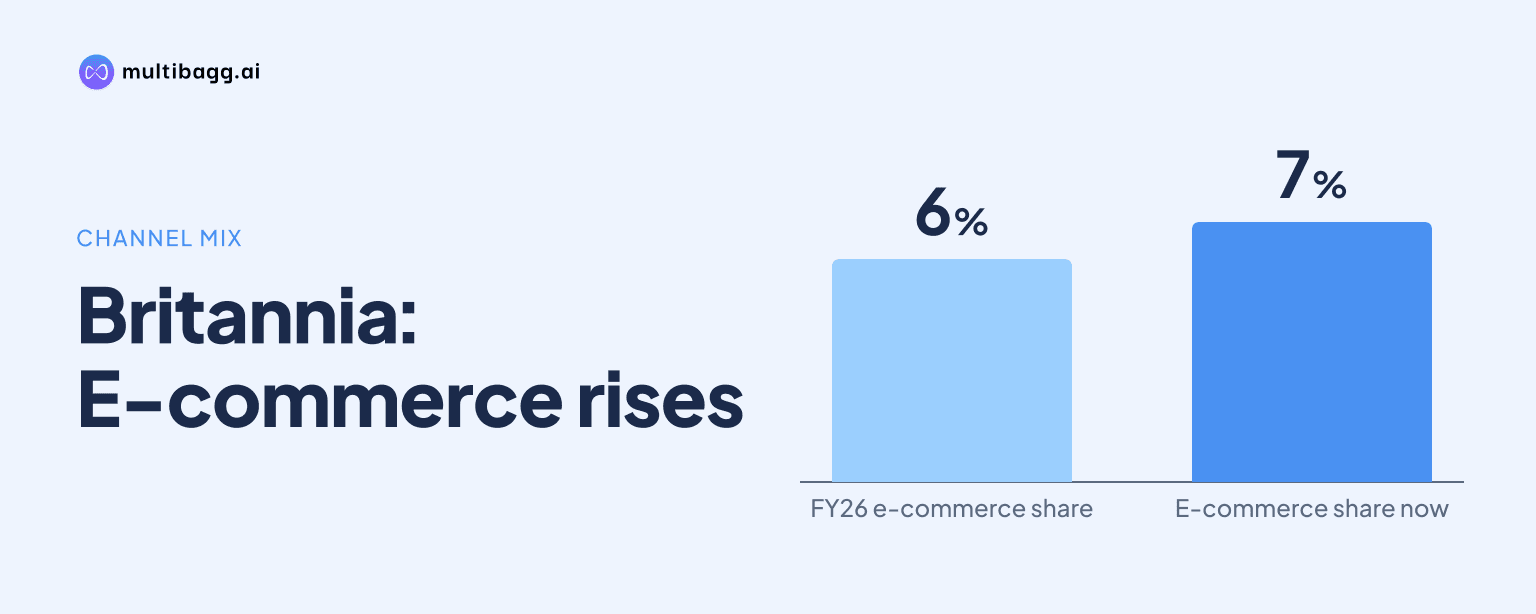
Britannia Industries Limited said e-commerce was trending at 7% of sales in the period discussed on its earnings call, compared with 6% for financial year 2025-26 (FY26), and management is making Britannia’s online operation a strategic business unit with products designed specifically for the channel.
Know Britannia Industries inside out
Results, valuation, peers and who's buying, in one view.
Why is Britannia making e-commerce a strategic business unit?
Britannia is making e-commerce a strategic business unit because management considers it critical for reaching new consumers and consumption occasions. Rakshit Hargave said the company has increased investment in e-commerce people and capabilities and has aggressive plans to expand those resources further as the channel moves beyond distribution of its existing range.
Britannia plans to develop products specifically for e-commerce. Hargave said the company sees its capabilities and relationships with platform partners and customers as an advantage in delivering those products. Management did not disclose product categories, launch dates, revenue targets or profitability targets for the channel-specific range.
The decision reflects the different mix of Britannia’s online business. A substantial part of its overall portfolio is sold at Rs 5 and Rs 10 price points, while management said it hardly sells any Rs 5 packs through e-commerce. That difference means the reported 7% channel share does not fully describe online penetration in products suited to online buying.
Vipin Kataria said consumer switching between channels is occurring in Britannia’s mature categories, but described premiumisation as the larger online opportunity. General trade also remained relevant: management said metros and the top 15 cities were performing decently, while semi-urban and rural general trade showed strong consumption. The strategy therefore adds an online growth engine rather than replacing physical distribution.
How much of Britannia’s sales come from e-commerce?
Britannia said e-commerce was trending at 7% of sales, an increase of 1 percentage point from 6% in FY26. Management said the proportion could rise as the company enters the big seasonal period, but gave no numerical indication of the likely exit share or a formal annual target.
Management said e-commerce sales are already in double digits as a proportion of the relevant portfolio after removing low-price packs with limited online presence. Hargave said the real universe of products Britannia sells on e-commerce produces a share materially above the reported 7%, although he did not provide the adjusted percentage or online sales value.
Kataria separately said Britannia’s e-commerce numbers for urban markets were already in double digits and that the company’s market share was “pretty good.” Neither the urban measure nor market-share figure was quantified. The comparison indicates that national reported penetration is held back by the company’s large mass-market pack base, rather than necessarily by online demand for its higher-price assortment.
How will e-commerce support Britannia’s premiumisation plans?
E-commerce will support Britannia’s premiumisation plans by enabling sales of higher price points, premium brands and what Kataria called healthy-margin brands. He said that mix opportunity, rather than a simple transfer of biscuit purchases from stores to platforms, is expected to be the principal growth impetus for online sales.
The channel’s very limited Rs 5 pack mix provides the mechanism for that shift. Britannia’s total portfolio includes sizeable Rs 5 and Rs 10 price-point sales, whereas management said it hardly sells Rs 5 products online. It did not disclose the online average selling price, margin, contribution from premium brands or the share of sales from products above mass-market entry price points.
Premiumisation is also part of Britannia’s wider portfolio plan. Hargave said the company is working on offerings for which consumers would willingly pay more, supported by its established brands. He linked e-commerce-specific product development to this opportunity but did not identify the planned formats, brands or pricing tiers.
Britannia’s adjacency business offers another potential source of higher-value formats. Management said adjacencies grew by more than 20%, with croissant and cake as star performers, while rusk grew more slowly. The company did not say whether croissant, cake or rusk products would be part of the e-commerce-specific assortment, so that connection remains an unannounced possibility rather than a disclosed plan.
Got a follow-up? Ask IRIS
What role will e-commerce play in Britannia’s wider growth plan?
E-commerce will be one of several growth levers for Britannia, alongside core biscuit innovation, adjacencies, healthier products, portfolio diversification and premiumisation. Hargave said there was no single driver of future growth and that management expects a more rounded outcome from pursuing several opportunity segments.
Biscuits remain Britannia’s largest portfolio, contributing about 78% to 80% depending on the month. Management said the core business would continue to receive innovation and grow, while the non-biscuit portfolio would start to punch above its weight. The online plan is therefore intended to complement the biscuit franchise rather than alter its central role.
The future-product platform includes health-based and protein-based products, according to management. Britannia did not provide a launch timeline, citing competitive considerations. It did say NutriChoice Zero, its no-added-sugar biscuit offering, is growing in very strong double digits, indicating an existing health-focused product line alongside the planned future platforms.
Britannia is pursuing online growth while retaining emphasis on general trade. Management said the effect of the prior-year goods and services tax transition on the quarterly comparison was at most 1.5% to 2%. It also cited strong consumption in semi-urban and rural general trade, including in wholesale where the Rs 5 price point performed well.
What could affect Britannia’s e-commerce execution next?
Britannia’s next e-commerce test is the big seasonal period, when management expects the channel’s 7% share to rise. Hargave did not specify the seasonal event, expected growth rate or sales contribution, leaving future disclosures to show whether the gain from 6% in FY26 develops into sustained channel expansion.
Input costs are a separate constraint on the broader portfolio and its pricing. Management said food inflation remained high and noted that milk prices continued rising in October, when they had not historically begun declining. Britannia said its cost-optimisation programmes would continue to limit consumer pass-through, but added that price hikes would cover inflation only to a certain extent.
Management declined to forecast gross-margin trends and said the next wheat season needed watching after challenging monsoons. Britannia described itself as an efficient wheat buyer and said it had beaten the market in some years, including through mark-to-market gains, but supplied no outlook for wheat costs or inflation. Those factors may influence pricing and product mix across both online and offline channels.
The disclosed execution agenda is clear but incomplete: Britannia will expand e-commerce resources and develop channel-specific products, yet it has not set a public timetable. Its ability to convert urban double-digit online participation and an addressable portfolio share already in double digits into reported sales growth will depend on the products it launches and demand during the seasonal period.
Conclusion
Britannia’s move to treat e-commerce as a strategic business unit follows a reported channel share of 7%, up from 6% in FY26. Management’s central rationale is the channel’s different product mix: minimal Rs 5 pack sales online create scope for higher price points, premium brands and products designed for digital platforms, while biscuits continue to account for about 78% to 80% of the portfolio.
Next, investors should watch whether the big seasonal period lifts e-commerce above its 7% trend, and whether Britannia announces the promised channel-specific products. Management has also identified continuing food inflation, rising October milk prices and the next wheat season after challenging monsoons as unresolved variables affecting pricing and the wider portfolio mix.