










Britannia says further price rises are under way as costs climb
Key highlights
- Britannia implemented 3.5% pricing in Q2 FY27, but management said it covered only part of cost inflation.
- Refined palm oil rose 11% sequentially, milk increased 16% year on year and laminate packaging rose 18% year on year.
- Britannia said shrinkflation-based pricing takes about 1.5 to 2 months to reach the market.
- Q2 FY27 revenue from operations was Rs 5,542 crore, up 16.6%, while operating profit grew 8.5%.
powered by IRIS
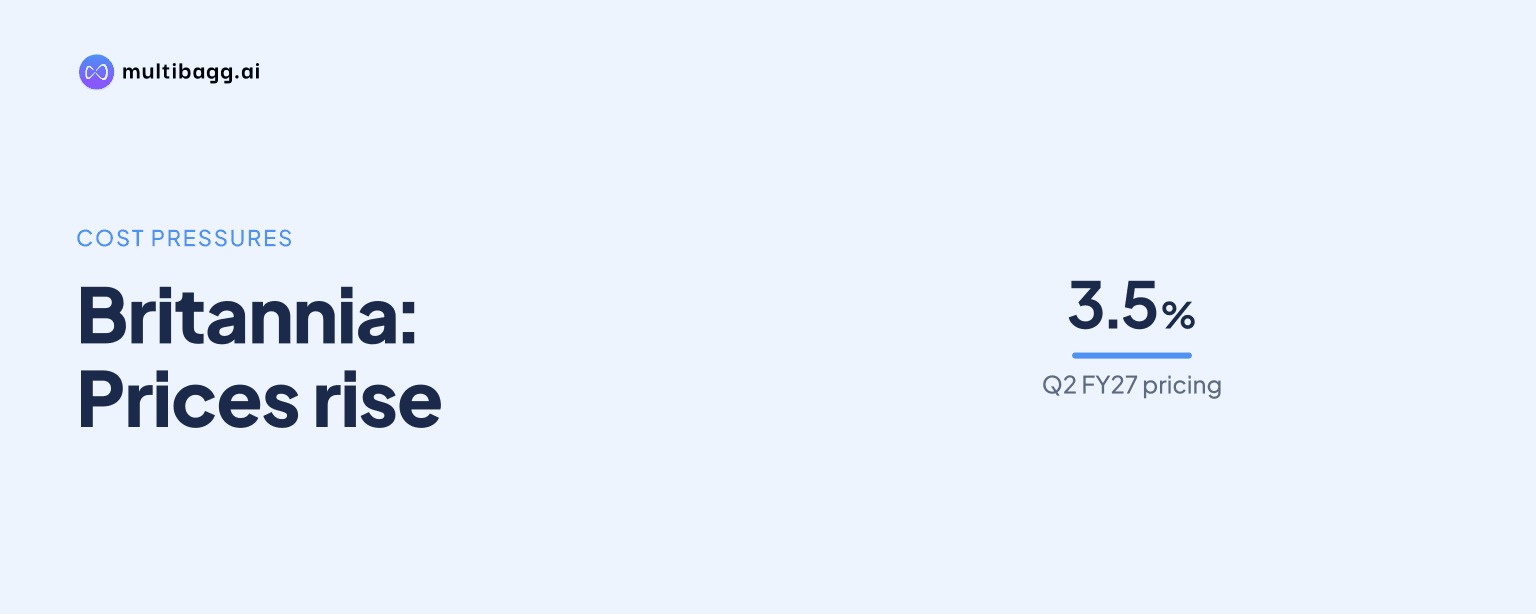
Britannia Industries Limited said in Q2 FY27 that further price increases were under way because its 3.5% pricing action covered only part of cost inflation, led by an 18% year-on-year rise in laminate packaging and an 11% sequential increase in refined palm oil.
Know Britannia Industries inside out
Results, valuation, peers and who's buying, in one view.
Why is Britannia raising prices again?
Britannia is activating further price increases because management said its 3.5% action in Q2 FY27 recovered only part of the rise in input costs. Chief Executive Officer Rakshit Hargave said the purpose of subsequent increases was to close that gap as agricultural commodities and packaging costs stayed elevated.
Britannia’s pricing process is shaped by the Rs 5 and Rs 10 price points that make up a large part of its business. Management said much of its pricing is delivered through shrinkflation, meaning lower pack grammage rather than a higher printed price, and physical implementation takes about 1.5 to 2 months.
Management did not disclose the size of the additional price increases or a date by which they would fully reach consumers. It said only that further pricing was “in activation” after the Q2 FY27 3.5% action, meaning the initial and subsequent measures may affect different sales periods.
Which Britannia input costs increased in Q2 FY27?
Britannia faced cost increases across refined palm oil, milk, laminate packaging, sugar and wheat flour in Q2 FY27. Refined palm oil rose 11% from Q1 FY27 and 17% from the year-earlier period, while laminate increased 7% sequentially and 18% year on year.
Wheat flour rose 9% from Q1 FY27 even though it was marginally lower than in the corresponding prior-year period. Sugar increased 4% sequentially and 6% year on year; management said it had corrected after a volatile quarter but remained at an elevated level.
Milk was 16% more expensive than a year earlier and 2% above Q1 FY27, despite the usual expectation of some winter easing in India. Management said it had not seen that relief yet and noted that large dairy companies were also taking price increases, while Britannia’s fuel costs, including gasoline and liquefied natural gas (LNG), remained 45% above the prior-year period despite sequential relief.
Got a follow-up? Ask IRIS
How did higher costs compare with Britannia’s revenue and profit growth?
Britannia reported Q2 FY27 revenue from operations of Rs 5,542 crore, up 16.6%, while operating profit grew 8.5%. Profit before tax (PBT) increased 10.6% and profit after tax (PAT) rose 10.2%, so profit growth was lower than revenue growth in the quarter.
Revenue rose from Rs 4,960 crore in Q1 FY27 to Rs 5,542 crore in Q2 FY27, an 11.6% sequential increase. Management also reported profit from operations at 17% in Q2 FY27, above the preceding quarter, but did not give a gross-margin figure during the November 6, 2026 call.
For the first half ended September, Britannia reported revenue from operations of Rs 10,506 crore, its first first-half total above Rs 10,000 crore. First-half net sales grew 13.1%, operating profit increased 10.3%, PBT rose 12%, and PAT increased 11.7%, compared with Q2 revenue growth of 16.6%.
The comparison shows that several cost pressures occurred at once in Q2 FY27: palm oil was up 11% sequentially, wheat flour 9% and laminate 7%. Management described the overall input-cost trend as a challenge that needed close management and monitoring.
Will Britannia’s pack-size changes affect volume growth?
Britannia said shrinkflation-based pricing could reduce grammage and therefore affect reported volume growth in future periods. It nevertheless reported 13% volume growth in Q2 FY27, which management said represented 13% more biscuit grammage consumed.
Chief Commercial Officer Vipin Kataria said transactions were moving on a healthy trajectory, with more packets and more biscuits reaching consumers. Management did not disclose a transaction-growth percentage or a volume forecast, but said the combination of value, volume and transactions was progressing well in Q2 FY27.
The Rs 5 and Rs 10 pack architecture means price recovery cannot be assessed only by changes in printed prices. A smaller pack can retain the consumer’s cash outlay while reducing quantity, and Britannia said this physical pack transition takes 1.5 to 2 months rather than the faster process of changing prices online.
Britannia’s 13% volume growth was measured against a prior-year base that management said had been low. Management remained confident in the volume-growth trajectory, while acknowledging that lower grammage from the additional pricing actions could affect the reported volume measure going forward.
Conclusion
Britannia’s Q2 FY27 message was that its 3.5% pricing action did not fully offset simultaneous inflation in palm oil, milk, wheat flour and laminate packaging. Revenue reached Rs 5,542 crore, up 16.6%, while operating profit grew 8.5%, leaving a gap between sales and operating-profit growth during the cost increase.
The next disclosure to watch is the market rollout of further pricing that management said was already in activation. Because much of the recovery uses pack-size changes requiring 1.5 to 2 months of physical execution, subsequent results should indicate the effect on revenue, grammage and profitability as palm oil, milk and packaging costs develop.