










Britannia Industries Ltd Revenue Rises 16.6% to ₹5,542 Crore
Key highlights
- Britannia reported Q2 FY27 standalone revenue from operations of ₹5,542 crore, up 16.6% year-on-year.
- Britannia's Q2 FY27 profit after tax attributable to owners rose 10.2% year-on-year to ₹721 crore.
- Britannia's H1 FY27 standalone revenue reached ₹10,506 crore, up 13.1% year-on-year.
- Britannia implemented a 3.5% price increase in Q2 FY27, which management said covered only part of input-cost inflation.
powered by IRIS
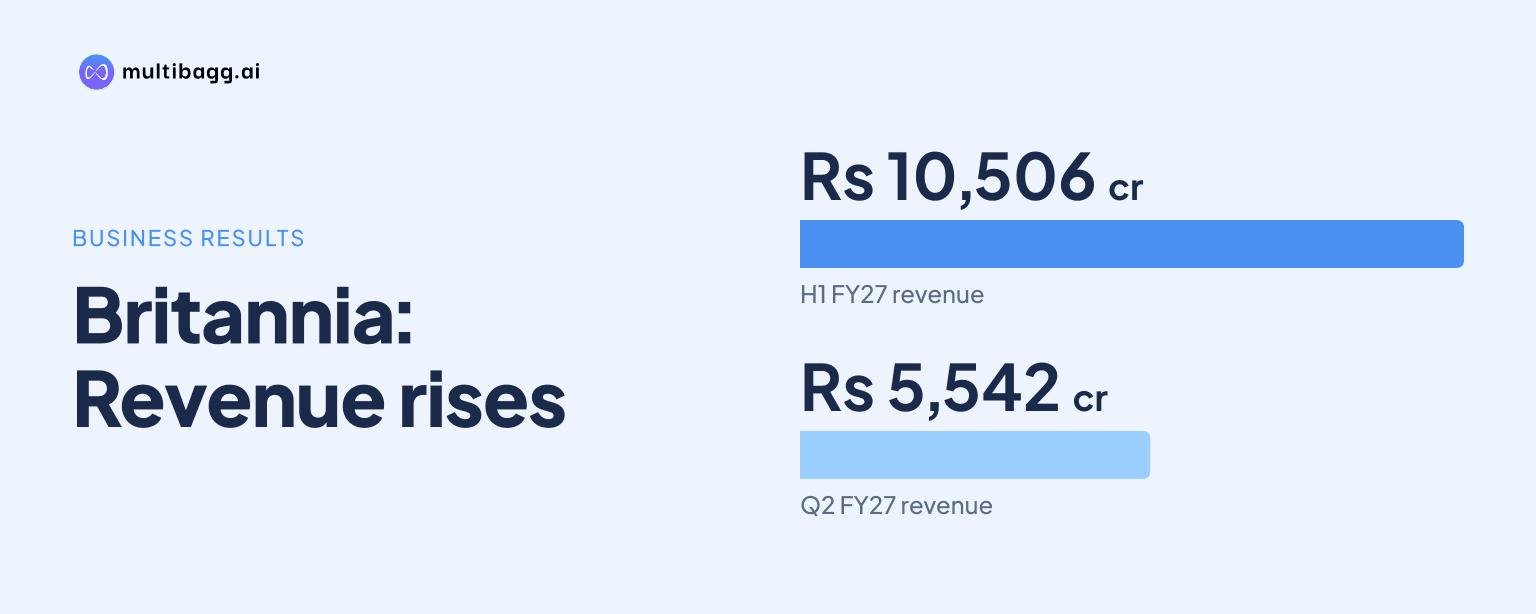
Britannia Industries Ltd reported revenue from operations of ₹5,542 crore in Q2 FY27, up 16.6% year-on-year, as growth across general trade, e-commerce, adjacencies and international markets offset continuing pressure from elevated input costs.
Know Britannia Industries inside out
Results, valuation, peers and who's buying, in one view.
What did Britannia report for Q2 FY27?
Britannia reported standalone revenue from operations, also described as net sales, of ₹5,542 crore for the July-September 2026 quarter. This was 16.6% higher than the corresponding quarter of FY26 and 11.6% above ₹4,960 crore reported in the preceding quarter. The company said the quarter was its highest in its quarterly revenue chart.
Profit after tax attributable to owners stood at ₹721 crore, rising 10.2% year-on-year. Operating profit increased 8.5% year-on-year and profit before tax grew 10.6%. The difference between revenue and profit growth reflected the effect of broad-based commodity inflation on the cost base.
On a consolidated basis, Britannia reported Q2 revenue from operations of ₹5,598 crore, up 15.6% year-on-year, and net profit of ₹726 crore, up 10.8%. Consolidated basic earnings per share were ₹29.93. The distinction matters because the company also highlighted standalone sales and owner-attributable profit in its investor communication.
What drove Britannia's sales growth during the quarter?
Britannia said growth strengthened across general trade, e-commerce, adjacencies and international markets. This indicates that the sales increase was spread across several channels rather than being reliant on a single route to market.
Management also cited a 3.5% price increase implemented during Q2 FY27. The increase supported revenue growth, but the company said it covered only part of the inflation in key inputs. Further price increases were under consideration, although management did not disclose a timeline.
The company described Q2 growth as 21% on a 24-month basis. This comparison places the quarterly performance against a two-year period and provides additional context beyond the year-on-year base. However, the reported quarter still faced a cost environment that limited the pace of profit expansion relative to sales growth.
General trade remains relevant to Britannia's domestic distribution, while e-commerce and international markets add channels for growth. The company did not provide a segment-wise revenue breakdown in the available call highlights, so the relative contribution of each channel was not disclosed.
How did input inflation affect Britannia's profitability?
Input-cost inflation remained the central operating issue for Britannia in Q2 FY27. Management said commodity inflation was elevated and expected to persist, while the 3.5% price increase had covered only part of the gap between costs and selling prices.
Operating profit rose 8.5% year-on-year, below the 16.6% increase in standalone revenue. Profit before tax and profit after tax grew 10.6% and 10.2%, respectively. These reported trends show that the company preserved profit growth, but that higher costs reduced the conversion of incremental sales into profit.
Britannia did not provide a margin outlook during the call. Management also did not offer detailed answers on gross margin or per-kilogram cost trends in the available earnings-call coverage. Investors therefore have confirmed quarterly results and commentary on inflation, but no quantified forward margin guidance.
For packaged food companies, commodity costs can affect profitability directly because products use agricultural and other raw materials whose prices can move sharply. Britannia's response in the quarter combined pricing action with continued channel expansion, but the available material does not quantify the savings or mix benefits from these measures.
Got a follow-up? Ask IRIS
What does the first-half performance show?
Britannia crossed ₹10,000 crore in first-half revenue for the first time, reporting standalone revenue from operations of ₹10,506 crore in H1 FY27. This represented growth of 13.1% year-on-year and included both the first and second quarters of the financial year.
For the first half, operating profit increased 10.3%, profit before tax rose 12%, and profit after tax grew 11.7%. Revenue growth again outpaced operating-profit growth, consistent with the inflation pressure described by management. Still, the company maintained positive growth across all the headline profitability measures disclosed.
The September-quarter performance was stronger sequentially, with Q2 standalone sales of ₹5,542 crore compared with ₹4,960 crore in Q1. The quarter's 11.6% sequential sales increase was supported by channel growth and pricing, based on the company’s call highlights.
What should investors take from Britannia's results?
Britannia's Q2 results show that demand and distribution execution supported double-digit sales growth despite a difficult input-cost environment. The rise in general trade, e-commerce, adjacencies and international markets broadens the set of channels contributing to sales, while the first-half revenue milestone demonstrates the scale of the company’s current growth.
At the same time, the earnings release underlines the importance of costs and pricing for investors. Revenue increased faster than operating profit and profit after tax, and management said the implemented price increase did not fully offset inflation. The company gave no margin outlook, leaving commodity-cost trends and any further pricing action as key unresolved variables.
No share-price movement, valuation data or market reaction was provided in the source material. As a result, the reported results can be assessed through operating and financial metrics, but the available information does not establish an immediate stock-market impact.
Conclusion
Britannia delivered Q2 FY27 standalone revenue of ₹5,542 crore, with 16.6% year-on-year growth supported by broader channel participation and a 3.5% price increase. Its first-half revenue reached ₹10,506 crore, while profit growth remained positive but slower than sales growth because commodity inflation continued to weigh on profitability.
The next key issue is whether additional pricing actions are implemented and how effectively they offset input-cost inflation. Management has said further increases are being considered but has not given a schedule or a margin forecast, making subsequent disclosures on costs, pricing and operating profit important to monitor.