










Britannia says shelf share recovered as Rs 4.5 packs ended
Key highlights
- Britannia said it regained shelf space and improved its share after Rs 4.5 biscuit packs disappeared around May and June this year.
- Britannia said the biscuit industry returned to Rs 5 and Rs 10 packs, ending fractional Rs 4.5 pricing.
- Britannia reported 13% quarterly biscuit volume growth and implemented a 3.5% price increase.
- E-commerce was trending at 7% at the time of the call, versus 6% for the full year of financial year 2026.
powered by IRIS
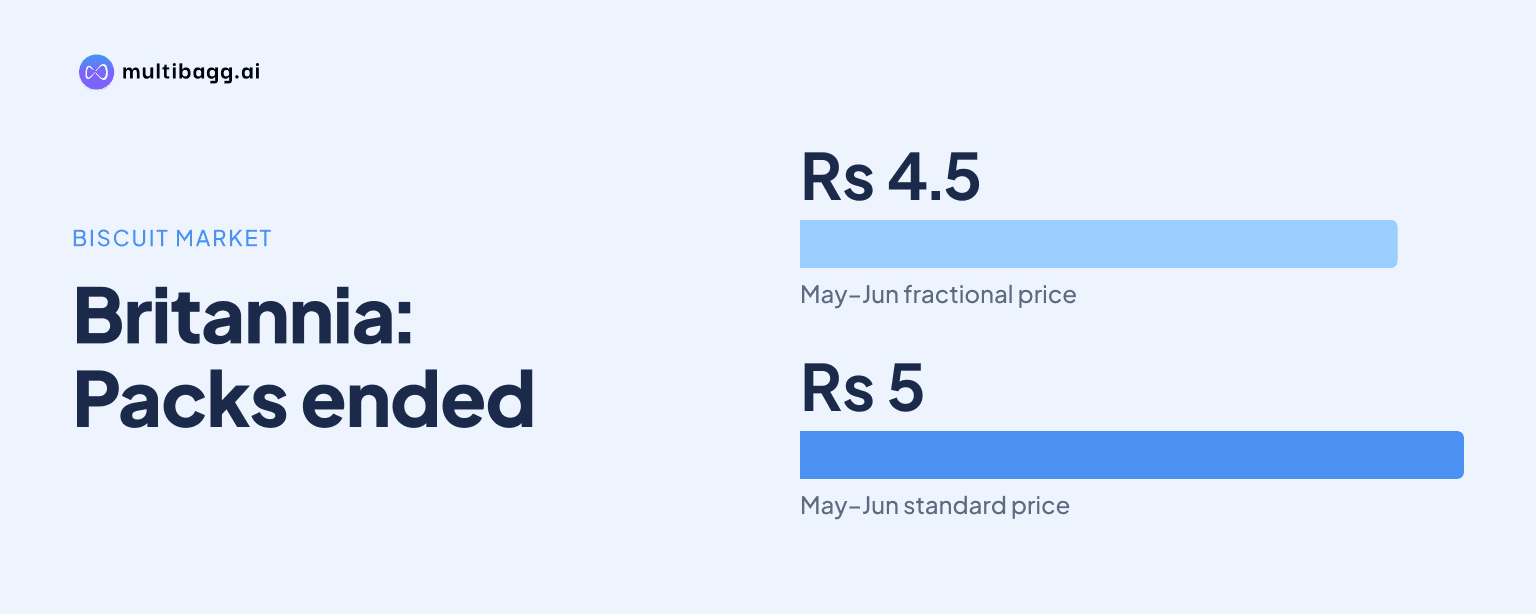
Britannia said it regained shelf space and improved its share after the biscuit industry returned to Rs 5 and Rs 10 packs, with the Rs 4.5 price point disappearing around May and June this year. Management did not provide a market-share percentage, but reported 13% quarterly biscuit volume growth.
Know Britannia Industries inside out
Results, valuation, peers and who's buying, in one view.
Has Britannia regained biscuit shelf share?
Britannia said it has regained shelf space and “done better on the share” after the earlier disruption from fractional pack pricing. The statement followed an analyst’s question on whether Britannia had returned to its prior shelf-market position rather than merely benefiting from the end of Rs 4.5 packs. Management gave no percentage for shelf share, sales share or the timing of the recovery.
Britannia linked the change to an industry-wide return to Rs 5 and Rs 10 price points. Management said Rs 4.5 pricing had been present toward the end of the prior year’s second quarter and to a large extent in the fourth quarter, but was no longer in the market. It described Rs 4.5 packs as remaining only in the comparative base of the previous year.
Britannia’s operating indicators provide context for the claim. Management said biscuit volume grew 13% in the quarter, although the analyst noted that the base period had a 3% volume decline. Britannia responded that consumers bought 13% more biscuit grammage and said transactions, packets and biscuits reaching consumers were all on a healthy trajectory.
Why did the Rs 4.5 biscuit pack disappear?
Britannia said the entire industry, including competitors, migrated back to Rs 5 and Rs 10 packs around May and June this year. Management’s view was that Rs 4.5 pricing was no longer in the market and that it did not expect a similar move to recur. Britannia did not identify the competitors involved or provide channel-by-channel price data.
The significance of those price points reflects Britannia’s product mix. Management said a large part of its business is sold at Rs 5 and Rs 10, and later said the Rs 5 point was doing well in wholesale. It argued that disrupting established Rs 5 and Rs 10 biscuit packs is harder than discounting cola products by Rs 5 or Rs 10 because those biscuit price points account for a large part of the category.
Pricing is also being used to manage input-cost inflation. Britannia implemented a 3.5% price increase during the quarter, but said that increase covered only part of the cost inflation. Management said further increases were being activated, with implementation taking 1.5 to 2 months because many adjustments involve reducing grammage rather than simply changing a printed price.
How is Britannia competing with Malkist?
Britannia said it is competing directly with Malkist in cheese-filled cracker products through Cheeze Dipped, which management said had performed well after its launch around December or January. Management described this as a small segment within the broader cracker market while acknowledging that competition is fierce.
Malkist was described by Britannia as the originator of products that place cheese or another filling between two crackers. Britannia said Cheeze Dipped had “dented” Malkist and that Malkist subsequently changed strategy and increased investment. Neither company’s segment revenue, volumes or share was disclosed on the call, so the stated competitive effect cannot be measured from the available information.
Britannia also cited product activation in Kerala, where it said Cheeze Dipped is a large category for both it and competitors. Elsewhere, it pointed to a Bourbon Modak promotion during Ganesh Chaturthi in Mumbai that sold out quickly. These examples show a response through local campaigns and product variants rather than a disclosed broad price reduction in crackers.
Got a follow-up? Ask IRIS
What does Reliance’s Tamil Nadu biscuit launch mean for Britannia?
Britannia said Reliance had started a biscuit range in Tamil Nadu and that it was watching the entry carefully. Management said it had already seen and analysed Reliance’s products, which it described as similar to classical products already available in the market. It did not disclose Reliance’s prices, distribution reach or an expected effect on Britannia sales.
Tamil Nadu matters because Britannia described it as a large state for biscuits and for its own business. Management differentiated biscuits from the cola category, where the analyst said Reliance had disrupted the market. Britannia’s early assessment was that the established Rs 5 and Rs 10 biscuit-pack architecture makes price-led disruption harder than in cola, though it called Reliance a respectable competitor.
Management said Britannia had plans to move ahead but did not provide countermeasures, promotional spending or a launch timetable. The unresolved issue is whether Reliance expands beyond Tamil Nadu and whether its range changes pricing or retailer shelf allocation. Britannia’s comments support a monitoring stance at this stage, rather than a forecast of the competitive impact.
Which channels are supporting Britannia’s biscuit demand?
Britannia said general trade, particularly semi-urban and rural general trade, showed strong consumption, while growth was fairly uniform from opportunity states to mature states. Management also said metros and the top 15 cities were doing decently despite the rise of e-commerce. It attributed general-trade performance to consumer resilience, its state-focused “Many Indias” strategy and sales execution.
The company said a Goods and Services Tax transition in September of the prior year affected the comparison, but estimated the cumulative quarterly impact at no more than 1.5% to 2%. Management therefore did not attribute the entire improvement to the lower base. It also cited premiumisation in semi-urban and rural markets as a tailwind, while describing rural as a large business for Britannia.
E-commerce was trending at 7% at the time of the call, compared with 6% for the full year of financial year 2026, according to the analyst’s question. Britannia said that share would rise during the season and that it planned products specifically for the channel. Management added that Rs 5 packs are hardly sold online, indicating that e-commerce has a different assortment mix from its wider biscuit portfolio.
Conclusion
Britannia’s central claim is that the industry’s abandonment of Rs 4.5 biscuit packs restored its shelf position after a period of fractional pricing. The available evidence is management’s unquantified assertion alongside 13% quarterly volume growth, a 3.5% implemented price increase and a return to the Rs 5 and Rs 10 price architecture. Competition remains active in cheese crackers through Malkist and in Tamil Nadu through Reliance.
The next items to watch are Britannia’s additional price increases, which management said need 1.5 to 2 months to reach the market, and any expansion of Reliance’s biscuit effort beyond Tamil Nadu. Management is also developing health- and protein-based future products without giving launch dates, while NutriChoice Zero was said to be growing in strong double digits and more health variants are planned.