










Britannia says rural trade recovery exceeds GST base effect
Key highlights
- Britannia said the September GST transition contributed at most 1.5%-2% to the quarter’s result.
- Britannia reported strong consumption in rural and semi-urban GT, including wholesale demand at the 5-rupee price point.
- Britannia said GT growth was fairly uniform across opportunity states, mature states, metros and the top 15 cities.
- Britannia said consumers consumed 13% more biscuit grammage, while cautioning that future grammage reductions could affect volume.
powered by IRIS
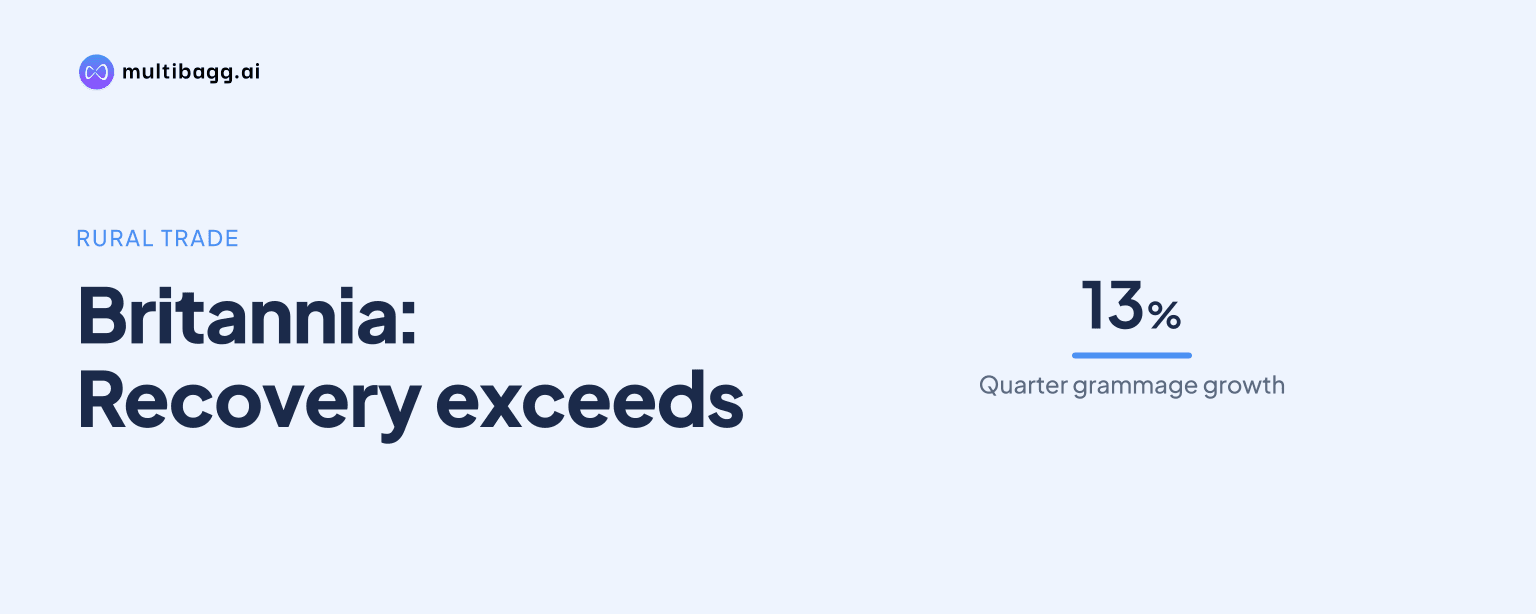
Britannia said the prior-year Goods and Services Tax, or GST, transition accounted for at most 1.5%-2% of the quarter’s result, while resilient rural and semi-urban General Trade, or GT, consumption, demand at the 5-rupee price point and state-level sales execution drove the recovery.
Know Britannia Industries inside out
Results, valuation, peers and who's buying, in one view.
Is Britannia’s general trade recovery mostly a GST base effect?
No. Britannia said the GST transition was a limited contributor, estimating that September last year was a transition month but that its cumulative effect on the quarter’s result would be no more than 1.5%-2%. Management acknowledged that Britannia, like other companies, faced disruption during the transition, but described it as a small factor rather than the main reason for the GT improvement.
Britannia identified three contributors: the limited GST comparison, resilient GT consumption and its own sales execution. The first is a comparison with the prior-year period, while the other two reflect current consumer purchases and distribution activity. Management did not provide a numerical allocation among these three factors, leaving the 1.5%-2% estimate as its only quantified measure of the base effect.
The distinction is material because management described the pickup as “pretty much sustainable,” rather than as a short-lived rebound from September last year. That view rests on demand across rural, semi-urban and urban GT channels, not on an announced revenue target or a forecast for quarterly growth.
Where is Britannia seeing the strongest trade demand?
Britannia said rural and semi-urban GT are showing strong consumption, including in wholesale, where the 5-rupee price point has performed well. Management linked the pattern to the broad reach of GT among Indian consumers and said consumption had remained resilient despite external developments. Britannia did not disclose separate rural, semi-urban or wholesale sales-growth figures.
The improvement was not described as limited to smaller towns. Britannia’s sales leadership said GT growth was fairly uniform from opportunity states to mature states in volume, transactions and value, while metros and the top 15 cities were also doing decently. This compares a wide set of geographies and channels: rural demand was described as a very strong story, but the company also reported continued activity in larger cities.
Management also pointed to premiumisation in semi-urban and rural markets as a tailwind. That observation sits alongside demand for the 5-rupee pack, indicating that Britannia is seeing both affordable, high-frequency purchases and demand for more premium products in those markets. The call did not quantify the mix of premium products in rural or semi-urban GT.
Why do 5-rupee and 10-rupee price points matter to Britannia?
Britannia said the 5-rupee and 10-rupee price points help protect biscuit demand because a large part of the category operates at those levels. Management said retaining these consumer price points provides some insulation compared with categories where consumers may face direct price changes when food inflation rises. In GT wholesale, Britannia specifically cited the 5-rupee point as performing well.
The industry has also moved away from the earlier 4.5-rupee price point. Britannia said competitors and the company migrated to 5-rupee and 10-rupee packs around May and June this year, and the 4.5-rupee point was no longer present in the market other than in the prior-year comparison base. That changed the pricing environment from the period when fractional pricing had affected competition.
Britannia said it had regained shelf space and done better on share after that period of fractional pricing. Management did not disclose a market-share percentage, so the statement cannot be measured against a reported pre-disruption share. It nevertheless connects the return to standard 5-rupee and 10-rupee points with Britannia’s assessment of improved shelf presence.
Got a follow-up? Ask IRIS
How is Britannia’s sales execution supporting general trade?
Britannia said its GT recovery has been supported by its sales system, its strategy of winning in “Many Indias,” and a focus on teams at the state level. Management presented these actions as company-specific contributors alongside broader consumption resilience. The reported uniformity between opportunity states and mature states was the operational evidence offered for that assessment.
Transaction trends provide another measure of the sales effort. Britannia said it was seeing higher value, volume and transactions, meaning more packets and more biscuits were reaching consumers. In a separate discussion of the quarter, management said consumers had consumed 13% more biscuit grammage, while noting that future reductions in grammage could affect reported volume growth.
That 13% volume figure was discussed against a minus 3% comparison base, according to an analyst on the call. Management called the growth healthy and said the company remained confident in its volume-growth trajectory, but did not issue a future volume-growth target. The transaction commentary adds a separate indicator to volume because it refers to the number of consumer purchase occasions and packets.
Can food inflation disrupt Britannia’s rural trade momentum?
Britannia did not give a demand forecast and said food inflation remains an issue to watch. Management said milk prices were still rising in October, an unusual seasonal pattern in its view, while raw-material inflation was challenging. Its position was that 5-rupee and 10-rupee price points offer some consumer-demand protection, but that Britannia must manage cost inflation through internal actions.
Britannia said a 3.5% price increase had come through, but that it covered only part of the cost inflation. Management said further increases were being activated to narrow the gap. For biscuits, implementation can take 1.5 to 2 months because price actions often involve shrinkflation, or a reduction in pack quantity, rather than an immediate change to a listed price.
Management also cited cost-optimisation programmes as part of its response to inflation. The company did not predict the direction of food inflation or gross margin, and said it would have to watch the next wheat season after challenging monsoons. The unresolved issue is whether further cost pressure can be managed while maintaining consumer affordability at 5-rupee and 10-rupee packs.
Conclusion
Taken together, Britannia’s comments portray GT demand as broad-based rather than confined to a GST-affected comparison period. The company cited strong rural and semi-urban consumption, growth across opportunity and mature states, decent performance in the top 15 cities, and 13% higher biscuit grammage consumption as the operating indicators behind that view.
The next issue to watch is the rollout of further pricing actions. Britannia said these can take 1.5 to 2 months to reach the market because of pack-size changes, while milk prices were still rising in October and management gave no forecast for raw-material inflation or gross margin.