










Castrol India Limited control shifts while BP retains 35% stake
Key highlights
- The Acquirer obtained indirect sole control of Castrol India on October 30, 2026 through the purchase of 100.00% of Castrol Group Holdings Limited.
- Castrol Limited remains Castrol India’s promoter and holds 50,44,52,416 shares, equal to 51.00% of equity capital.
- BPMH received a 35.00% non-controlling interest in the Acquirer, while PAC 1 holds 65.00% and sole control.
- The open offer is for up to 26.00% of Castrol India at Rs 199.45 per share, implying maximum consideration of Rs 5,129.29 crore.
powered by IRIS
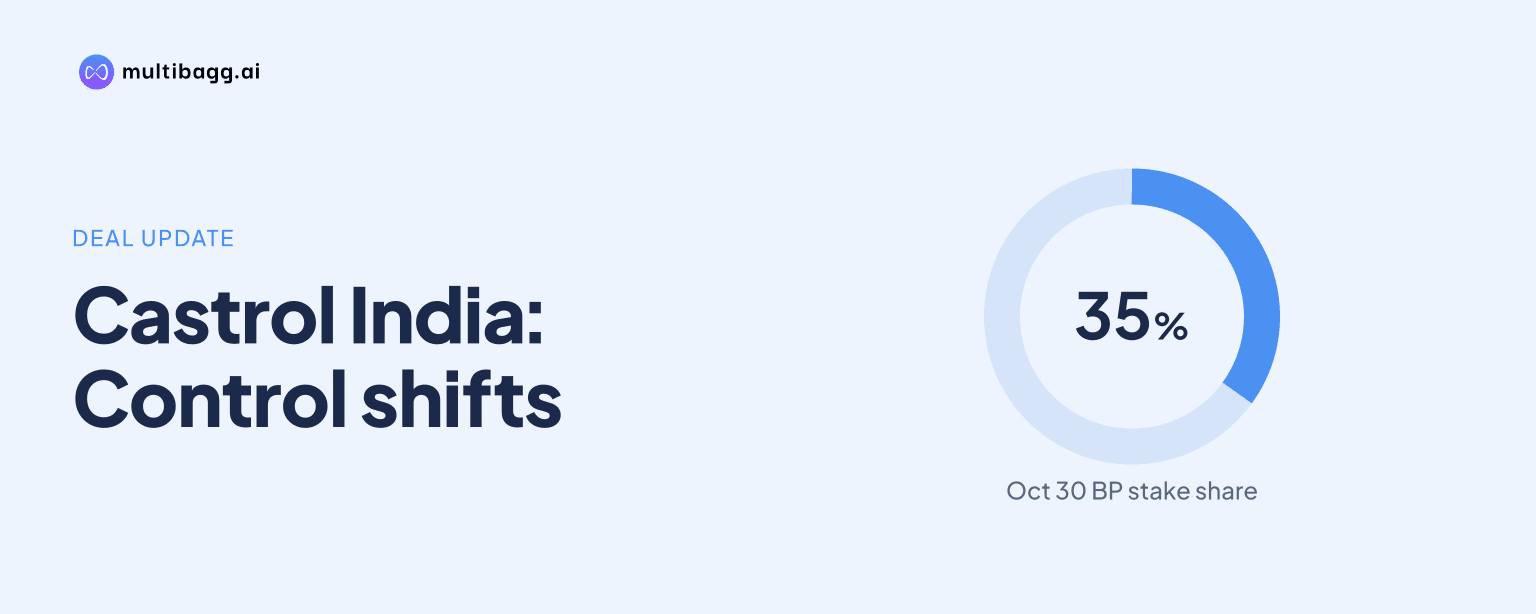
Castrol India Limited came under the Acquirer’s indirect sole control on October 30, 2026, after the Acquirer bought Castrol Group Holdings Limited; Castrol India’s promoter chain holds 51.00% of its equity. BP Motion Holdings Limited received 35% of the Acquirer’s equity capital but holds a non-controlling interest.
Know Castrol India inside out
Results, valuation, peers and who's buying, in one view.
How did control of Castrol India change?
Control of Castrol India changed indirectly because the Acquirer completed its purchase of 100% of Castrol Group Holdings Limited on October 30, 2026. The sale and purchase agreement, or SPA, was signed with BP p.l.c. on December 23, 2025, subject to conditions precedent and statutory approvals. The filing says the transaction completed in accordance with those conditions.
Castrol Group Holdings Limited owns 100% of Castrol Limited, which is Castrol India’s promoter. Castrol Limited holds 50,44,52,416 Castrol India equity shares, equal to 51.00% of its equity share capital and total voting rights. By acquiring Castrol Group Holdings Limited, the Acquirer obtained the right to direct voting attached to that 51.00% stake and acquired sole control of Castrol India.
This was an indirect acquisition rather than a direct purchase of Castrol India shares from public shareholders. The Acquirer acquired the holding-company chain above the listed company, while Castrol Limited remains the registered promoter holding the 51.00% stake. The filing classifies the change as an indirect acquisition of equity shares, voting rights and sole control under the Securities and Exchange Board of India takeover regulations.
What interest did BP retain in the Acquirer?
BP retained an indirect economic interest through BP Motion Holdings Limited, or BPMH, an indirect wholly owned subsidiary of BP p.l.c. BPMH received shares equal to 35% of the Acquirer’s equity capital. Consideration for the holding-company acquisition was paid in cash as agreed by the parties, with a portion ultimately directed to BPMH through the Acquirer’s issue and allotment of shares.
Stonepeak Motion Holdco Limited, identified as PAC 1, held 100.00% of the Acquirer before the allotment and holds 65.00% afterwards. The filing states that PAC 1 remains in sole control of the Acquirer. The ownership split therefore changed from 100.00% held by PAC 1 to 65.00% for PAC 1 and 35.00% for BPMH, without transferring control to BPMH.
PAC 1 and BPMH entered into an investment and shareholders agreement dated December 23, 2025. Its substantive operative provisions took effect only on completion of the SPA. Despite that agreement and BPMH’s 35.00% equity interest, the filing states that neither BP p.l.c. nor BPMH will control the Acquirer or indirectly control Castrol India.
A further investor, CPP Investment Board Private Holdings (6) Inc., identified as PAC 4, made an indirect capital investment in PAC 1 in connection with the acquisition of Castrol Group Holdings Limited. PAC 4 also holds a non-controlling interest. The filing provides no percentage ownership figure for PAC 4, establishing its non-controlling status but not its economic share of the ownership chain.
Got a follow-up? Ask IRIS
Why are Castrol India shareholders receiving an open offer?
Castrol India shareholders are receiving a mandatory open offer because the Acquirer’s indirect purchase resulted in control over the promoter’s 51.00% holding and sole control of the company. The offer is made under Regulations 3(1), 4 and 5(1) of the SEBI (Substantial Acquisition of Shares and Takeovers) Regulations, 2011, or SEBI SAST Regulations.
The Acquirer and persons acting in concert propose to buy up to 25,71,71,820 Castrol India equity shares, representing 26.00% of equity share capital, at Rs 199.45 per share. At full acceptance, maximum consideration is Rs 5,129.29 crore. The price comprises an initial offer price of Rs 194.04 per share, increased by Rs 16.91 and reduced by a Rs 11.50 dividend adjustment.
Castrol India had 98,91,22,384 fully paid equity shares, representing 100.00% of its equity capital, for the stated offer-capital calculation. The filing reports no partly paid shares, differential voting-right shares, outstanding convertible instruments, depository receipt shares or shares under lock-in. If valid tenders exceed the 26.00% offer size, shares will be accepted proportionately up to the stated maximum.
The offer is not conditional on any minimum acceptance level from public shareholders. The filing says the Acquirer and persons acting in concert had not acquired Castrol India equity shares after the December 24, 2025 public announcement and up to the date of the draft letter, apart from the indirect acquisition completed on October 30, 2026.
Will the transaction change Castrol India’s listing or board?
Castrol India is not intended to be delisted through the open offer, according to the filing. The company must continuously maintain at least 25.00% public shareholding under the SEBI Listing Obligations and Disclosure Requirements Regulations and Rule 19A of the Securities Contracts (Regulation) Rules, 1957. If open-offer acceptances reduce public shareholding below that threshold, necessary steps are to be taken within prescribed timelines to restore compliance.
As of the draft letter’s date, there was no proposed board change because of the underlying transaction. The filing names Nisha Trivedi and Kartikeya Dube as directors representing Castrol Limited who were appointed before the offer period. It says no other Castrol India directors represented the Acquirer or persons acting in concert as of that date.
The filing also states that no competing offer existed as of the draft letter’s date. Castrol India’s independent directors must form a committee and publish a written, reasoned recommendation on the offer at least two working days before the tendering period begins. That requirement applies under Regulations 26(6) and 26(7) of the SEBI SAST Regulations.
Conclusion
The October 30, 2026 transaction separates economic participation from control in Castrol India’s promoter chain. The Acquirer controls Castrol Group Holdings Limited and, through Castrol Limited’s 51.00% holding, has sole control of Castrol India. BPMH holds 35.00% of the Acquirer, while PAC 1 holds 65.00% and remains its sole controller; PAC 4’s investment in PAC 1 is also described as non-controlling.
The disclosed next event is the 10-working-day tendering period, expected to open on December 24, 2026 and close on January 7, 2027. Before it starts, Castrol India’s independent-director committee is required to publish its recommendation. The other disclosed issue is whether tender acceptances require steps to preserve the 25.00% minimum public-shareholding requirement.