










Castrol India owner keeps restructuring options open after offer
Key highlights
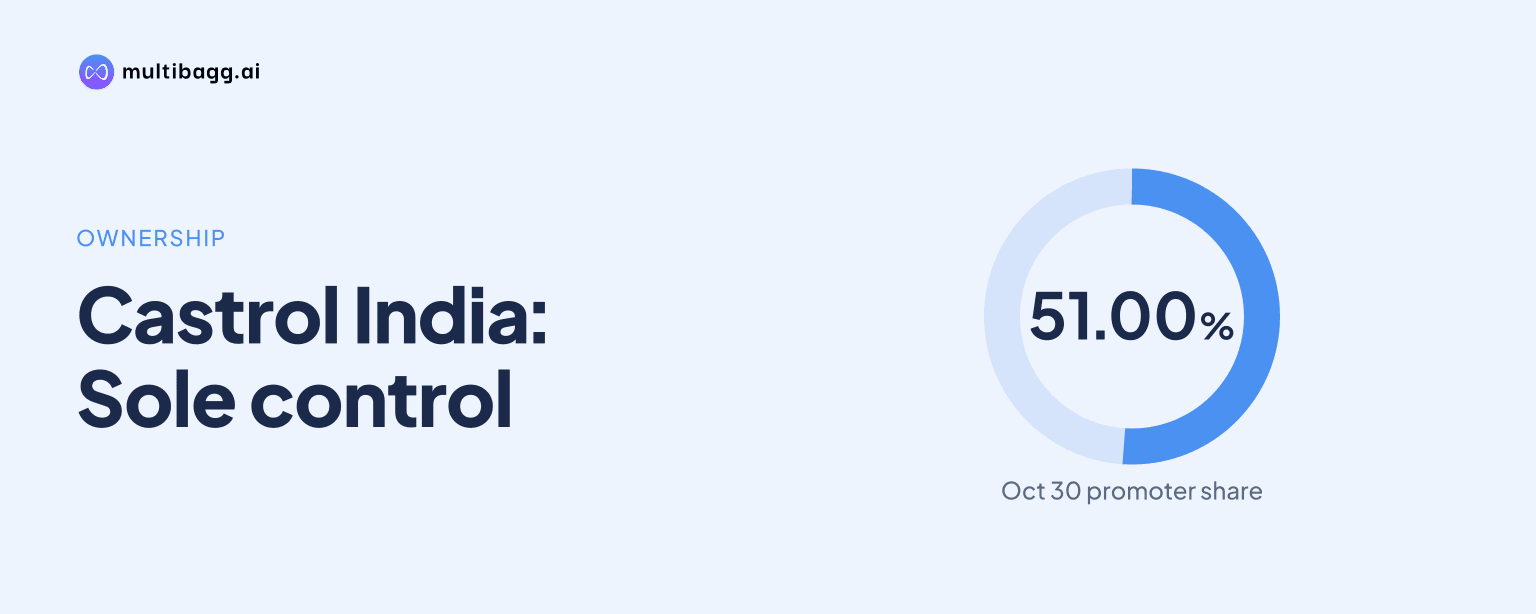
- Motion JVCo obtained indirect sole control of Castrol India on October 30, 2026 through a promoter holding of 51.00%.
- The open offer seeks up to 25,71,71,820 Castrol India shares, equal to 26.00% of equity capital.
- The cash offer price is Rs 199.45 per share, implying maximum consideration of Rs 5,129.29 crore.
- Castrol India must maintain at least 25.00% public shareholding for continued listing.
powered by IRIS
Castrol India Limited’s acquirer, Motion JVCo Limited, has retained options to restructure operations, contracts, assets and liabilities after an open offer for up to 26.00% of equity, following its October 30, 2026 indirect acquisition of sole control through the promoter’s 51.00% holding. No specific restructuring, disposal or partnership has been announced.
Know Castrol India inside out
Results, valuation, peers and who's buying, in one view.
What changes can Castrol India’s owner consider after the open offer?
Castrol India’s owner may consider operational, management, contractual and portfolio changes, but the filing does not commit it to a particular transaction. Motion JVCo says that, after the open offer, it may consult Castrol India’s board on streamlining operations, restructuring business processes and management structures, and changing contracts, assets or liabilities at Castrol India and any subsidiary.
The options disclosed include acquiring new assets, entering new markets, disposing of assets, and forming strategic partnerships, joint ventures or joint development agreements. Motion JVCo also lists schemes of arrangement, asset or slump sales, and the creation or release of encumbrances as possible mechanisms to pursue operational and capital efficiencies and commercial or strategic benefits.
Under Regulation 25(2) of the Securities and Exchange Board of India Takeover Regulations, Motion JVCo may also assess a sale, lease, reconstruction or restructuring of Castrol India’s assets, investments or liabilities. It may renegotiate or terminate contractual and operating arrangements, but says any decision will depend on Castrol India’s business requirements, board consultation and applicable law.
Has Castrol India announced an asset sale or strategic partnership?
No, Castrol India has not announced an agreed asset sale, strategic partnership, joint venture or restructuring programme in the offer document. The disclosure made after the October 30, 2026 completion of the underlying transaction preserves Motion JVCo’s ability to evaluate those options without identifying an asset, counterparty, timetable or financial target.
Motion JVCo’s immediate stated intention is to support Castrol India’s management in pursuing sustained growth of its existing business activities after the offer. That objective sits alongside its retained ability to change the company’s contracts, management arrangements, assets and liabilities, rather than representing a disclosed plan to sell or separate a business.
The filing makes board consultation a stated part of any post-offer action and says measures must be permitted by applicable law. It therefore describes a range of potential actions available after a control change involving 51.00% of Castrol India’s equity, not a completed strategic review or mandated restructuring exercise.
Who controls Castrol India following the October 2026 transaction?
Motion JVCo obtained indirect sole control of Castrol India on October 30, 2026 by acquiring control of the promoter that holds 50,44,52,416 equity shares, equal to 51.00% of the equity share capital. The transaction gave Motion JVCo the right to direct voting rights attached to that promoter stake as well as sole control over Castrol India.
The promoter continues to hold the 50,44,52,416 shares, while the open offer is a separate route to acquire up to 25,71,71,820 shares from public shareholders. Those offer shares equal 26.00% of Castrol India’s 98,91,22,384 fully paid equity shares, and valid tenders above that limit would be accepted proportionately.
As of the draft letter of offer, Castrol India had no proposed board change because of the underlying transaction. Nisha Trivedi and Kartikeya Dube, who represent the promoter, had been appointed before the offer period, while the filing identifies no new Castrol India board appointment by Motion JVCo or persons acting in concert, known as PACs.
Got a follow-up? Ask IRIS
What are the terms of Castrol India’s open offer?
Castrol India’s open offer seeks up to 26.00% of equity at Rs 199.45 per share in cash, with maximum consideration of Rs 5,129.29 crore assuming full acceptance. The offer is not conditional on a minimum acceptance level, and it is not a competing offer under the takeover regulations.
The final Rs 199.45 offer price comprises an initial price of Rs 194.04, an enhancement amount of Rs 16.91 and a dividend adjustment of Rs 11.50. The filing states that there is no differential pricing and that Motion JVCo and the PACs have no intention to delist Castrol India through the offer.
The public announcement was filed with stock exchanges and the Securities and Exchange Board of India on December 24, 2025, while the detailed public statement was published on November 6, 2026. The underlying transaction was consummated on October 30, 2026 after the conditions precedent and statutory approvals under the share purchase agreement were satisfied.
How will Castrol India retain its listing after the offer?
Castrol India must maintain at least 25.00% public shareholding continuously to remain listed under the Securities and Exchange Board of India Listing Obligations and Disclosure Requirements Regulations and Rule 19A of the Securities Contracts Regulation Rules. If the 26.00% offer reduces public ownership below that threshold, the filing says necessary steps will be taken within prescribed timelines and in accordance with applicable law.
The threshold matters because the promoter holding controlled by Motion JVCo is already 51.00% and the offer can acquire a further 26.00% of equity. The document does not specify how Castrol India would restore public shareholding if required, so it discloses the legal obligation but no selected mechanism.
Resident and non-resident public shareholders may tender shares, subject to required documents and approvals. For example, shareholders needing Reserve Bank of India or other regulatory approvals must submit them with their tender, and Motion JVCo and the PACs reserve the right to reject shares if the required approvals are not provided.
Conclusion
Castrol India’s control change gives Motion JVCo indirect command over the promoter’s 51.00% stake while the open offer can add up to 26.00% of equity at Rs 199.45 per share. The acquirer has signalled support for the existing business while explicitly retaining flexibility over operations, contracts, assets, liabilities and potential partnerships.
The next disclosed matters to watch are the outcome of the open offer, whether Castrol India maintains at least 25.00% public shareholding, and any board-consulted action announced after the offer. The filing sets no date, asset or transaction target for a restructuring, disposal or partnership, leaving such decisions subject to business requirements and applicable law.