










Castrol India completes deal after 36 regulatory reviews
Key highlights
- Castrol India completed the underlying transaction on October 30, 2026.
- The filing lists 23 antitrust authorities involved in the underlying transaction.
- The transaction also involved 12 foreign-investment or national-security authority reviews and 1 European Union Foreign Subsidies Regulation clearance.
- The open offer covers up to 25,71,71,820 equity shares, equal to 26.00% of equity share capital.
powered by IRIS
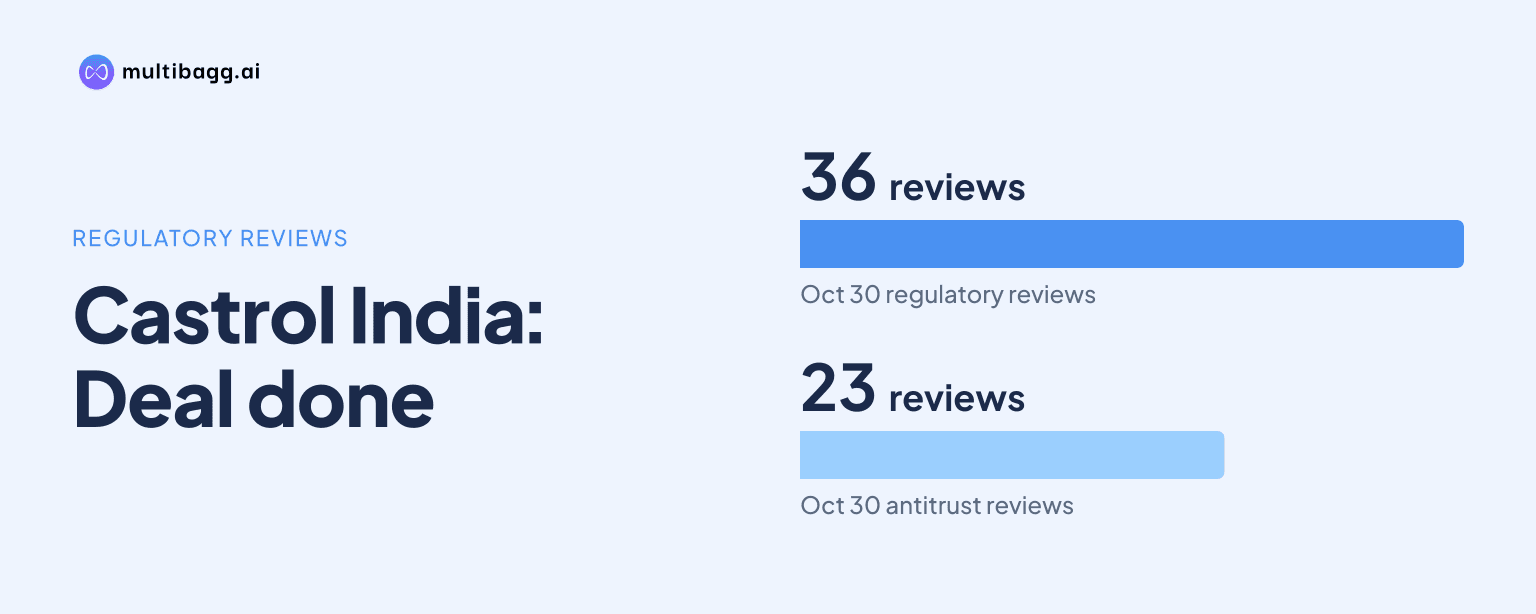
Castrol India completed its underlying transaction on October 30, 2026 after obtaining, or being deemed to have obtained, 36 listed regulatory clearances: 23 antitrust reviews, 12 foreign-investment or national-security authority reviews, and one European Commission clearance under the European Union Foreign Subsidies Regulation.
Know Castrol India inside out
Results, valuation, peers and who's buying, in one view.
What regulatory approvals did Castrol India complete?
Castrol India completed the underlying transaction with the Seller on October 30, 2026 after satisfying the conditions precedent in the share purchase agreement, including the requisite statutory approvals. The draft letter of offer states that all approvals required for consummation of that transaction had been granted or deemed granted by that date.
The filing separates the completed review process into 23 competition-authority approvals, 12 foreign-investment or national-security authority approvals, and one clearance under Regulation (EU) No 2022/2560, the European Union Foreign Subsidies Regulation. This produces 36 listed regulatory review authorities or clearances, although the document does not provide decision dates, remedies or conditions for individual jurisdictions.
These completed reviews relate to the underlying transaction, not the subsequent Indian open offer. Castrol India’s open offer is for up to 25,71,71,820 equity shares, representing 26.00% of its equity share capital, and the filing says that, as of the date of the draft letter of offer, the Acquirer and persons acting in concert were not aware of approvals required to acquire validly tendered offer shares.
Which antitrust authorities cleared the Castrol India transaction?
Castrol India listed 23 antitrust authorities whose consents, approvals, clearances, confirmations or licences were required for the underlying transaction. The list includes the Competition Commission of India, the European Commission, the United States Federal Trade Commission and the United States Department of Justice, alongside competition authorities in 19 other jurisdictions.
The other competition authorities named cover Angola, Australia, Botswana, Brazil, China, Egypt, Kenya, Kuwait, Mexico, Morocco, Namibia, Nigeria, Pakistan, Saudi Arabia, South Africa, South Korea, Türkiye, Ukraine and the United Kingdom. The filing records the United Kingdom Competition and Markets Authority outcome specifically as confirmation of no further questions, while stating overall that all required approvals were granted or deemed granted.
The 23-authority antitrust process was geographically broader than the Indian open offer mechanism. The offer is governed by the Securities and Exchange Board of India (SEBI) Substantial Acquisition of Shares and Takeovers Regulations, while its scheduled tendering period runs from December 24, 2026 to January 7, 2027, both days inclusive.
The filing does not disclose any market definitions, competition concerns, divestment commitments or behavioural conditions associated with the 23 antitrust reviews. It discloses the completion outcome on October 30, 2026, rather than the timing or reasoning of each authority’s decision.
Which foreign-investment reviews did Castrol India complete?
Castrol India listed 12 foreign-investment or national-security reviewing authorities as having provided the required approvals for the underlying transaction. Those authorities were identified under applicable foreign-investment and national-security laws, separately from the 23 merger-control authorities.
The list includes Austria’s Federal Ministry for Economy, Energy and Tourism; Australia’s Treasurer and Foreign Investment Review Board; Belgium’s Interfederal Screening Commission; and the relevant authorities in France, Germany, Greece, Italy, New Zealand, Romania, Spain and Sweden. The filing treats the Australian Treasurer and Foreign Investment Review Board as separate listed authorities, contributing two of the 12 reviews.
The foreign-investment reviews differ from merger-control clearances because the filing categorises them under foreign-investment and national-security laws. However, the draft letter of offer does not state which transaction features were examined in individual jurisdictions, nor does it disclose whether any of the 12 approvals involved continuing requirements after the October 30, 2026 completion.
Castrol India also received a separate European Commission clearance under Regulation (EU) No 2022/2560, the Foreign Subsidies Regulation. This was the sole European Union foreign-subsidy review disclosed and is distinct from the European Commission’s separate inclusion in the 23-authority merger-control list.
Got a follow-up? Ask IRIS
What does regulatory completion mean for Castrol India’s open offer?
Castrol India’s completed underlying transaction does not remove the procedural steps required for the 26.00% Indian open offer. Public shareholders can tender shares in whole or in part during the December 24, 2026 to January 7, 2027 tendering period, and the offer is not conditional on a minimum level of acceptance.
If valid tenders exceed 25,71,71,820 equity shares, PAC 5 will acquire validly tendered shares on a proportionate basis up to that offer size. The filing says PAC 5 will determine acceptance in consultation with the manager to the offer, with the basis intended to be fair and equitable; consequently, an eligible shareholder’s entire tender may not be accepted if the offer is oversubscribed.
As of the draft letter’s date, no further approval was known to be needed for PAC 5 to acquire shares validly tendered in the offer. If a statutory or other approval becomes applicable before completion, the offer would become subject to its receipt, and PAC 5 would complete payment within 10 working days after the tendering period closes, subject to required approvals and valid documents.
Shareholders may have separate approval obligations even where the Acquirer and persons acting in concert do not require another approval. The filing says residents, non-resident Indians, overseas corporate bodies and non-resident shareholders must submit approvals needed to tender, including Reserve Bank of India approval where applicable, and failure to provide them may lead to rejection of tendered shares.
Could a later approval issue delay or end the Castrol India offer?
Castrol India’s offer could be delayed if a statutory or other approval becomes applicable before completion and is not received on time. Under Regulation 18(11) of the SEBI Substantial Acquisition of Shares and Takeovers Regulations, SEBI may extend the completion period if it is satisfied that the delay did not arise from wilful default, failure or neglect by the Acquirer or persons acting in concert in pursuing the approval.
The filing also provides for payment to shareholders for whom no approval is required when an approval affects only some public shareholders. This means an approval issue involving one group of tendering holders need not necessarily prevent payment to another group, subject to the terms described in the draft letter of offer.
Under Regulation 23(1), the Acquirer and persons acting in concert may withdraw the open offer if an approval required or becoming applicable before completion is finally refused, or in circumstances that SEBI considers merit withdrawal. If withdrawal occurs, a public announcement must be made within two working days in the newspapers used for the detailed public statement and sent to SEBI, stock exchanges and Castrol India.
Conclusion
Castrol India’s filing documents a completed multi-track approval process for the underlying transaction: 23 competition-authority reviews, 12 foreign-investment or national-security authority reviews and one European Union Foreign Subsidies Regulation clearance. The October 30, 2026 completion therefore followed the satisfaction of the statutory conditions precedent identified in the share purchase agreement.
The next disclosed event is the open-offer tendering window from December 24, 2026 through January 7, 2027. Investors should watch the volume of valid tenders against the 25,71,71,820-share cap, whether an additional approval becomes applicable before settlement, and whether PAC 5 makes payment within 10 working days after the tender period closes.