










Castrol India public float could fall to 23% after offer
Key highlights
- Castrol India’s projected public shareholding would fall from 49% to 23% if the 26% offer is fully accepted.
- PAC 5’s projected holding would rise from 51% to 77%, or from 50,44,52,416 to 76,16,24,236 shares.
- The projected 23% public float is 2 percentage points below the 25% continuous-listing requirement.
- The offer price is Rs 199.45 per share and the maximum consideration is Rs 5,129.29 crore.
powered by IRIS
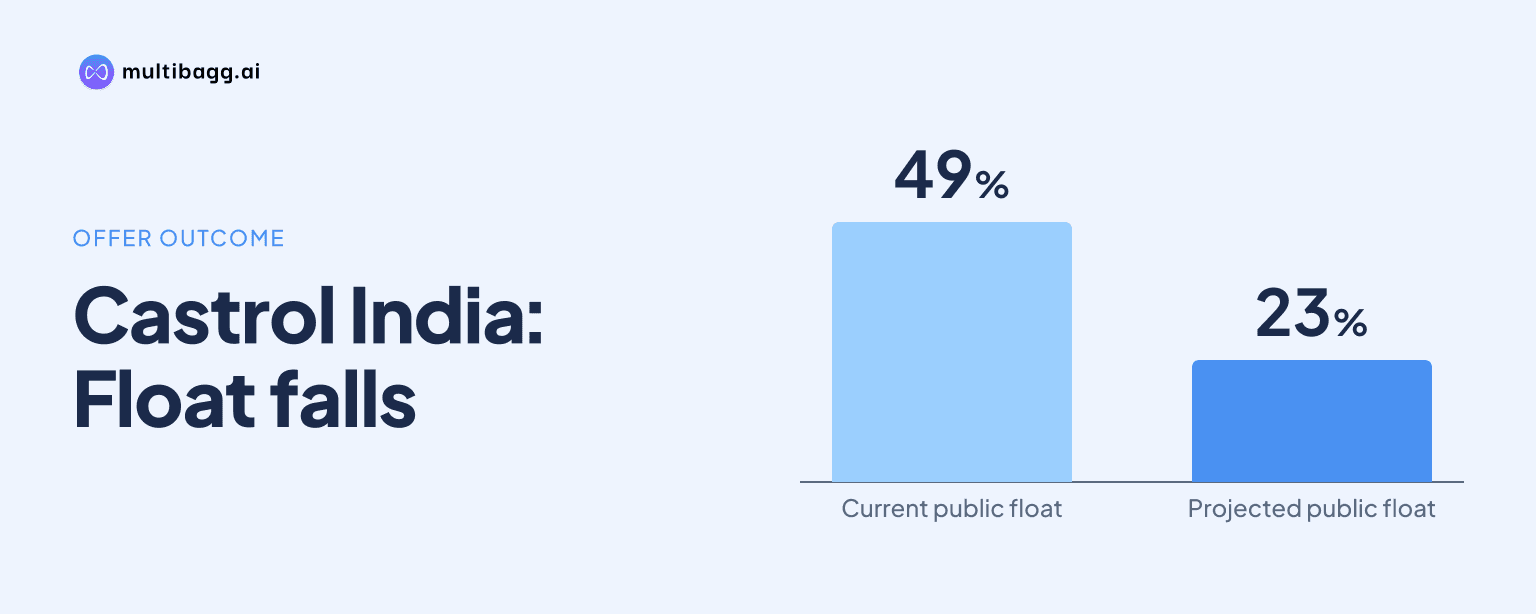
Castrol India Limited’s open offer could leave 23% public shareholding if all 25,71,71,820 shares sought are tendered, 2 percentage points below the 25% continuous-listing minimum. The projected shareholding table as of November 6, 2026 shows PAC 5’s holding rising from 51% to 77% under full acceptance.
Know Castrol India inside out
Results, valuation, peers and who's buying, in one view.
What would Castrol India’s public float be after full acceptance?
Castrol India’s public shareholding would be 23% after full acceptance of the offer, according to the projected shareholding pattern as of November 6, 2026. That outcome assumes PAC 5 acquires the full 25,71,71,820 equity shares sought, equal to 26% of the company’s 98,91,22,384 issued and paid-up equity shares.
Before the offer, the public category held 48,46,69,968 shares, or 49% of Castrol India. The projection reduces that holding to 22,74,98,148 shares, or 23%, while the total number of shares remains 98,91,22,384. The projected decline is 26 percentage points, matching the maximum open-offer size.
The 23% public holding is a full-acceptance illustration rather than a confirmed final ownership level. Actual post-offer ownership will depend on the number of shares tendered during the tendering period, but the filing specifically presents the 23% outcome on the assumption that all 25,71,71,820 shares are accepted.
Why would 23% public shareholding breach the listing requirement?
Castrol India would fall below the applicable threshold because Regulation 38 of the Securities and Exchange Board of India Listing Obligations and Disclosure Requirements Regulations, read with Rule 19A of the Securities Contracts Regulation Rules, requires at least 25% public shareholding on a continuous basis. A public float of 23% would be 2 percentage points below that requirement.
The filing says necessary steps will be taken if acquisitions under the open offer reduce public shareholding below 25%. Those steps are intended to ensure that Castrol India meets the minimum public-shareholding requirement within prescribed timelines and in accordance with applicable law, although the disclosed extract does not specify the restoration mechanism or deadline.
The test applies while Castrol India’s 98,91,22,384 paid-up equity shares remain listed on BSE under scrip code 500870 and on NSE under symbol CASTROLIND. The filing states that the entire paid-up equity share capital is listed and that trading has not been suspended by either stock exchange.
How would the offer change Castrol India’s controlling stake?
Castrol India’s promoter-group holding through PAC 5 would increase from 50,44,52,416 shares, or 51%, to 76,16,24,236 shares, or 77%, if the offer is fully accepted. PAC means person acting in concert, and PAC 5 is identified both as a promoter and as a person acting in concert for this offer.
The filing states that the underlying transaction was completed by the acquirer on October 30, 2026, resulting in the acquirer indirectly obtaining sole control of PAC 5. PAC 5, rather than the acquirer directly, will acquire shares tendered in the offer for Castrol India.
No shares are shown as being acquired under the transaction that triggered the Securities and Exchange Board of India Substantial Acquisition of Shares and Takeovers Regulations. The entire illustrated 26-percentage-point increase in PAC 5’s stake is attributed to open-offer acceptances, while the acquirer and PACs other than PAC 5 are shown with nil direct holdings.
Got a follow-up? Ask IRIS
Which holders make up Castrol India’s projected public float?
Castrol India had 5,17,601 shareholders in the public category as of November 6, 2026. Before the offer, that category held 48,46,69,968 shares, or 49%, split between 23,77,57,276 shares, or 24.03%, held by institutional and related entities and 24,69,12,692 shares, or 24.97%, held by other non-institutions.
The projected full-acceptance table states total public ownership of 22,74,98,148 shares, or 23%, after the acquisition of 25,71,71,820 shares through the offer. It does not provide a final split of the residual 23% public holding between the two public categories.
The other non-institutional category includes directors, the Investor Education and Protection Fund, resident individuals, non-resident Indians, foreign nationals, bodies corporate, Hindu Undivided Families, clearing members and trusts. The filing does not disclose how many of the 5,17,601 public-category shareholders will tender or predict an acceptance rate.
What are the price and funding terms of Castrol India’s offer?
The offer price for Castrol India shares is Rs 199.45 per equity share, calculated from the Rs 194.04 initial offer price, a Rs 16.91 enhancement amount and an Rs 11.50 dividend adjustment. The initial price was the 60-trading-day volume-weighted average market price on NSE, where the shares were classified as frequently traded for the relevant regulatory purpose.
The Rs 11.50 dividend adjustment reflects a final dividend of Rs 5.25 per share for the year ended December 31, 2025, paid on April 22, 2026, and an interim dividend of Rs 6.25 per share for the year ending December 31, 2026, paid on August 28, 2026. Their combined Rs 11.50 exceeded the Rs 10.25 threshold, calculated as 50% above the prior three-financial-year average dividend of Rs 6.83 per share.
The maximum consideration assuming full acceptance is Rs 5,129.29 crore, supported by an unconditional, irrevocable and on-demand bank guarantee for the same amount dated November 3, 2026. PAC 5 furnished the guarantee from Hongkong and Shanghai Banking Corporation Limited in favour of the manager, covering 100% of the stated funding requirement.
Conclusion
The full-acceptance scenario would move Castrol India from 49% public ownership to 23%, while PAC 5’s holding would rise from 51% to 77%. The resulting 2-percentage-point gap below the 25% continuous-listing threshold is the compliance issue identified in the filing; the company’s total share capital would remain 98,91,22,384 shares.
The next point to watch is the tendering outcome, which will determine whether public ownership falls below 25%. If that happens, the filing says steps will be taken within prescribed timelines to restore compliance, and the offer price or offer size may still be revised until one working day before the tendering period begins under the disclosed conditions.