










Centum says bare-PCB lead times rose to 40-50 weeks now
Key highlights
- Centum said bare-PCB lead times increased from a typical maximum of 8-12 weeks to 40-50 weeks.
- An analyst cited Centum’s first-half inventory at Rs 540 crore.
- Centum said about 50% of net inventory on hand is covered by customer prepayments or advances.
- Centum may stock constrained devices for up to 12 months of expected demand.
powered by IRIS
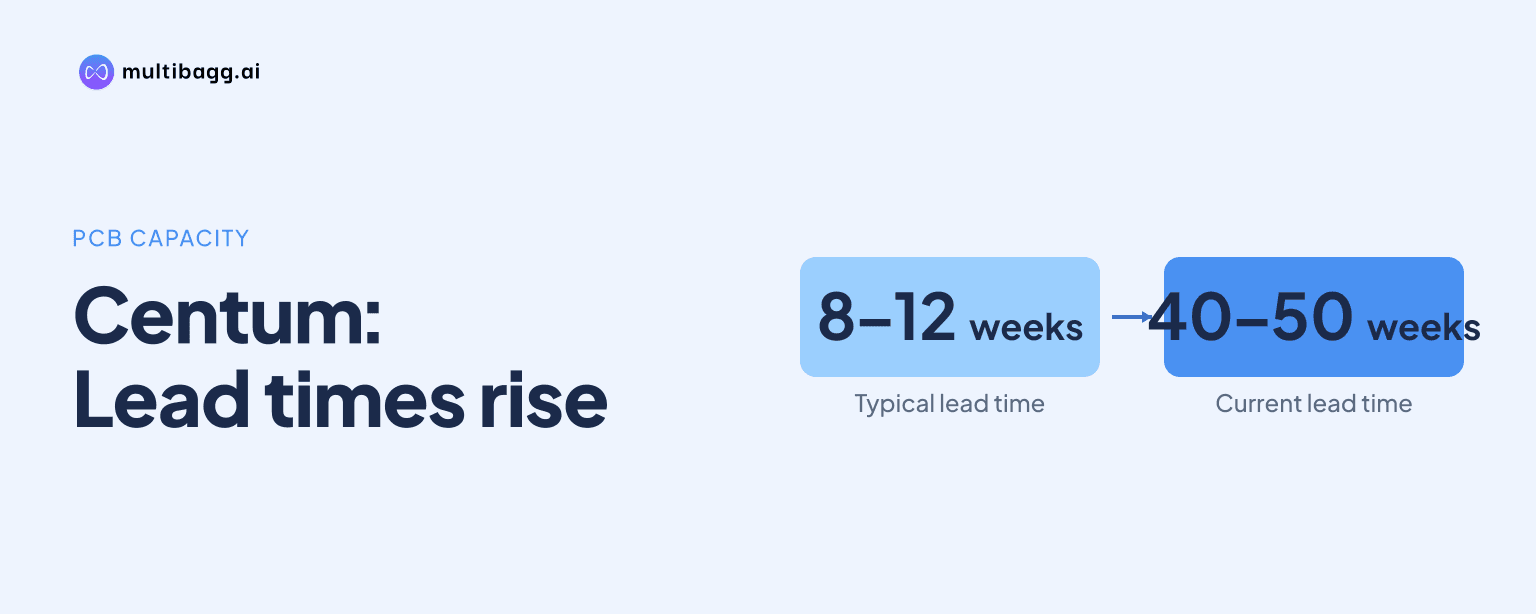
Centum Electronics Limited said in its first-half earnings call that bare printed circuit board, or bare-PCB, lead times had risen to 40-50 weeks from a typical maximum of 8-12 weeks, as artificial-intelligence and data-centre demand redirected supplier capacity and required earlier inventory purchases.
Know Centum Electronics inside out
Results, valuation, peers and who's buying, in one view.
Why have Centum’s bare-PCB lead times reached 40-50 weeks?
Centum said supplier capacity being allocated to artificial-intelligence and data-centre infrastructure was the main reason bare-PCB lead times had risen to 40-50 weeks. Management said companies making components for those applications were prioritising that demand, leaving other applications with lower priority, longer delivery schedules and higher prices.
The shift is substantial against Centum’s earlier procurement range of typically 8-12 weeks at most, and sometimes less. Management said it was working closely with suppliers to obtain priority allocations, but it did not give a date by which the 40-50-week range would return to its former level.
The procurement issue is specific to supply availability rather than a disclosed fall in end-market demand. Centum said the same artificial-intelligence and data-centre build-out that is absorbing component capacity is also a major demand driver for its semiconductor-related electronic manufacturing services, or EMS, business.
How are AI and data centres affecting Centum’s supply chain?
Centum said artificial-intelligence and data-centre infrastructure is creating critical shortages in memory devices as well as stretching bare-PCB deliveries. Management said memory parts are in heavy demand for data centres, making them harder to secure for other applications when production material is required.
Centum also cited logistics delays related to conflicts in the Middle East and Europe. Management said these disruptions had made it harder to obtain raw materials used in some components, adding a transport and material-availability constraint to the supplier-capacity pressure caused by data-centre demand.
The supply constraints sit alongside rising semiconductor-programme volumes. An analyst said semiconductor applications delivered about Rs 85 crore to Rs 90 crore in the first half, compared with around Rs 100 crore in the prior full year, while management said demand for existing qualified products was increasing almost quarterly.
Centum also said it had added new product lines in the semiconductor segment. Management identified artificial intelligence and data centres as the principal driver of that ramp-up, while power, industrial and energy-grid programmes won during the previous six months were progressing through prototyping and qualification.
Why is Centum carrying higher inventory?
Centum said it is buying and holding constrained devices when they are available to meet requirements for the next 12 months. This advance stocking applies particularly to components such as memory devices, where shortages could otherwise prevent production when customer demand or programme execution requires material.
An analyst cited first-half inventory of Rs 540 crore and asked about its purpose. Management said inventory must be secured in advance during supply constraints, and that it seeks adequate customer payment coverage when building those positions rather than treating the purchases as unsupported stock.
The mechanism can increase inventory even when the company expects eventual order execution: material needed months before manufacturing must be acquired earlier. Centum did not disclose an inventory-days figure, a component-by-component inventory split, or the amount of the Rs 540 crore balance specifically attributable to bare PCBs or memory devices.
Centum’s inventory approach is also linked to its order profile. Management said business-to-system, or BTS, orders generally execute over about two to two-and-a-half years, so securing long-lead material can be necessary before the revenue from a programme is recognised.
Got a follow-up? Ask IRIS
How much of Centum’s inventory is covered by customer advances?
Centum said about 50% of its net inventory on hand at the company level was covered by customer prepayments or advances. Management said this funding coverage should be considered alongside inventory held to protect production against the 40-50-week bare-PCB lead times and shortages in memory devices.
The disclosure does not mean that every component in the Rs 540 crore first-half inventory figure was prepaid. Centum did not identify the value of advances related specifically to bare PCBs, memory products or any individual customer programme, but said customer funding was significant when inventory had to be secured early.
Management also discussed funds raised through a qualified institutional placement, or QIP. It said almost all of Rs 35 crore allocated for capital expenditure had been used, with the remaining amount expected to be used in the current quarter, while Rs 50.70 crore earmarked for general corporate purposes remained reserve cash without a specific near-term use.
The customer-advance coverage and QIP reserve serve different purposes in the disclosed discussion. The advances relate to inventory required for programme execution, while the Rs 50.70 crore reserve cash is earmarked for general corporate purposes and may be used when management’s strategic plans take shape.
Could supply constraints restrict Centum’s order execution?
Centum said it had no short-term production-capacity bottleneck in executing current BTS orders despite the longer component lead times. Management said BTS orders typically run for about two to two-and-a-half years, with revenue ramping over that period rather than being recognised in equal annual portions.
Management nevertheless said it was adding engineering capability and pursuing a new BTS facility. The planned site is intended to provide system-level capability, dedicated test infrastructure and more room for larger systems, including activities for which Centum currently relies on third parties.
The company’s stated production-capacity position differs from its supply-chain challenge. Centum said factory capacity was not a short-term restriction, whereas the 40-50-week bare-PCB delivery period and memory shortages require earlier supplier engagement, advance stocking and customer payment coverage.
Management also said it was targeting growth of about 25%-30% in EMS and BTS over the next couple of years, without providing specific quarterly or annual revenue guidance. For BTS, the pace of execution will depend on programme ramp-ups across the two-to-two-and-a-half-year delivery timeline rather than on an even allocation of order-book value.
Conclusion
Centum’s disclosure shows that the same artificial-intelligence and data-centre demand supporting semiconductor-related EMS activity is also reshaping procurement. Bare-PCB lead times have moved from a typical maximum of 8-12 weeks to 40-50 weeks, while memory shortages and logistics delays have led Centum to hold material for as much as 12 months of expected requirements. About 50% of net inventory is covered by customer advances.
The next points to watch are whether supplier-priority efforts reduce the 40-50-week bare-PCB delivery range, how the Rs 540 crore first-half inventory balance changes, and whether customer advances remain aligned with advance purchases. Management also expects to use the remaining capital-expenditure allocation in the current quarter and is planning a BTS facility with dedicated testing infrastructure and capacity for larger systems.