










Centum says three EMS wins can each reach $10m yearly after ramp-up
Key highlights
- Centum expects each of three new EMS accounts to reach at least $10 million of annual business in two to three years.
- The new customer additions span rail transportation, industrial machinery and a Middle East drone-defence programme.
- Centum’s semiconductor opportunity estimate rose to $45 million to $50 million in about two years from $25 million to $30 million.
- Centum said bare PCB lead times have increased to 40 to 50 weeks from a typical eight to 12 weeks.
powered by IRIS
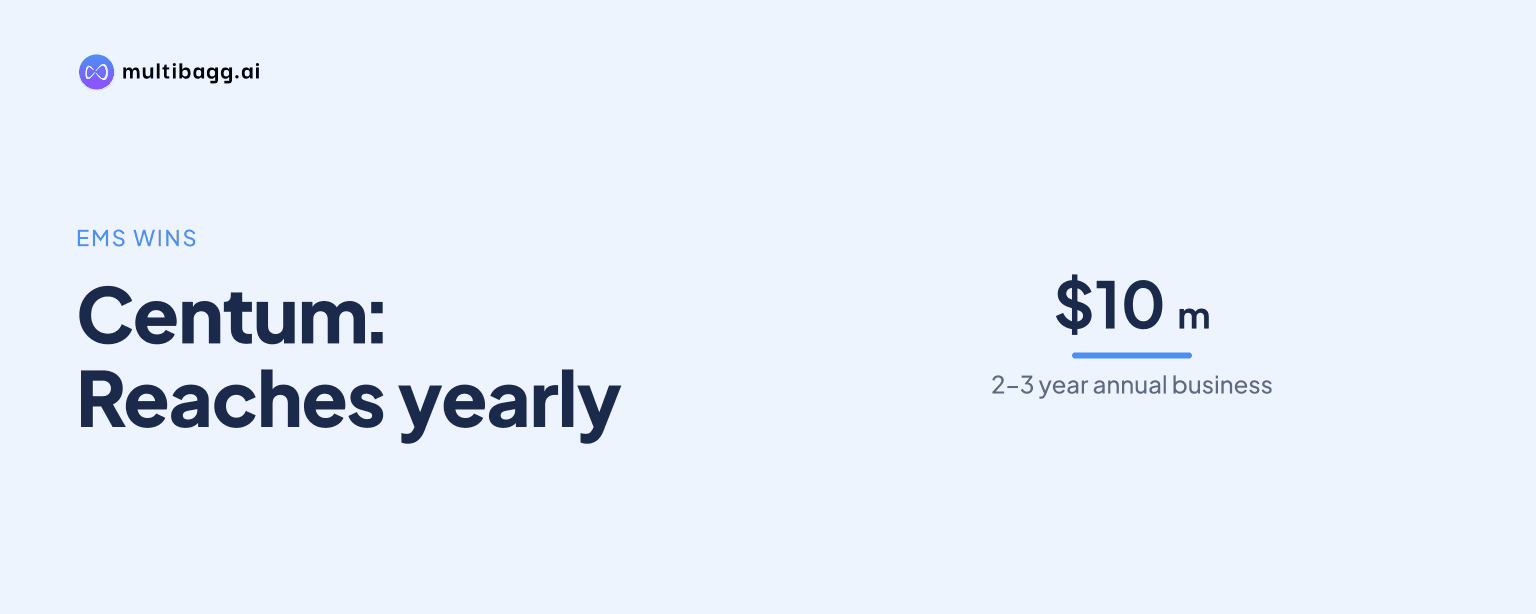
Centum Electronics Limited said its three new electronic manufacturing services customers could each become an at-least-$10-million annual engagement within two to three years, spanning rail transportation, industrial machinery and drone-defence. The disclosure sets a minimum combined annual potential of $30 million if all three programmes achieve management’s stated ramp-up threshold.
Know Centum Electronics inside out
Results, valuation, peers and who's buying, in one view.
Which new EMS customers has Centum added?
Centum added customers in transportation, industrial machinery and defence, but did not disclose their names. The transportation customer is a large global tier-1 original equipment manufacturer, or OEM, that supplies equipment for applications including braking systems and platform-door controllers used in metro and mainline rail networks.
The transport OEM already has facilities in India and is established in critical metro and mainline programmes, according to management. Its electronics had largely been imported and integrated into its systems, but it has decided to localise them. Centum has been selected as its first EMS partner in India and plans to ramp several products, although management did not provide purchase-order values or a product launch date.
The industrial customer is a large German OEM in capital equipment, with operations in metrology and measurement tools. It is establishing a large Indian plant and is seeking to localise its supply chain. Centum said it is the customer’s first EMS supplier in India for the initial application.
Centum said the German OEM also operates in markets beyond industrial machinery, including medical applications. The engagement begins with one part of the customer’s business, while Centum plans to seek expansion into other areas. Management did not state whether those potential future applications are included in the $10 million annual threshold.
The third customer is a Middle East-based defence company for a drone application. Centum had worked with this customer from the design stage, making the project partly design-led, and has begun receiving orders for serial production. This is the only one of the three relationships for which management explicitly confirmed that production orders have started.
How much annual business could the three EMS wins generate?
Centum expects each of the three relationships to become at least a $10 million annual engagement after ramp-up over the next two to three years. This is management’s estimate of mature annual business, rather than a disclosed order-book value, revenue forecast for a specific financial year or contract commitment.
On that basis, the three programmes imply at least $30 million in annual business if each reaches the stated threshold. That calculation is an arithmetic minimum based on management’s estimate. The transcript does not say which programme will ramp first, how revenue will be distributed across the three customers or whether one could exceed $10 million a year.
The starting points differ across the three programmes. The drone-defence customer has moved from design engagement to serial-production orders, the rail customer is preparing to ramp multiple products after localisation, and the industrial customer starts with one application. As a result, the two-to-three-year timeframe applies to management’s overall expectation rather than a separately disclosed delivery schedule for every account.
Got a follow-up? Ask IRIS
How do the customer wins compare with Centum’s semiconductor opportunity?
The three new customer additions sit alongside a semiconductor-related EMS opportunity that management said is growing faster than its earlier expectations. Centum had initially assessed the semiconductor opportunity at a $25 million to $30 million annual run rate, but management now said it has visibility towards $45 million to $50 million in about two years.
That updated semiconductor range is $15 million to $25 million above the prior range, depending on the comparison point. Management attributed the change to quarterly demand increases for existing qualified products and the addition of new lines or products. It did not say whether the three new transportation, industrial and drone-defence accounts are included in the semiconductor opportunity estimate.
An analyst on the call said Centum had delivered about Rs 85 crore to Rs 90 crore for semiconductor applications in the first half of FY27, compared with around Rs 100 crore in the preceding full year. Management did not confirm those revenue figures in its response, but said the semiconductor segment was growing aggressively and was surpassing its initial expectations.
At the company level, management declined to give specific quarterly or annual revenue guidance. It maintained a medium-term objective of 25% to 30% growth, while stating that first-half FY27 performance and demand gave it visibility for healthy growth. That objective does not assign a defined FY27 revenue contribution to the three new EMS programmes.
What could determine the pace of the EMS ramp-up?
Component availability and logistics could affect programme execution, although Centum did not identify either factor as a specific constraint on the three new customer engagements. Management said artificial intelligence and data-centre infrastructure build-outs have redirected manufacturing capacity, raising lead times and prices for components used in other applications.
Centum cited bare printed circuit boards, or PCBs, as an example of this constraint. Typical PCB lead times of eight to 12 weeks have extended to 40 to 50 weeks, according to management. It also identified memory devices as an area of shortage because of data-centre demand and said it may secure available components to cover expected requirements for the next 12 months.
Inventory management is relevant where components must be secured early. Management said about 50% of Centum’s net inventory at the company level is covered by customer prepayments or advances. The company did not disclose whether any of the three new EMS customers have made advances or whether their programmes require components facing the longest lead times.
Centum said it has no short-term production-capacity bottleneck for its current order book and is adding engineering capability for design-intensive programmes. It is also pursuing a new facility for its build-to-spec, or BTS, business, including dedicated test infrastructure and space for larger systems. Management presented that facility as a BTS capability plan, not as a stated requirement for the three EMS customer ramps.
Conclusion
Centum’s three new EMS relationships have different routes to scale: electronics localisation for a rail-equipment supplier, supply-chain localisation for a German industrial OEM and serial production for a drone-defence customer. Management expects each to reach at least $10 million of annual business within two to three years, but has not disclosed customer names, order values or individual ramp schedules.
The next disclosures to watch are serial-production order flow from the drone programme, product ramp-up at the transport account and expansion beyond the industrial customer’s first application. Management’s two-to-three-year ramp target, its $45 million to $50 million semiconductor opportunity estimate for about two years, and its 25% to 30% medium-term growth objective are the stated benchmarks for future updates.